





Why a home or office needs a water cooler
The appliance does three things a bottle cannot do on its own: it holds the water up, cools it and heats it to tea temperature. Of the three, the first turns out to matter most. Nineteen litres weigh as much as a large dog, and nobody is going to lift that to a glass ten times a day — which is why people rarely drink bottled water without equipment, and never for long.
The second argument is an everyday one: heating takes the kettle off the table. In an office you notice it at once — the queue at the kettle disappears, because hot water comes from the tap and there is no wait. The third argument is consumption: a drinking water cooler stands in plain sight, and the family starts drinking noticeably more than when the bottle is hidden in the fridge.
Price lists call the same appliance different things: cooler, water dispenser, water dispensing unit. There is no difference between these words — it is a matter of translation and the seller's habit, not two different products.
Floor-standing and desktop water coolers: two ways to place one
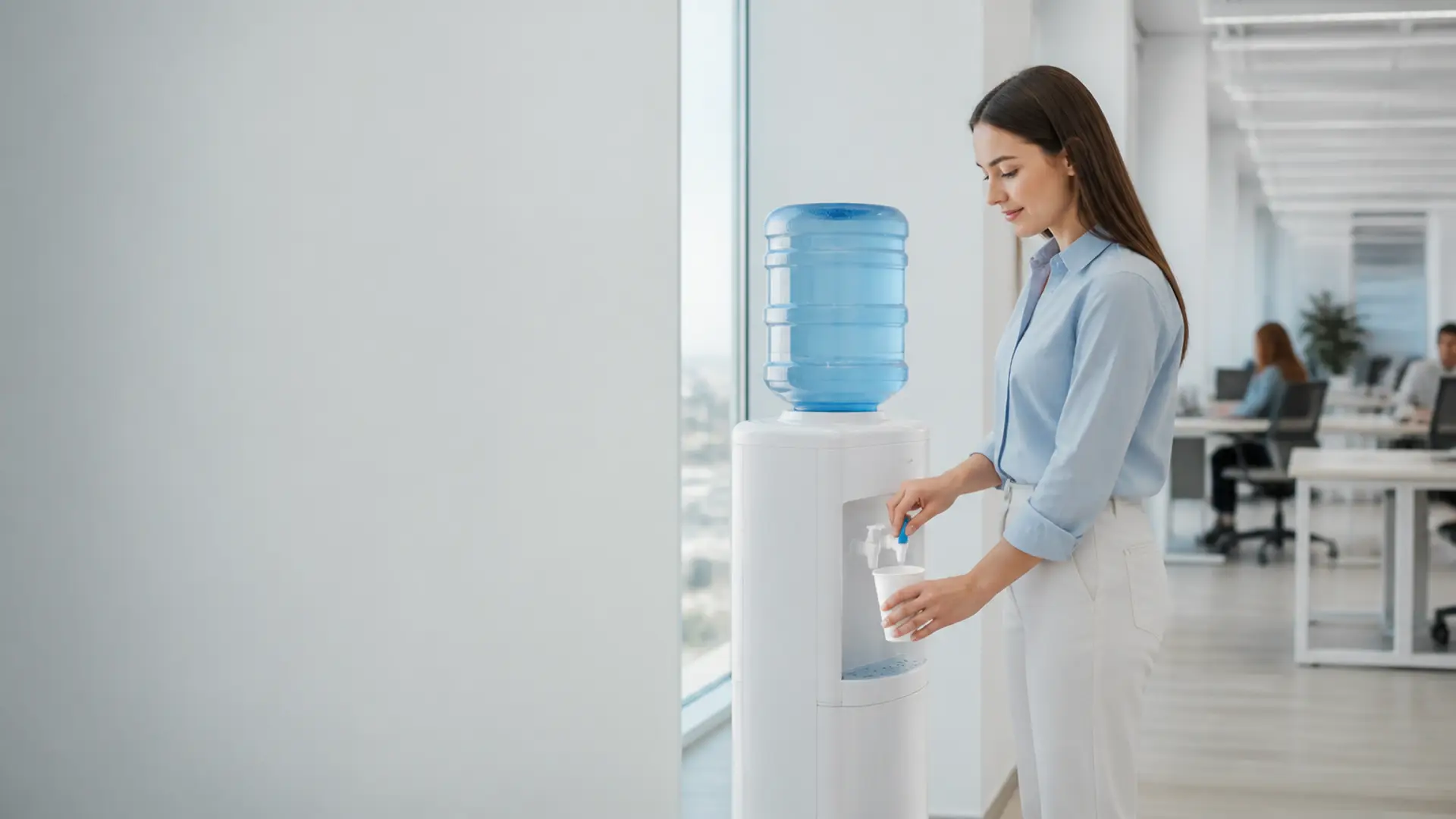
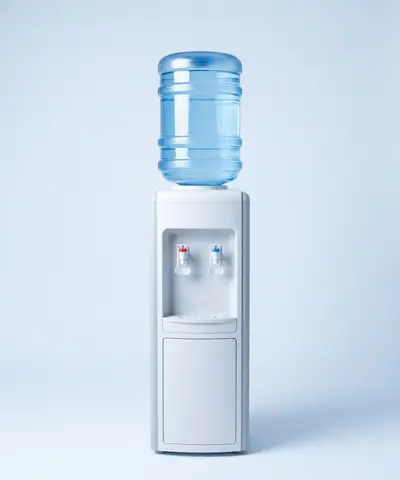
By installation, appliances fall neatly into two groups. A floor-standing water cooler stands on the floor, reaches waist height and needs neither a cabinet nor a table: it goes in a corner of the kitchen, an office corridor or by reception. The body usually has a small cupboard inside — for cups or a spare bottle.
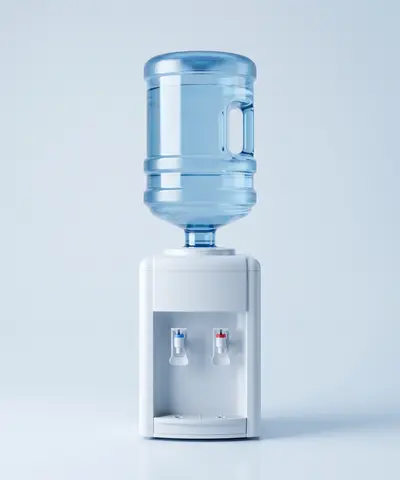
A desktop model goes on a cabinet, a windowsill or a kitchen worktop, where it takes the place of a kettle. People choose it where a floor-standing one simply has no room: a small kitchen, a rented flat, an office for two. Details on size and weight are on the separate desktop models page; what matters here is something else: the choice between floor and table is made before choosing a model, not after.
Read more: Desktop water cooler
There is a third feature too — where the bottle goes. The classic design has the bottle on top, neck down. The second, bottom-loading design hides it in the cabinet, so you never have to lift nineteen litres onto your shoulder. That is a separate subject with its own page.
Read more: Bottom-loading water coolers
What is inside the body: the parts an appliance is made of
From the outside the models look alike, and choosing from a photo makes no sense. Inside, though, any top-loading appliance has the same set of parts, and it is worth understanding them in advance: nearly every everyday question — why it leaks, why it does not cool, where an aftertaste comes from — comes down to one of five parts.
| Part | What it does | What it affects |
|---|---|---|
| Bottle seat with a probe | Pierces the cap and holds the bottle neck | Leaks when changing the bottle, air getting in |
| Cold tank | Holds the chilled water reserve, usually 2–3 litres | How many cold glasses you can pour in a row |
| Hot tank with heater | Heats about a litre to 90 degrees | How fast it reaches temperature and electricity use |
| Taps | Dispense the water: lever, push button or valve | Convenience and child safety |
| Drip tray and drain | Collects drips, emptied by hand | A puddle under the appliance if you forget about it |
Water inside flows by gravity. The bottle stands neck down, the level in the tanks is held by air that enters it as bubbles, and the familiar gurgling is the system working, not a sign of a fault. An ordinary appliance has no pump at all, so there is almost nothing in the water circuit to break.
The taps differ more than anything else, and they are the one part you deal with every day. A lever tap opens when you press a cup against it — handy when your hands are full, but it is the one that most often fails to spring back. A push-button tap needs a finger and drips less often. A valve tap with a catch is fitted to the hot water tap: to pour boiling water you first have to slide the lock, and that is the child protection people ask about. If there is a child at home, look at that, not at the general safety class in the description.
Why the appliance leaks
There are three reasons, all of them everyday ones. First, the bottle has been put on crooked, the probe has pierced the cap off-centre, and water seeps down the neck. Second, the drip tray is full: it holds a glass or a glass and a half, after that water goes on the floor. Third, a tap has not closed fully; lever taps sometimes do not spring back if a crumb of limescale gets under them. A genuine tank leak is much rarer, and there is one sign to recognise it by: the puddle appears by itself, without anyone pouring water.
Where an aftertaste comes from
From the tank, not from the water. In the cold tank water stands for hours, and a biofilm gradually forms on the walls — a thin deposit that is harmless in the first weeks but eventually gives a stale taste. That is exactly why the tank is cleaned on a schedule rather than by smell: by the time you can smell it, the film is already dense and can only be removed by taking the unit apart.
The second source is the tube from the tank to the tap. If the appliance has stood without water for a long time, it dries out, and the first glasses after start-up taste of something else. Run off a couple of litres and pour them away — after that the water will be normal. The same trick works after moving house and after a long holiday when the appliance was unplugged.
The third source, and the most unpleasant, is the bottle itself, left open for two or three weeks. The appliance cannot fix that: it stores water and changes its temperature, but does not filter or disinfect it. So the order size is chosen so that an opened bottle is finished in a week to a week and a half, rather than waiting for the next delivery.
It is worth asking separately about the tank material. Cheap models have plastic tanks, more expensive ones stainless steel. The difference is not in safety but in care: stainless steel is easier to clean and hardly holds odours, while a plastic tank after several years of service can no longer be cleaned completely. On an appliance you intend to keep for ten years, this is the item worth paying extra for.
A model's description lists two performance figures — litres per hour for cold and for hot. Read them together with the tank size. A three-litre tank with an output of two litres an hour means that after three glasses in a row the cold water runs out and comes back in about an hour and a half. For a family this does not matter; for an office of fifteen people it is the deciding factor, and this is exactly where compressor models pull ahead of electronic ones.
How the appliance cools and heats water
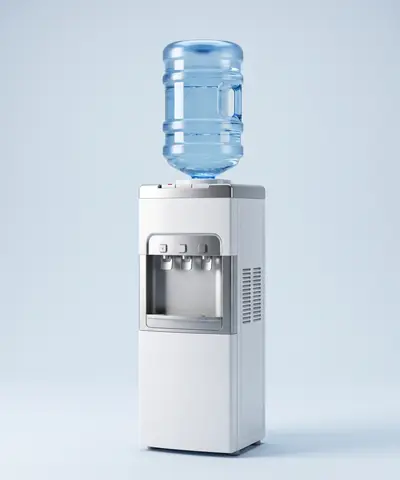
There are two kinds of cooling, and it is the only technical thing worth understanding before you buy. Electronic cooling works on a Peltier element: quiet, cheap, it cools water to cool — roughly like tap water in winter. Compressor cooling works like a fridge: it gives real cold and refills its reserve faster, but you can hear it switch on.
Heating is the same in both — a coil in a separate small tank, at about ninety degrees. A cooler does not give true boiling water: it does not reach a hundred degrees, and brewing tea copes with that, but someone who insists on water at a rolling boil will not. There are also coolers without heating: cheaper, safer with children, and families with little ones choose them deliberately.
Size, weight and electricity: where the appliance will go
Measure before you buy, not after. A floor-standing model is roughly 30 by 33 centimetres at the base and 90–100 centimetres tall, and with a bottle on top the total height reaches a metre and a half. A desktop model is half as tall, about 50 centimetres, but its base is almost the same: on a worktop it takes the space of a kettle on its stand.
| Type of appliance | Size without bottle | Weight | Heating | Cooling |
|---|---|---|---|---|
| Desktop | 30 × 33 × 50 cm | 8–10 kg | 450–500 W | 60–70 W |
| Floor-standing, electronic cooling | 30 × 33 × 95 cm | 12–14 kg | 500 W | 70–90 W |
| Floor-standing, compressor | 31 × 35 × 100 cm | 15–18 kg | 500 W | 100–120 W |
The power in the specifications is a peak, not constant consumption. The heater and the cooling unit switch on by thermostat and stay silent most of the day, so real consumption with normal office use is comparable to that of a small fridge. Most of the bill comes from heating: keeping a litre of water at ninety degrees around the clock costs more than cooling three litres.
- A socket within a metre and a half: an extension lead under constant load is a bad habit
- At least ten centimetres from the wall, fifteen for a compressor model
- A level floor: on an uneven one the appliance hums, and the drip tray tilts and leaks
- Not by a radiator, not by a cooker and not in the sun — cooling will work at half strength
- Room to stand with a bottle on your shoulder, and for a desktop model, clearance up to the wall cupboard
Weight matters not on its own but together with the water. Fifteen kilograms of appliance plus nineteen litres is thirty-four kilograms on four feet. A desktop model is best not kept on a flimsy cabinet, and a floor-standing one should not stand on a deep-pile carpet: the feet sink in, the appliance rocks, and you feel it at once when changing the bottle.
Noise depends on the type of cooling. Electronic cooling is practically silent; only a small fan runs. A compressor switches on several times an hour and sounds just like a fridge: in an office it is lost in the background, in a bedroom it is clearly audible. That is perhaps the only reason people sometimes deliberately choose a less cold appliance for the home.
And once more about the socket, because that is where people trip up most often. The appliance stays switched on around the clock, and a multi-plug adaptor shared with a kettle and a microwave is no place for it: the heater switches on at random, and the combined load trips the breaker exactly when it is midday in the office and everyone needs hot water at once.
The appliance is transported strictly upright. If a compressor model travels lying down, the oil runs from the compressor into the pipes, and it must not be switched on straight away — let it stand for a few hours, preferably a full day. An electronic model is not at risk: it has neither a compressor nor oil. The rule is simple and worth remembering: when moving house, the appliance travels upright and secured, not lying in the boot on top of boxes.
One habit helps save on the bill — switching off heating at night and at weekends. Most appliances have a separate switch on the back panel for exactly this purpose. Better to leave the cooling alone: the cold tank takes a long time to get back to temperature, and there will be no cool water in the morning until lunchtime. In offices the heating switch is usually flicked off on Friday evening, and Monday loses nothing by it.
Buying a water cooler in Almaty or renting one
Buying starts from 34 900 ₸ for a desktop model, 45 000 ₸ for a floor-standing one with electronic cooling and 69 000 ₸ for a compressor model. The appliance is yours, you can take it with you when you move or sell it, and you depend on nobody.
Rental removes the upfront payment: the rate is charged monthly, and with a regular order of 15 bottles a month or more it drops to zero. That is how almost every water delivery in the city works, and for an office it is usually the answer. Where the break-even point lies over time is covered on the rental page; in short, buying pays for itself after a year and a half to two years of constant use.
Read more: Water cooler rental
Which cooler is best for the home: four questions instead of a ranking
Model rankings go out of date faster than people read them. Instead, here are four questions whose answers narrow the choice down to two or three models:
- How much water you get through in a week. Up to twenty litres, electronic cooling is enough; more than that, take a compressor model.
- Where it will go. Measure the space before buying: a floor-standing model needs a gap behind it, a desktop one needs clearance up to the wall cupboard.
- Who will change the bottle. If there is nobody to lift nineteen litres, look at bottom-loading models.
- Whether you need boiling water and whether there are children at home. This decides whether to take a hot tap with a child lock or do without heating.
A separate note on water coolers without a bottle: these exist too, with water coming from the mains through filters inside the body. That is a purifier; it has different economics and its own page.
Five mistakes when buying an appliance
The mistakes repeat year after year, and nearly all of them cost money not at the moment of purchase but a month later.
- Choosing on price and price alone. The cheapest appliance usually has no heating or a one-litre tank, and a month later it turns out the cold water runs out after two glasses in a row
- Buying second-hand. The price is half, but there is no way to check what went on in the tank with the previous owner, and sanitising and repairs after purchase fall on you
- Not measuring the space. An appliance that does not fit into a recess or hits the wall cupboard is returned more often than it breaks
- Not thinking about who will change the bottle. If nobody at home can lift nineteen litres, you need a different loading type, and that has to be decided before buying
- Chasing the name on the front. Bodies and electronics in this category come from the same factories, and the difference between brands is smaller than the difference between cooling types
A separate case is trying to get an appliance for small bottles. Price lists include a 5 litre water cooler: a compact desktop dispenser for a shop-bought bottle. It exists and it works, but you have to top it up four times as often, and a litre in small bottles costs noticeably more than a litre in a large one. There is no saving here, only compactness, and such a model is worth taking only for that.
The second common hope is that the appliance will improve the water. It will not. It stores, cools and heats water, but does not filter it: whatever gets inside is what you pour into your glass. Quality is decided by the choice of water and by how quickly an opened bottle is used up, not by the price tag on the body or the number of modes on the panel.
The third thing people rarely think about is service life and spare parts. A household appliance handled with care lasts seven to ten years and almost never breaks down completely: the heater or a tap fails, and both can be replaced. Before buying, it makes sense to ask not about the length of the warranty but whether a tap for this model will still be available in three years.
And the fourth: not every solution has to be a purchase. If you need the appliance for a year or a year and a half, during renovation or in a rented flat, rental covers the same need without an upfront payment, and with a regular order of 15 bottles a month or more it costs nothing. The arithmetic is set out on the rental page — here it is enough to remember that there are two options, not one.
Read more: Water cooler rental
And the very last point — checking on delivery. The appliance is worth checking with the courier present, not a week later: switch it on, wait for hot water and pour a glass from each tap. The hot tank reaches temperature in a few minutes, the cold one in about an hour, so you cannot check the cold at handover, but heating, the absence of leaks and smooth tap action are visible straight away. If something is wrong, swapping the appliance on the first day is easier than on any other.
Floor-standing water dispenser: care and sanitising
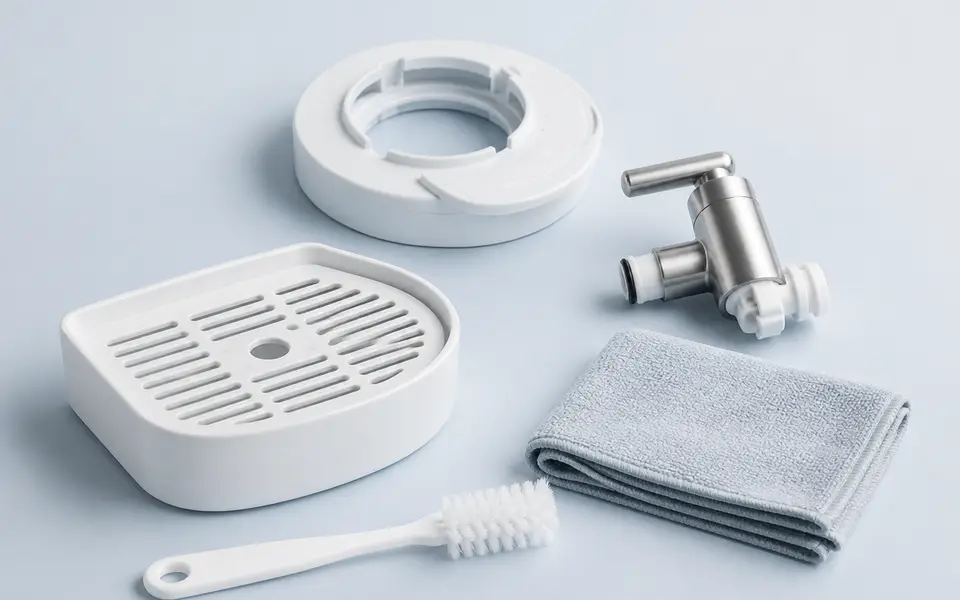
Every appliance has a tank inside where water stands and waits. Once every six months it should be rinsed and disinfected — otherwise a biofilm forms on the walls, and the taste of the water changes before your nose notices. For rented appliances we do the sanitising; for purchased ones, on request in the same chat.
Between treatments three habits are enough: wipe the taps and drip tray, do not top up the tank with water from a kettle, and do not keep an opened bottle longer than a week or two. One more small thing that trips up offices: the appliance must not stand right against a wall or a radiator — the grille at the back releases heat, and without a gap the cooling works at half strength.
Water for your dispenser: which bottle fits
The neck of a nineteen-litre bottle is standard, so 19 litre cooler water fits any appliance bought in the city — in polycarbonate and in PET alike. We bring the dispenser bottle, put it in place and take the empty one at the next delivery, so you rarely have to change it yourself.
Delivery in the city is free from 2 bottles, the price per bottle starts from 1 490 ₸ and falls with volume. An order placed before 10:00 usually goes out the same day; delivery windows are 9–13, 13–17, 17–21. The courier handles installation and first start-up: shows how to remove the cap, where to let the air out and how many minutes until the water is cold.