





10 litre water: half a bottle, and it is all about weight
A 10-litre container sits right between what people carry and what gets delivered. It holds roughly half a bottle of water and weighs roughly half as much, and that is the only reason anyone buys it. In every other way it is no better than the bottle: each litre costs about the same, the container is single-use, and it takes up almost as much room.
So 10 litre water is chosen by circumstance, not by taste. A stairwell with no lift, elderly parents, a rented flat where a cooler is not worth setting up, renovation, the dacha season, a five-person office with one sink and no room for a stand. Wherever nobody can lift nineteen kilograms, ten are lifted without fuss.
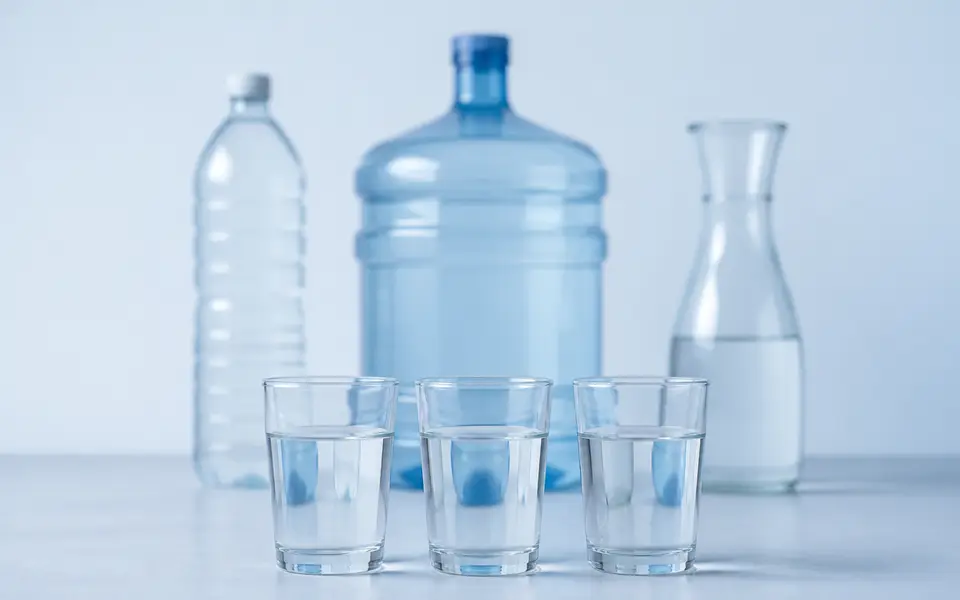
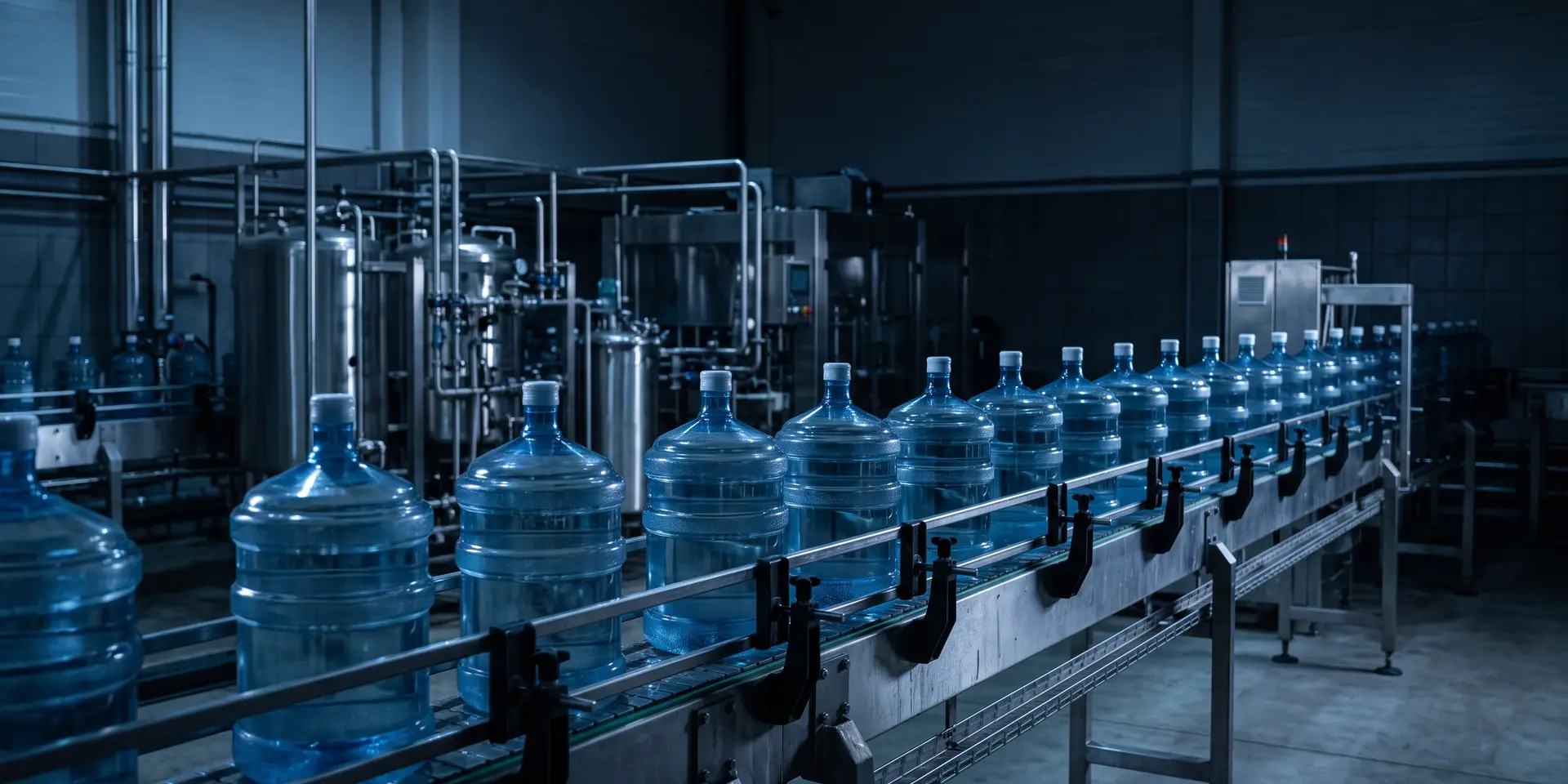
Our 10 L drinking water comes from the same artesian well as our cooler bottles. Same bottling line, same lab tests. There is no difference in taste between the 10-litre and the 19-litre, and there cannot be: it is one water poured into different containers.
Who buys the 10-litre container
This is a container for particular circumstances, and the list is short. It turns up where nobody can lift nineteen litres or there is nowhere to put them, while five litres run out before the next delivery arrives. In every other case people pick one of the two neighbouring formats, and rightly so.
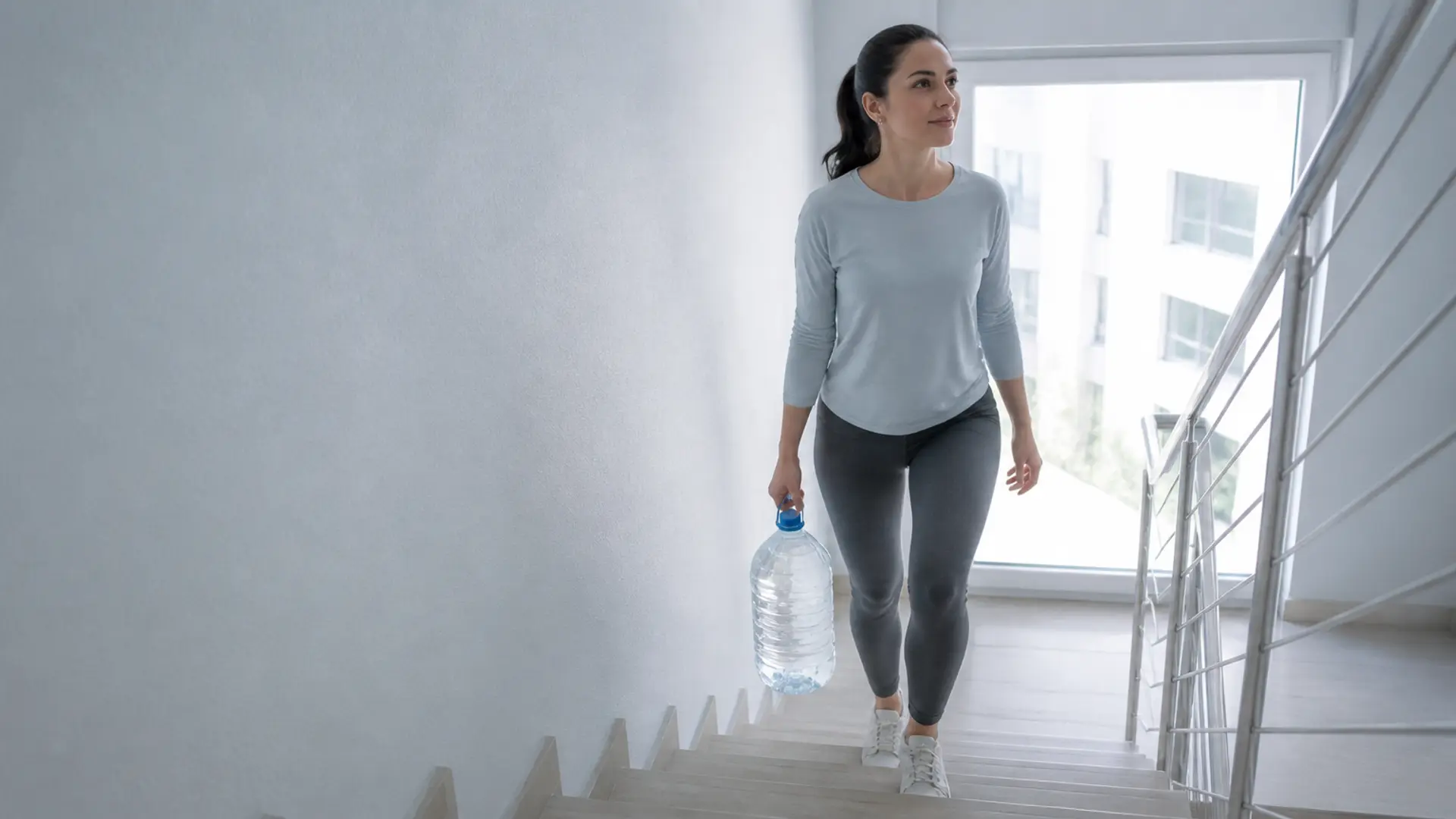
- A building with no lift: ten kilograms go up to the third floor, twenty no longer do
- Elderly parents: once the water is carried into the flat, they manage on their own
- Rented housing, where a cooler and returnable bottles for six months make no sense
- Renovation and moving house: you need plenty of water, but there is no room for a stand or cooler yet
- The dacha and seasonal living: you arrive, bring water, leave, and nobody is there to return bottles
- An office of three to five people, where a floor-standing cooler would block the only walkway
Most often this water is ordered in two city situations, and both are about stairs. The first is an old building without a lift, where nobody can haul nineteen kilograms up to the fourth floor; the second is a flat with simply no space for a cooler and tap water that is not fit to drink. In both, people start with 5-litre bottles and after a month get tired of fetching them every other day.
What these cases share is one thing: a returnable bottle is inconvenient not because of the price but because of the way people live. A bottle assumes someone is home on delivery day, there is somewhere to keep the empty until the courier comes, and the water is needed all the time rather than for a month or two. As soon as any one of those three fails, the single-use container wins, and the price per litre has nothing to do with it.
A separate case is keeping this container alongside bottles rather than instead of them. In a home with a cooler it goes in the pantry as a two-day reserve: if the main bottle runs out ahead of schedule or a delivery slips, there is still water, and nobody has to run to the shop in the evening. For an office the logic is the same, for the day when suddenly twice as many people turn up.
The decision is easier made not by volume but by two questions: who carries the water from the van to where it goes, and how long this will last. If the courier carries it and it is for years, take bottles. If you carry it yourself and do not know what happens in three months, ten litres settle the matter with no deposit, no equipment and no commitment.
How much it weighs and who will carry it
A full 10-litre container weighs about ten kilograms. That is no longer a bag of shopping but a real load: almost any adult can carry it to the lift, but not up to the fifth floor on foot. What matters is not arm strength but the distance from the van to the spot where the water will stand.
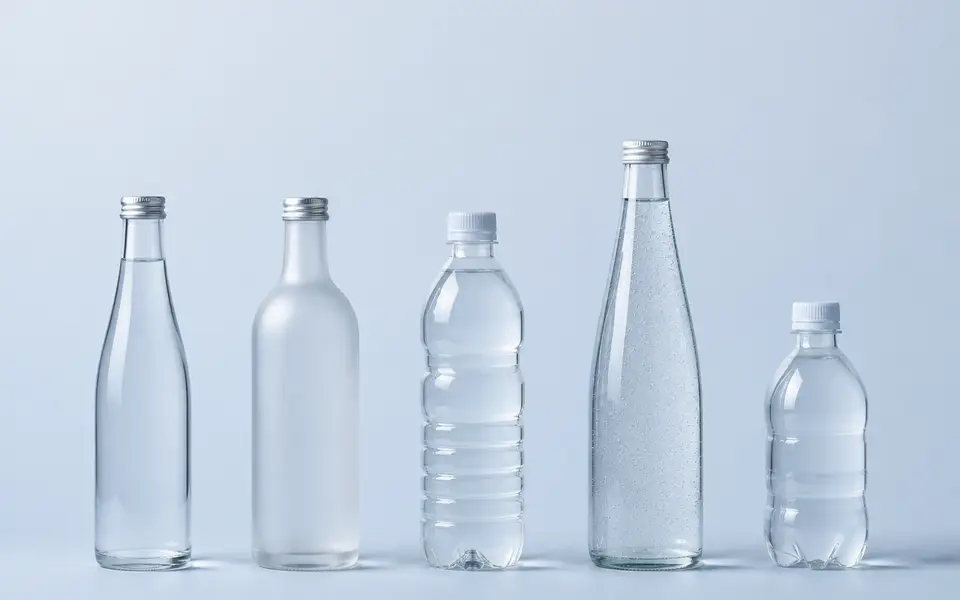
| Volume | Weight when full | How it is usually carried |
|---|---|---|
| 1.5 litres | about one and a half kilograms | in a bag, without noticing |
| 5 litres | about five kilograms | in one hand by the handle, all the way to the flat |
| 10 litres | about ten kilograms | in one hand over a short distance, then switching hands |
| 19 litres | about nineteen kilograms | with both hands, on the shoulder or on a trolley |
Hence a simple rule of thumb: if you carry the water yourself and live above the second floor, ten litres is your limit. If the courier brings the bottles in, there is no limit at all, and the 19-litre makes more sense.
How a large single-use container is made
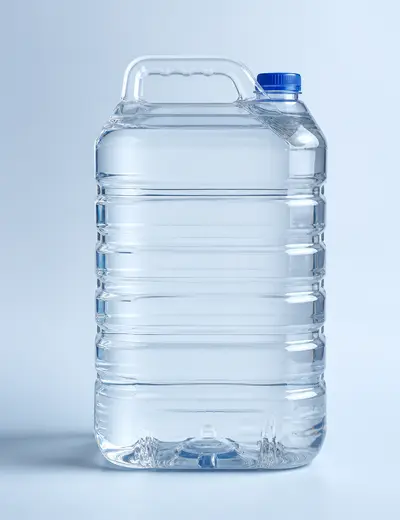
The body is blow-moulded from food-grade PET, and its wall is thinner than it looks when full: the shape is held not by the plastic but by the water inside and the stiffening ribs on the sides. An empty container weighs only a few hundred grams and crumples in your hand. That is not a flaw but the design: such containers are not shipped back or washed, they go to recycling.
The neck is narrow, made for a screw cap with a tamper ring, and the handle is either moulded into the body or clipped onto the neck as a separate bracket. A bracket is comfortable for carrying and worse for tilting: pouring from it is harder than holding the body itself. So a full container is usually carried by the handle and poured with both hands, or without lifting it at all.
- Hot water: the plastic is made for cold and room-temperature water and warps with boiling water
- Freezing: water expands and splits the seam at the base, and the crack is not visible at once
- Direct sunlight: the clear walls let light through, and the water picks up an off taste
- Squeezing the body: a crease stays where you pressed, and a leak will start along it
- A second round: a narrow neck cannot be washed at home so that nothing is left inside
After first opening, the cap is screwed on tight and never fully removed again: the tamper ring stays on the neck and doubles as a reminder that the container has been opened. A small thing, but in a home with several of these it decides which one gets finished and which one waits sealed.
That last point also explains the difference from bottles. Returnable bottles are washed, disinfected and inspected on the line before every refill, and that cycle is what the deposit pays for. A single-use container never goes through it, so its wall is made thinner and its life is counted as one purchase.
You will hardly find this size in shops, and demand is not the reason. A large single-use container sits badly on a shelf: it takes the space of two rows of small bottles, sells more slowly and earns the shop no more per square metre. So it lives mostly with delivery services, where it is not displayed but driven straight to the address.
Towards the end the container starts to flex in your hands: half the weight is gone, the water no longer supports the wall, and tilting it gets more awkward than at the start. If you have to support the last litres from below, that is normal behaviour for the plastic, not a defect. It is easier to pour the rest into a jug than to wrestle with an emptying bottle over the sink.
Where to put it and how to pour
A 10-litre container will not fit in the fridge: it is too tall for the shelf and too heavy for it. People keep it on the floor in a cool corner, in the pantry, under the sink or on the bottom shelf of a kitchen cupboard. Direct sun and radiators are the only things this container really cannot take.
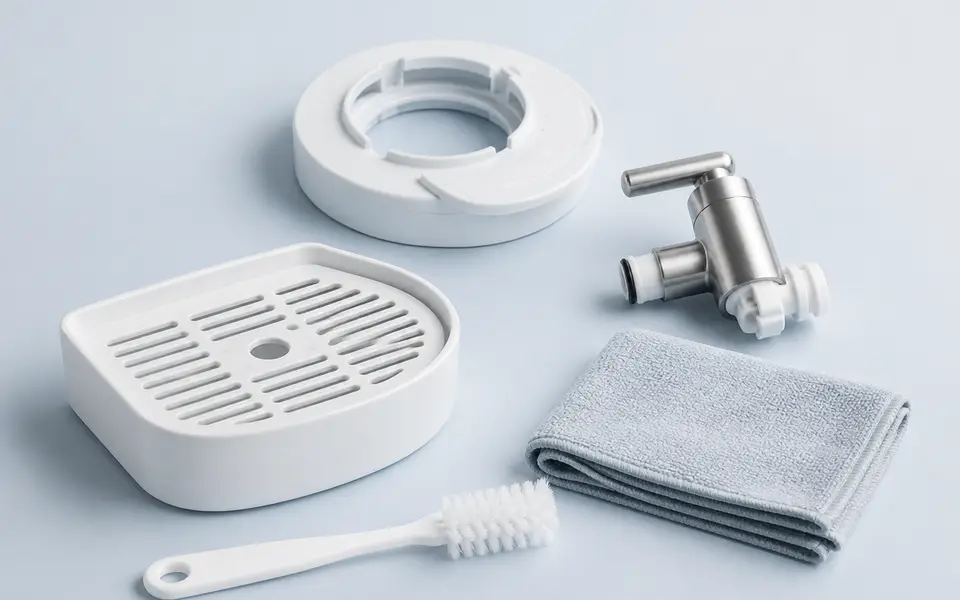
Pouring by hand gets awkward after the first few litres: a full container pours fine, but by the middle you have to support it from below. There are two practical fixes: set it on a stable stand at the edge of a table and tilt it without lifting, or fit a pump on the neck. The same pumps that work on bottles also fit large single-use containers.
10-litre water is almost always single-use: the container is thin-walled, you do not wash or return it, and once empty it is crushed and goes to recycling. No deposit is charged for it, which is a noticeable difference from bottles.
How long it lasts and when to switch to bottles
The easiest way to count is by people. For one person, ten litres for drinking and tea last about a week; for a couple, about four days; for a family of three or four, two or three days, especially in summer. If you buy this water more than twice a week, you are paying more for the container and delivery than for the water itself.
- One person: about a week, buying once a week, the format works
- A couple: three or four days, worth looking at bottles with a pump
- A family of three or more: two or three days, easier to switch to 19 litres
- An office: a day or two, the 10-litre is only a reserve in case of interruptions
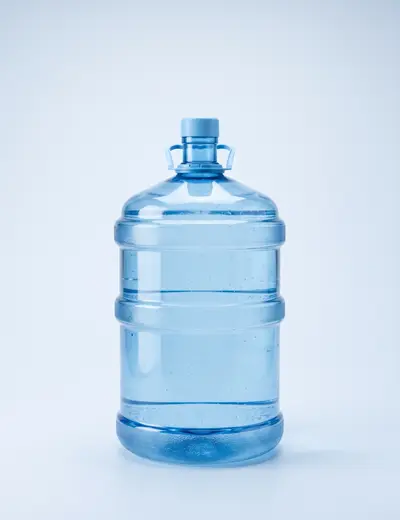
Switching to bottles is not only about price. The bottle goes round: the courier leaves a full one and takes the empty, and there is no waste left at all. In return you get a deposit on the bottle and the need for something to pour with: a pump, a cooler or a stand.
Ten litres versus nineteen: what changes when you switch
Switching to bottles changes not the price but the routine, and that is usually what decides it. A returnable bottle appears, a deposit is taken for it, it needs a cooler or a pump, and delivery needs someone at home on the day. In return all the fuss of buying and throwing out empties goes away, and the price per litre barely changes.
| What we compare | 10 litres | 19 litres |
|---|---|---|
| Weight when full | about ten kilograms | about twenty including the bottle |
| Container | single-use, goes to recycling | returnable, goes round |
| Deposit | none | 4 500 ₸ for polycarbonate, 3 500 ₸ for PET |
| How it is poured | from a stand or with a pump on the neck | cooler, pump or stand |
| Price per unit | 750 ₸ | from 1 490 ₸ |
| What is left afterwards | an empty container with every purchase | nothing: the courier takes the empty |
Three things work against switching, and all of them are practical. The deposit ties up money for as long as the bottle is with you: for two bottles that is a noticeable sum, even if you get it back. A cooler needs a corner and a socket, a pump needs room on the neck and a stand for the bottle itself. And finally someone has to put the full bottle on the cooler: not everyone can lift twenty kilograms above their head.
Half of these objections are removed by equipment. A pump costs 4 500 ₸ in the mechanical version and 8 900 ₸ in the automatic one, and comes free with a first order of 4 bottles or more; a bottom-loading cooler does not require lifting the bottle at all, as it sits inside the cabinet. Cooler rental starts from 1 500 ₸ per month and costs nothing when you order 15 bottles a month or more.
It is fairer to count the benefit of switching not by the price per litre but by the whole month. Take your usual consumption and multiply it by the unit price: that is your monthly bill on single-use containers. The same volume in bottles is priced by the price ladder, plus a one-off deposit that comes back to you. Per litre the two bills come out almost level, so a pump or a cooler pays off not in savings but in no longer carrying the water yourself.
It is better not to switch all at once. A sensible path is to take one bottle with a pump, keep the 10-litre as a reserve, and live with both formats for a month: you will see who puts the water on, where the empty bottle stands and whether delivery fits your schedule. If everything works, the second bottle joins naturally, and the single-use container stays for trips and the dacha.
Price per litre: what it is made of
The price of any bottled water has three parts: the water itself, the container and delivery. The water is the cheapest of them; most of the money goes on plastic, the label, the cap and logistics. Hence the main rule of small containers: the smaller the bottle, the larger the share of its price that is not water.
It takes one step to work out: divide the unit price by the volume. By this measure the 10-litre beats the 1.5-litre several times over and comes out almost level with the bottle, even though the water in all three is the same, from one well and tested to one report. You are paying not for the water but for the form it arrives in.
The second part of the bill is delivery, and it is charged not per litre but per order as a whole. So a single container on its own always costs more than the same container in a combined order: it makes sense to buy in one go rather than split it into three orders a week. The same reasoning is usually what leads people to keep a week's reserve.
Comparing with the shop shelf is also fairer by the litre than by the price tag. Large containers are rare in shops and almost always cost more per litre than delivery, because the shelf and warehouse space are added to their price; on the other hand you carry the water away yourself, right away. Delivery wins on volume and on the fact that the buyer does not carry it, and loses when you need a bottle right now.
The third part is what is left after the purchase, and the price list never shows it. Four or five empty containers a month take up room, have to be taken out, and cost you exactly what you think that job is worth. Bottles do not have this line: the empty leaves with the courier on the same visit.
Dacha, building site and trips: where this container works best
There are situations where a returnable bottle is inconvenient by nature, because nobody has the time or presence to return it. A dacha, a work site, a summer rental, a two-day trip: in all of them water is needed once and in a known amount, and the obligation to hand back an empty bottle turns into an extra journey.
At the dacha people take several of these containers at once and keep them in the shade: in the shed, under an awning, in a corner of the veranda away from the sun. It covers drinking, tea and washing hands before meals if the well water is not fit to drink. The sums are simple: two litres per adult a day for drinking plus the same again for everything else, which means one container per person for two or three days.
A separate dacha question is where to put the empties until you leave. Piling them in a corner of the veranda until the end of the season is not a good idea: the plastic gathers dust and smells, and takes up no less room than a full one. A crushed container with the cap screwed on takes a quarter of the space, and a month's worth of empties fits in one car boot in one trip.
On a work site or building site the 10-litre is handy because it does not need guarding or returning. In summer a crew is allowed three litres per person a day, half that in winter; the container goes in the site cabin, not in the sun, and is capped between pours. There is usually no cooler there, so water is poured from a stand or through a tap attachment.
In the dacha season one more consideration applies: the road. Driving water from the city in your own car only makes sense if you are going anyway; otherwise it is cheaper to have it delivered straight to the address. We go out of town for orders of 4 bottles or more and agree the day in advance, so dacha orders are put together for the season ahead rather than a bottle at a time each weekend.
For a trip or an event the count is different: not by days but by heads and hours. One and a half litres per person for an evening and two or three for a hot day outdoors is plenty, and a spare sealed container keeps happily until the next trip. The main thing is not to leave it in the car in the sun: that is where the plastic heats up most.
How to buy 10 litre water in Almaty
Message us on WhatsApp with the quantity and address. We deliver 10-litre containers together with a regular order: delivery in the city is free from 2 bottles per order, and large single-use containers ride along on the same run. A separate run just for them is priced in advance, and we tell you the cost before confirming the order.
Orders placed before 10:00 usually go out the same day; delivery windows are 9–13, 13–17, 17–21. The service has one day off: Sunday. Demand for this size is small, so we always confirm availability in the chat rather than promise a number on the page.