





How a purifier differs from a cooler
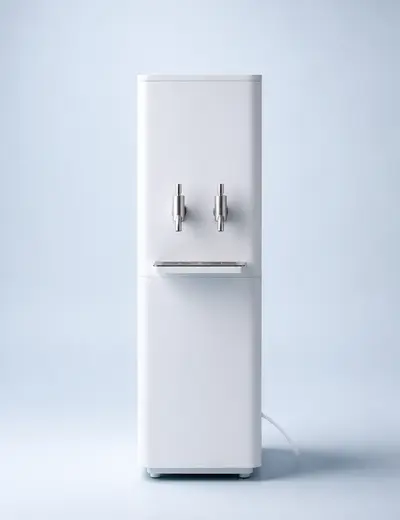
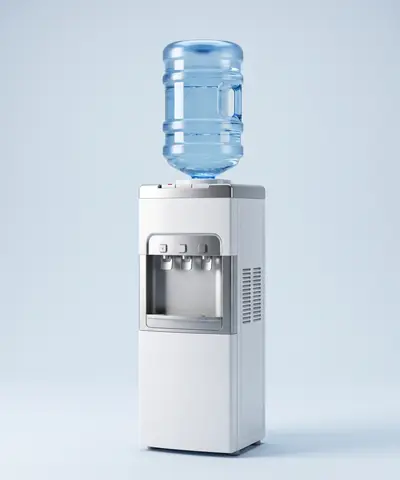
From the outside it is the same cabinet with two or three taps, and the two are easy to confuse. The difference is inside and underneath: instead of a socket for the bottle neck it has a hose running to the water supply, and the cabinet holds filter housings. Water comes from the city mains, is purified and ends up in the same cold and hot tanks.
Two consequences follow, and both matter more than any specification. First, the water never runs out, and nobody has to carry it, order it or receive it. Second, the unit is tied to its connection point. You cannot move it to the other end of the office — a new supply line has to be run.
And a third point people mention less often: it is different water. The bottle brings artesian water from a known well with a lab report; here it is city water purified on the spot. Both can be perfectly safe, but in taste and composition they are not the same thing.
This also shows what you will not find on this page. A purifier has no bottle at all: the cabinet has no socket for a 19 L bottle, top or bottom, there is no deposit to pay, no room for stock is needed and there are no empties to hand back. That is exactly why it goes where there is nowhere to keep bottles — not because it is somehow better than a cooler.
How much water it gives and how many people it suits
Since no bottle limits it, it seems a purifier has endless water. As far as supply goes, that is true: over a day it will pour as much as the pipe brings. Its limit is different — how much cold and hot water it keeps ready and how quickly it refills the tanks after they have been drained.
The sums are the same as for a cooler. At home, allow 2 litres per person a day; in an office, 1 litre per person per working day. Divide the total by working hours and check it fits the model's output. The difference shows at peaks: in an office half the daily consumption goes in the twenty minutes of the lunch break, and a unit with a 1.5 litre cold tank is pouring room-temperature water by the middle of the queue.
- A flat for two or three: no peaks at all, any cabinet will do, including a desktop one.
- An office of up to ten: look at the cold tank, two litres or more, otherwise after lunch you have to wait for it.
- A floor of thirty to forty people: take a floor-standing model with compressor cooling or put two units at opposite ends.
- A coffee shop, salon or clinic: count litres per shift rather than people, and add water for the equipment.
- A workshop or warehouse: add the heat from machinery — in summer consumption there is double that of an office.
Reverse osmosis adds one more number to the sum — membrane speed. It releases water slowly and so works through a storage tank: while the tank is full the tap pours as usual, but once it is drained the next litres arrive tens of minutes later. At home nobody notices; at a busy site this turns out to be the key parameter.
It is also worth counting not the water but the people at the unit. One tap for forty people means a queue at lunch and a puddle underfoot, however many litres an hour the unit delivers. Where consumption is high, the question is settled not by output but by a second unit at the other end of the floor.
What sits between the mains and the tap
Purification goes in stages, and the set of stages is exactly what you pay for. Models combine them differently, but the order is the same.
- Sediment filter: catches sand, rust and scale from the pipes and protects everything downstream.
- Carbon block: removes chlorine, odour and aftertaste. It is after this stage that the water starts to taste different.
- Membrane. Ultrafiltration holds back bacteria and suspended matter while leaving the salts; reverse osmosis removes almost everything, hardness salts included, and needs a drain to the sewer.
- Post-filter and remineraliser: after an osmosis membrane the water is almost empty, and its minerals are put back.
- UV lamp — not in every model, fitted as a safeguard before the tap.
Which membrane to choose depends not on the model description but on what comes out of your tap. Where the water is hard and heavily mineralised, osmosis is justified. Where there is nothing wrong with its composition and you only need taste and safety, ultrafiltration copes, costs less and sends no water down the drain.
On-site purification has a limit people rarely mention. The unit works with whatever the pipe brings, and it is the first to meet anything that happens to the water on the way — a burst main, riser repairs, rusty water after a shut-off. On such days a sediment cartridge clogs in a week instead of six months. So after any pipework the first litres are run off, and the tap pressure is watched: falling pressure is the first sign the sediment filter is blocked.
Floor-standing and desktop water purifiers
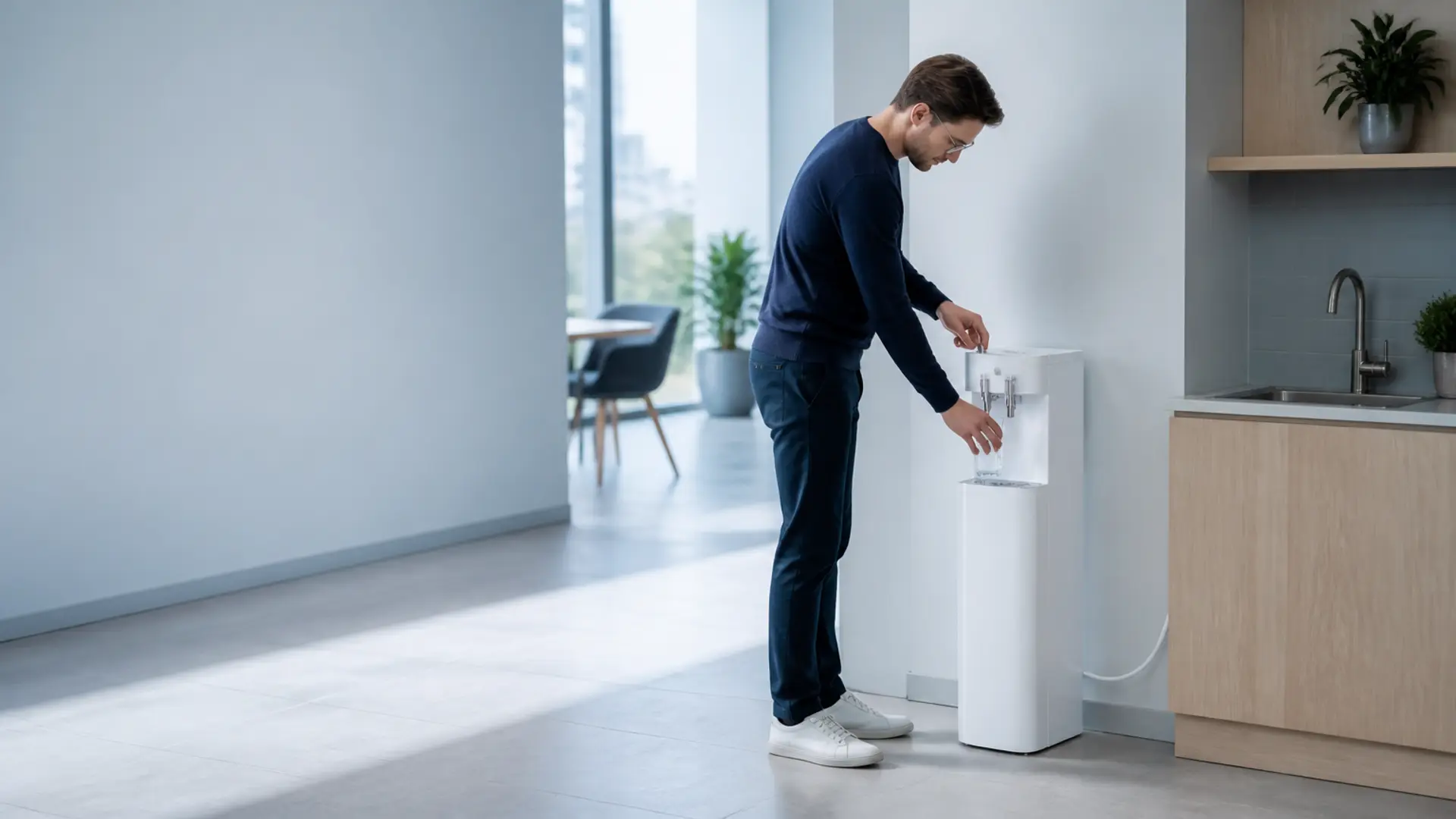
The difference between them is exactly the same as with coolers: it lies in the cabinet, not the principle. A floor-standing unit holds more hot and cold water at once and is built for an office where people come to the tap dozens of times a day. A desktop unit sits on a cabinet and suits places with few people and little space.
Some desktop models have the filters moved to a block under the sink: only the unit with its taps stays in view, but you reach the housings through a cupboard door.
There is also a third type sold under the same name — the instant one, with no tanks at all: water is heated or chilled on its way to the tap. It is more compact, does not keep a heated tank for nothing and never waits for the temperature to recover, but it costs more and depends more noticeably on the mains pressure.
The cabinet is chosen by the space, not by the specification. A floor-standing unit needs half a metre of wall with a socket nearby; a desktop one needs a sturdy cabinet that will not rock when someone presses the tap with a palm. Measure in advance and leave room for the door in front of the housings: you will need to reach the cartridges every six months, and a unit pushed tight into a niche will have to be pulled out every time.
Cold water, hot water and cabinet modes
The purification stages decide what water reaches the tank. The cabinet decides how it reaches the glass, and it is built just like a cooler: two tanks, a heater on one and cooling on the other.
There are two ways to cool. A thermoelectric element is cheaper and quieter and holds about 10–12 degrees, but refills the tank slowly after heavy use. A compressor is the same unit as in a fridge: it reaches 5–7 degrees and recovers quickly. It costs more and can be heard, yet it is fitted in every unit people use dozens of times a day.
- Tank capacity: it affects not the monthly consumption but the rush-hour queue.
- Lock on the hot tap: the water in the tank is heated above 90 degrees, and in a home with children this is a requirement, not an option.
- Night mode: the heater switches off for set hours and does not keep a tank hot for nothing.
- Clearance under the tap: a jug and a coffee pot should fit in whole, otherwise water gets poured over from a glass.
- Dry-run protection: heating switches off by itself when there is no water in the pipe.
Some models can also make sparkling water: there is a carbon dioxide cylinder inside the cabinet. In a café this makes a difference; at home it is nearly useless — the cylinder needs replacing, the unit needs washing, and people usually use it for the first two weeks.
One thing to know about the hot tap: it does not give boiling water. The water in the tank stays at about 90 degrees — enough for tea, instant coffee or porridge, but not for everything people keep a kettle in the kitchen for. So the kettle stays, and the unit does not replace it but takes some load off it.
The electricity bill for such a unit is the same as for a cooler, and most of it goes on the hot tank. The savings come not from the declared energy class but from night mode and the same tap lock: water that was not poured by accident does not get reheated.
What you need to install one
- A cold-water connection point nearby: a supply line across the whole room is not a solution but a problem.
- A socket: the unit heats and chills just like an ordinary cooler.
- For osmosis — a drain to the sewer and room for the storage tank, usually under the sink.
- Free access to the housings: cartridges get replaced, not forgotten forever.
- The property owner's consent to tapping into the pipe.
It is also worth checking what happens to that point in winter and while you are away. A supply line running along a cold wall or through an unheated porch freezes first; a valve shut while you are away leaves water in the tanks that will have to be drained on your return anyway. Both are solved when choosing the spot, not after the first puddle.
And one more detail people remember only during installation — the water pressure. A reverse osmosis membrane needs quite a lot of it, and on the upper floors of old buildings there is sometimes not enough. Then a booster pump is added: another socket, more noise and one more part that will need servicing one day.
The last point is why such units are rarely installed in rented flats. The tap-in and the hole in the cabinet stay with the landlord, the equipment has to be removed when you move, and the pipe cannot always be restored as it was. A bottle drills nothing and moves with you the same day.
The cost of ownership, not just of purchase
The Almaty market benchmark is 138 590 ₸, and this figure needs care: the spread in shops is huge because the same word covers both simple ultrafiltration and a reverse osmosis system with a tank and a remineraliser. We quote a specific model in the chat once we know your water, your connection and your consumption.
Then comes what a bottle simply does not have. Sediment and carbon filters are replaced roughly every six months, the osmosis membrane several times less often, and once a year the tanks and taps need sanitising. An expired cartridge does not simply stop cleaning: it becomes a source of what it was meant to protect against. With bottles the costs work the other way round — you pay for the water you actually use and leave a refundable deposit for the bottles.
| What we compare | Purifier | Cooler and bottles |
|---|---|---|
| Where the water comes from | city mains, purified on site | artesian well, delivered ready |
| What you pay for regularly | cartridges and servicing | each bottle: from 1 490 ₸ |
| One-off payments | the unit and installation | bottle deposit: 3 500 ₸ and 4 500 ₸, refundable |
| Storage space | none needed | a corner for full and empty bottles |
| Moving | removal and a new tap-in | the cooler and bottles move with you |
| Water shut off in the building | no water from the taps until it is back | the stock in bottles remains |
Looking after the unit: cartridges, tanks and taps
Maintenance works differently from a cooler, and this is the main change for anyone switching. With a cooler, cleanliness arrives with each new bottle: it has been washed, disinfected and inspected at the plant, and all you do is wipe the tap. A unit without a bottle leaves all that work on site — it is done by hand or under a service contract.
| Stage | What it removes | When it is replaced |
|---|---|---|
| Sediment cartridge | sand, rust and scale from the pipes | roughly every six months, more often with dirty water |
| Carbon block | chlorine, odour and aftertaste | roughly every six months |
| Ultrafiltration membrane | bacteria and suspended matter, leaves the salts | several times less often than carbon |
| Reverse osmosis membrane | hardness salts and almost everything else | less often than carbon, replaced when the flow drops |
| Post-filter and remineraliser | restores taste and minerals after the membrane | together with the carbon or right after it |
| UV lamp | disinfects the water before the tap | by operating hours, usually once a year |
The intervals in the right-hand column are a guide, not a promise: a cartridge lives not by the calendar but by litres and by what comes through the pipe. With hard water the sediment filter is changed twice as often, and the first sign is usually not the taste but a drop in pressure at the tap.
- Shut off the water at the inlet and unplug the unit.
- Drain what is left through both taps, otherwise the housing will empty onto the floor.
- Remove the housing with the wrench from the kit and pour out the water.
- Fit the new cartridge, check the O-ring and reassemble the housing by hand, without the wrench.
- Turn the water on, check the joints for leaks and run the first litres into the sink: the filter media sheds dust, and the first water comes out cloudy.
- Write down the replacement date — a cartridge's age can never be reconstructed from memory.
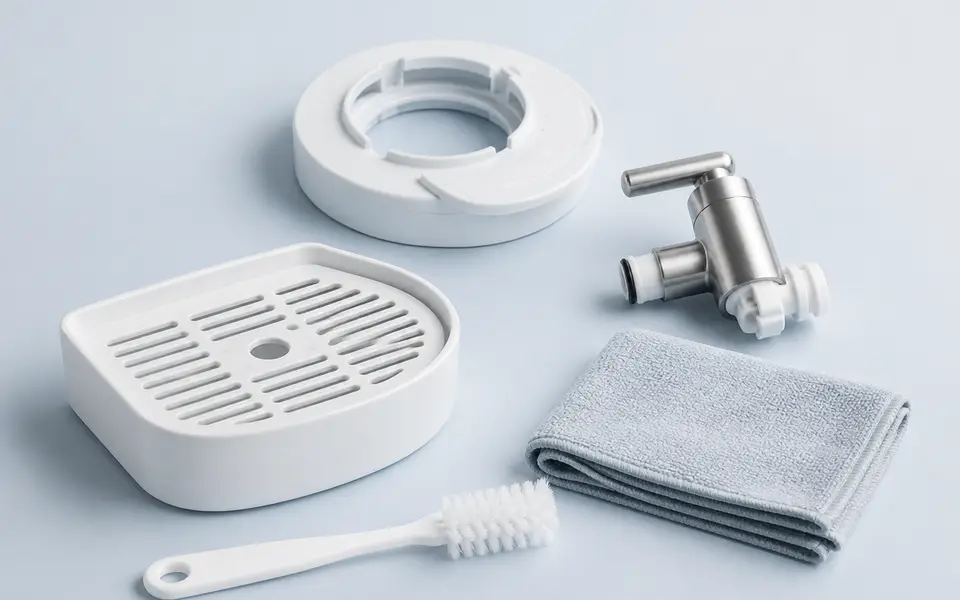
Once a year sanitising is added: the water path and tanks are flushed with a disinfecting solution, and the taps are removed and washed separately. It is done on schedule, not when the water starts to smell — by then something has grown in the tank that takes longer to get rid of.
And the rule that matters more than the rest: a unit that has stood unused for a week or longer is flushed before the first glass. Water that has sat overnight in a warm tank is no longer the water that came through the filters.
Renting a purifier
Renting solves two things at once: you do not pay the full price up front, and servicing passes to the supplier — cartridge changes and technician visits are included in the rate rather than remembered every six months. There are almost no published monthly rates in Almaty, and terms are worked out for the site: consumption, membrane type, length of the supply line, whether there is a drain. Ask in the chat. We have a separate page on cooler rental and the free-use threshold.
Read more: Water cooler rental
It makes sense to compare it as a yearly total, not a monthly rate. The yearly total covers what buying spreads over separate payments: cartridges, technician visits, sanitising and repairs. The unit stays the supplier's, which also answers the question of what to do with it when you move or close the site.
The downside is the usual one for any rental: after a few years the total paid will exceed the price of the unit, and it will never be yours. So people rent where the horizon is short or unclear — a rented office, a seasonal outlet, a site during construction.
When it pays off compared with bottles, and when it does not
The benefit appears where consumption is high and steady and space is expensive: an office of several dozen people, a coffee shop, a salon, a clinic, a workshop. There bottles have to be received every other day, and the corner for stock takes up usable floor area. In your own premises, which you are fitting out anyway, installation stops being a problem too.
It does not pay off at home for two or three: the up-front cost and cartridges take years to recoup, and the consumption is not there. It does not suit rented homes or premises without a connection point. Nor does it suit people who switched to delivery for the taste of a particular water.
It is best to calculate over three years in two columns. On the left: the price of the unit, installation, cartridges for the number of changes in three years, sanitising once a year and electricity. On the right: bottles at your actual consumption and the refundable bottle deposit. The lines that most often settle the matter are not in the first column: the floor space for stock, which an office pays for in rent, and the time of the employee who receives deliveries.
The second question in the same calculation is what happens when the unit fails. Bottles have no breakdowns at all: a bottle does not break, and a faulty cooler is swapped in one visit. Here a failed membrane or a leaking joint means a day without water and a call-out, and at a site that needs water every hour a stock of bottles is kept anyway.
We deliver bottles and say it plainly: if bottled water wins at your consumption, we will tell you so. A bottle costs from 1 490 ₸, from ten bottles 1 350 ₸, and delivery across the city is free from 2 bottles. Message us on WhatsApp with how many people and how many litres a week.