








Water pump for a 19 L bottle: pour without lifting it
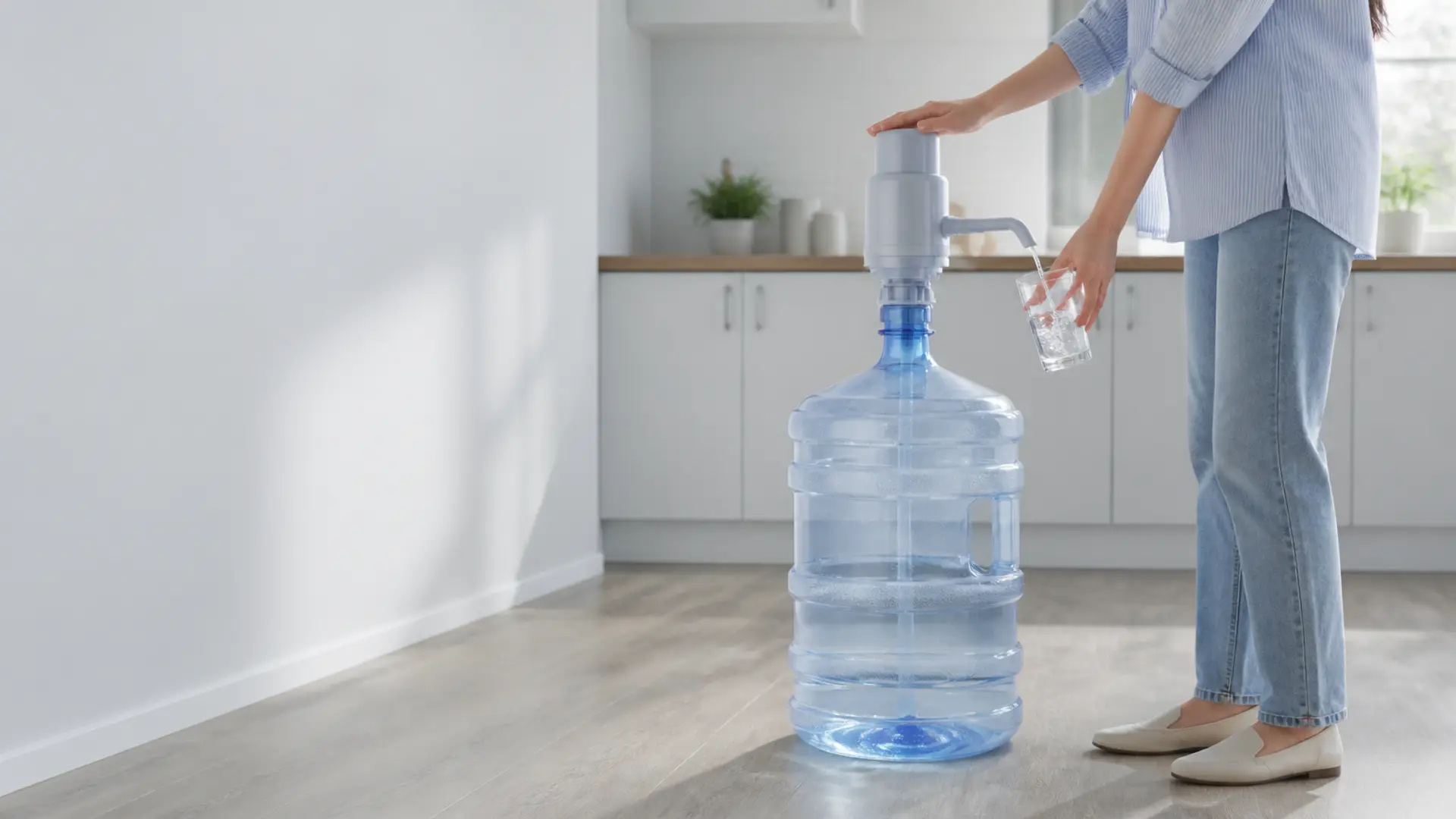
A bottle does not pour on its own. You either put it on a cooler, tip it over a saucepan with a second pair of hands, or fit a pump with a tube on top. The third way is cheaper than the other two and needs neither a socket nor a spot for an appliance: the pump sits on the neck, the tube reaches the bottom and water runs along the hose into your glass.
A water pump does exactly one job: it dispenses. It does not chill, heat or filter. If you need even one of those three words, look at a cooler. If you just want to drink from the bottle without dragging nineteen kilos around the kitchen, a pump is enough.
Tipping a full bottle over a saucepan is a solution that works exactly once. Twenty kilos held in the air feel unsteady, the water comes out in spurts, and the rim of the neck touches the pan and your hands. The pump removes all of that at once: the bottle stays put, the water flows evenly, and nothing but the tube ever touches the water inside.
It goes on in a minute and comes off just as fast: pull off the cap, push it down all the way, tighten the ring. The empty bottle leaves with the courier, and the pump goes onto a fresh bottle at the next delivery — the device stays with you and moves from bottle to bottle for years.
It has a second name too — in Russian price lists and ads it is sold both as a “pompa” and as a “nasos”, and both words mean the same device. The difference is only the seller’s habit. Do not confuse it with household transfer pumps: those sit in another section of the shop and have nothing to do with a bottle neck.
What it is made of and what wears out
You can take it apart on the kitchen table in a minute, and that is the best way to see why it is so cheap. There are only five parts, and none is more complicated than a thermos stopper.
- A threaded cap or a clamping ring — what holds the pump on the neck.
- A sealing ring under the cap: it makes sure the air goes into the bottle rather than past it.
- An intake tube down to the bottom, usually clear: the water rises up through it.
- The drive: a piston with a rod and spring in the mechanical pump, a small motor with an impeller in the automatic one.
- A spout on a flexible hose with a clip that shuts off the flow between pours.
All of this works on a pressure difference. The piston or motor raises the pressure above the water, the water climbs the tube and pours out of the spout. As soon as the drive stops, the column of water in the tube drops back — which is why, after a long break, the first half glass comes with a delay, and that is not a fault.
All pumps use similar materials, and two things are worth checking. The first is the tube: silicone is softer and bends more easily, PVC is stiffer and copes worse with hot washing. The second is transparency: through a clear wall you can see what is going on inside and spot a deposit by eye rather than by smell. The body and cap are made of food-grade plastic, and that is the end of the questions about materials.
Two of the five parts wear out, and they differ between the two drives. In the mechanical pump it is the piston seal: the rubber hardens, stops holding air, and a glass takes twice as long to fill. In the automatic one the battery gives up first — after two or three years it holds a charge for a week instead of a month. Everything else lasts until it is broken by hand: the tube gets pinched by a cupboard door, the spout snaps off, the ring gets lost while washing.
Spare parts for these pumps are usually not sold; the whole unit is replaced. The exception is the sealing ring: one comes in the box, and it is worth keeping a spare separately, because it is lost more often than anything else.
There is also a third drive, rarer than the two main ones — battery power. It is bought for places with no socket at all and nothing to charge from: a set of AA batteries lasts about as long as one battery charge and can be swapped on the road in a minute. The downside is obvious — you keep buying batteries, and over a year they cost more than the price gap between the two main drives.
Mechanical water pump: a piston and zero sockets
A mechanical pump is a hand pump built into the cap. You press it with your palm, air goes in, and the pressure pushes water up the tube. A glass fills in five to seven presses, a saucepan in about a minute. There is nothing to break: a rod, a spring and two rubber seals, which are replaced together with the cap.
A hand pump for bottled water is good because it works where there is no electricity at all — an off-grid dacha, a building site, a garage, a campsite. It has one honest drawback: you pour by hand, and an elderly person or a child finds that harder than pressing a button. It costs 4 500 ₸.
The effort deserves a separate word, because that is what the choice comes down to. Pressing the top until water flows is roughly the same movement as pumping up a bike tyre with a hand pump: not hard, but noticeable. An adult does it without thinking, a seven-year-old or someone with a weak wrist does not, and that is the only criterion that rules out the mechanical pump straight away.
When buying a mechanical pump, check three things. The rod stroke: the longer it is, the fewer presses a glass takes. The length of the outlet hose: it should reach a glass on the table, not just the edge of the bottle. And the clip that shuts the hose between pours — it breaks more often than anything else, and on cheap models it can be purely decorative, so the water keeps dripping until you lift the hose higher.
Electric water pump: charge, flow and auto stop
The principle is the same, only a small motor does the piston’s work. Power comes from a built-in battery charged over USB from any socket or power bank, and one charge lasts about a month of household use. An automatic water pump stops by itself the moment you release the button and does not overflow the glass.
The flow is steadier than with a mechanical pump, and anyone can pour — that is the whole difference you pay extra for. The trade-off is clear too: the device costs 8 900 ₸, it has a battery that will die in a few years, and it must not be left in a car in the frost — the water left in the tube freezes and splits the hose.
These models state their flow in litres per minute, and the figure says little until you translate it into something familiar. One and a half litres a minute means a glass in ten seconds and a saucepan in just over three minutes; two and a half litres means a glass in six seconds. The difference shows on a saucepan and barely shows on a glass, yet that is usually what you pay for.
| What we compare | Mechanical | Automatic USB |
|---|---|---|
| What it needs to work | nothing | a charged battery |
| Price | 4 500 ₸ | 8 900 ₸ |
| How you pour | by pressing the top | with a button |
| What wears out | the piston seal | the battery and motor |
| Where it fits | dacha, garage, building site | kitchen, office, children’s room |
Which bottles it fits
The neck of 19 and 20 litre bottles follows one standard, and that is the whole convenience: one pump serves both a reusable polycarbonate bottle and a single-use PET one. The diameter is the same; the only difference is how stiff the wall is.
| Bottle | Neck | What you get |
|---|---|---|
| 19 L bottle, polycarbonate | standard | the normal case, the one people buy the pump for |
| 19 L bottle, PET | standard | fits the same way, but the wall is softer — do not squeeze the bottle by hand |
| 20 L bottle | standard | the same fit, the difference is the bottle height and tube length |
| 10–12 L bottle | its own, narrower | you need a model for this diameter, universal ones do not always hold |
| 5–6 L bottle | narrow, for a screw cap | pumps exist, but it is easier to open it and tip it |
Hence the order of choice: first name the bottle, then look at the drive. The reverse order ends with a box with a button that does not fit what stands in your kitchen.
A separate word on switching supplier. Bottles look different from one service to another, but the neck is the same, so the pump stays yours when you switch. The reverse is true too: bought together with water, it does not tie you to anyone — it fits any standard bottle.
The tube length is set once, at the first installation. It should reach the bottom without pressing against it: a short tube starts sucking air halfway down the bottle, a tube that is too long bends and blocks itself. The excess is cut at an angle — an angled cut does not stick to the bottom.
A bottle with a handle or a bottle on a stand does not affect the fit, but it strongly affects convenience. From a stand you pour standing up, and the tube works in the same position it was cut in — one more reason to trim it in place rather than in advance.
Where people use a bottle pump
A drinking water pump is not bought instead of a comfortable life, but instead of an appliance that has nowhere to stand or no reason to run. Five typical places look like this:
- A rented flat: you do not want to leave equipment behind, and the bottle goes straight into a corner of the kitchen.
- A dacha or a country house: there is not always a socket, but water is needed all summer.
- A building site or renovation: an appliance would gather dust and get in the way, a pump bothers nobody.
- A warehouse, garage or car service: people drink from the bottle and do not need cold water.
- A small office of three or four people, where a cooler would sit idle half the day.
These five places have one thing in common: people drink water there, but an appliance has no reason or no room to stand. That gives a simple rule of choice. If you have a socket, a free corner and dozens of trips to the water a day, a cooler pays off in convenience. If even one of the three is missing, a pump settles the question in an evening and for a sum that is lost against a month’s water order.
A water pump for smaller bottles is a separate story. Pumps are made for five-litre bottles too, but they make little sense: it is easier to open such a bottle and tip it. A countertop water pump earns its place from nineteen litres, that is, where the bottle can no longer be lifted with one hand.
How to fit it on a bottle without flooding the table
Installation takes a minute, and there are two places where water usually gets spilled: pulling off the cap and seating the top.
- Put the bottle where it will stand: it is better not to carry it with the pump on.
- Wipe the neck and the rim under the cap — the dust on them goes inside with the first water.
- Pull the cap off completely instead of piercing it with the tube: bits of plastic fall into the water and later float in your glass.
- Lower the tube to the bottom, push the top all the way down and tighten the ring by hand.
- Hold a glass under it and do two or three idle presses: the first portions come with air.
- Pour the first glass away — it rinses the tube and spout.
After that it is a matter of habit. A glass fills in five to seven presses, a saucepan in about a minute; with the automatic pump you release the button a moment early, because water keeps running down the hose for half a second after the motor stops.
The height the bottle stands at matters more than the drive. A bottle on the floor makes you bend down for every glass and makes the tube work at an angle; a bottle on a stand or a low cabinet raises the spout to table level, and then you pour standing up with one hand. The stand costs 7 900 ₸, and in that sense it is an extension of the pump rather than a separate purchase.
If the flow has weakened over time, the cause is almost always air, not water. The unit works on a pressure difference, and any gap between the top and the neck eats that difference: air escapes past the bottle and the water stays at the bottom. Check in order — the seating of the top, the ring under it, kinks in the tube — and only then think about replacing it.
And one rule about moving it: take the pump off before you move a full bottle. There is pressure under the top, and when tilted the water runs out of the spout onto the floor.
Water pumps versus a cooler: the price of simplicity
The main price is temperature. The water comes out at room temperature, and in summer you notice it. People get round this in different ways: they keep a couple of juice bottles in the fridge, pour a jug in advance, and in winter do not notice the problem at all. A drinking water pump honestly promises nothing about cold water, and that is how it differs from a cooler, which does promise cold and charges for it.
The second price is height. A bottle with a pump stands on the floor, so you either bend down to pour or put it on a stool or a stand. The third small thing people find out later: the tube needs rinsing every couple of months, otherwise a deposit forms inside. Five minutes under running water settles it.
The fourth price shows up in an office rather than at home, and it is about pace. A cooler fills a glass in three seconds and asks nothing of you; a pump needs a hand and attention, and where people come to the water forty times a day, that adds up to a real inconvenience. At home for two the same arithmetic means nothing — the bottle gets five visits.
And the last thing worth saying before you buy: a pump does not make water cheaper and does not replace an appliance where one is genuinely needed. It removes exactly one task — getting water from the bottle into the glass. Everything else people sometimes expect of it — cold water, boiling water, purification — stays with the appliances that charge for it.
Care, storage and service life
It needs about as much care as a kettle, and all of it comes down to the tube. Water sits in it between pours, and standing water in a warm room is the best thing that can happen to a deposit.
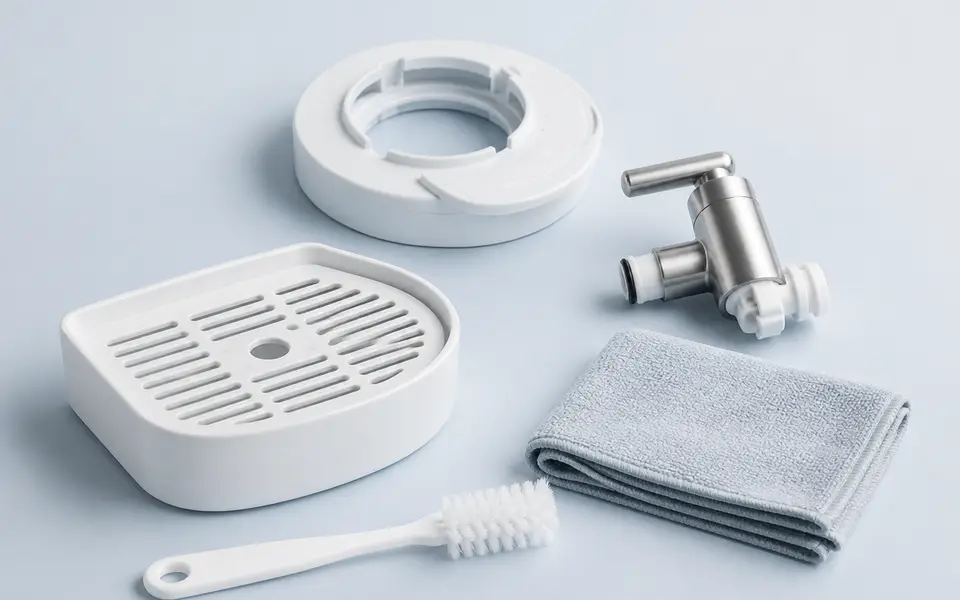
- Every couple of months the top and tube are rinsed in warm water without abrasives.
- The spout and clip are taken off and washed separately: hands and glass rims touch them.
- The body of the automatic pump is not held under the tap — there is a motor and battery inside; wipe it with a damp cloth.
- After washing, dry the parts laid out separately: a tube assembled wet starts to smell within a week.
- While washing, always put the ring in the same place — it gets lost more often than any other part.
Once every six months, hold the tube up to the light. If there is a cloudy film along its wall, rinsing in warm water is no longer enough — replace the tube or get a new unit. It costs less than two bottles of water, and there is no point fighting a deposit over such a sum.
Storage is simple, with one rule. Do not leave it in the frost with water inside: the water left in the tube freezes, the ice splits the hose, and you find out with a puddle at the first press. So in a car, an unheated garage or a dacha in winter, take the unit off and drain it rather than leaving it on the bottle until your next visit.
Service life is measured not in years but in presses. As long as a glass fills in the usual number of movements, there is nothing to replace; once it takes twice as many, the mechanical pump’s seal has worn out. In the automatic one the same sign looks different: the charge lasts a few days instead of a month. In both cases the whole unit is replaced, and the cost is 4 500 ₸ or 8 900 ₸.
The battery also lasts longer if it is not run down to zero and not left on the cable for days. The practice is simple: charge it when the flow drops noticeably and unplug it when the indicator goes out.
How to order a pump together with water
A pump for bottled water comes on the same run as the bottles, so there is no separate courier visit. Delivery across the city is free from 2 bottles, an order placed before 10:00 usually goes out the same day, the delivery windows are 9–13, 13–17, 17–21, and there is one day off: Sunday.
There is also a way not to pay for it at all: the pump comes free with a first order of 4 bottles or more. The courier brings it with the water, fits it on the neck and shows you how to take it off — no need to call anyone separately.