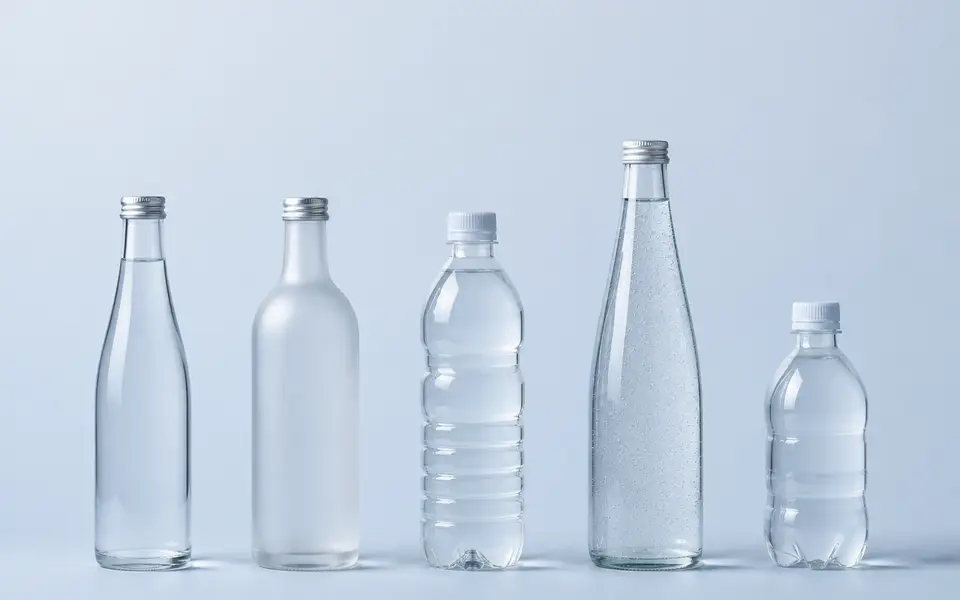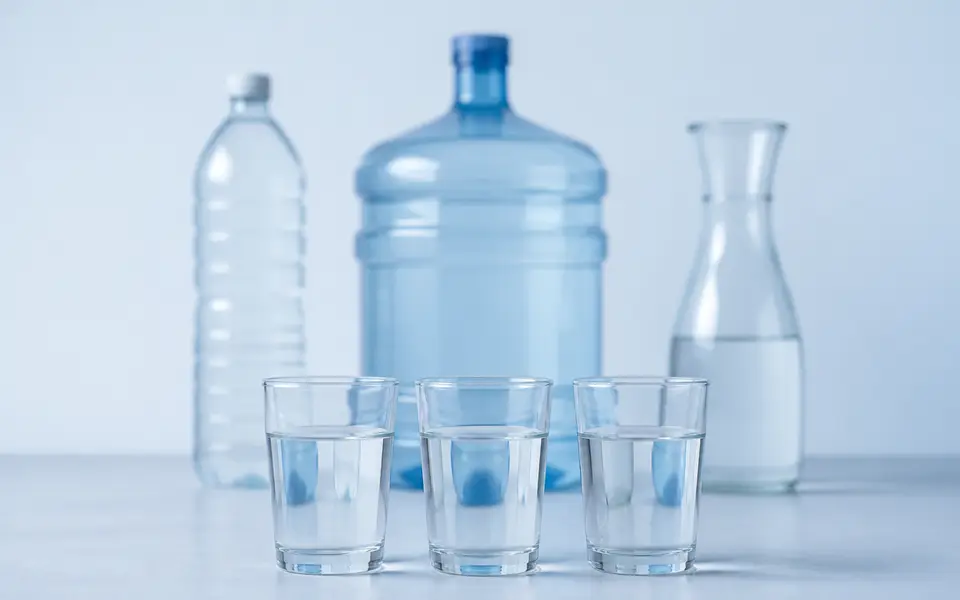

What matters is the composition, not the packaging
The answer to the question in the title is duller than you might like: it is best to drink water when you know what it consists of and where it comes from. Not the most expensive, not the most advertised and not the one in the prettiest bottle. Everything you need to choose is usually printed in small type on the back of the label.
Three lines instead of a brand
When people ask which water is best to drink, they expect the name of a brand. But a brand is packaging and logistics, while quality is described by three lines: total mineralisation, source and bottling date. If even one of them is missing, you are choosing blind, and no words on the front of the bottle will fix that.
Total mineralisation, also known as total dissolved solids, is the combined amount of dissolved salts. For everyday drinking a sensible range is 100–500 mg/L. Below that, water tastes flat and quenches thirst less well; above it, it is already mineral water with a character of its own, and there is no need to replace ordinary water with it every day.
The source tells you what happened to the water before it reached the bottle. An artesian well with a stated number, a specific spring, a surface water intake followed by treatment: all of these can work, what matters is that the source is stated clearly. Wording such as “purified drinking water” with not a single word about its origin is not a lie, but it is not information either.
Freshness of bottling
The bottling date matters as much as the composition. Water does not go off like milk, but microflora grows in containers that have stood a long time or been opened, and heated plastic gives off foreign tastes. Fresh water of known composition is almost always better than aged water of unknown composition.
There is no universal winner
And straight away a caveat, without which the rest reads the wrong way: there is no universal winner here. In one part of the city tap water is perfectly drinkable without a filter, while in the next it smells of chlorine and leaves scale after the very first kettle. So what follows is not about which source is objectively best, but about which one suits which task.
Four sources: tap, filter, bottled, mineral
Who is responsible for each source
Everything people drink at home and at the office comes down to four sources. They differ not only in quality but also in who is responsible for that quality: the city answers for the mains supply, you answer for the filter, and the producer with its own laboratory answers for the bottle.
| Source | Strength | What to bear in mind |
|---|---|---|
| Tap | Constant monitoring at the treatment plant, next to no cost | Quality changes on the way: old pipes, chlorine, scale |
| Filtered | Removes chlorine, odour and some of the hardness | The cartridge has a limited life, and an expired filter is worse than the tap |
| Bottled | Known composition and bottling date on every batch | Depends on the producer's integrity and on storage conditions |
| Mineral | Distinct mineral composition, familiar taste | Therapeutic types are drunk in courses, not instead of ordinary water |
The argument about which water is best for drinking usually comes down to habit: someone who grew up on well water finds bottled water empty, and someone used to a filter will not drink from the tap on principle. There is only one objective criterion, and that is how predictable the composition is. By that measure bottled water and a good filter with a working cartridge are level, while the tap depends heavily on the district and the age of the pipes.
How to combine them at home
The most sensible thing is to combine them. For cooking and tea, filtered water is usually enough: when boiling, some of the salts stay in the pan anyway, and chlorine leaves as the water heats up. For drinking on its own, bottled water is convenient: its composition is printed and does not change because the building's riser pipe was replaced.
Taste and season as clues
Taste as a way of checking deserves a separate word. Taste picks up chlorine, hydrogen sulphide, iron and excessive hardness, which is exactly what is noticeable anyway. It does not pick up nitrates, heavy metals or microbiology at all, so “it tastes fine” is not a verdict on safety, only the absence of obvious complaints.
The season plays a part too. In spring, when meltwater reaches the intakes, the load on treatment rises, and there is usually more chlorine in the mains, which you can tell by the smell. If tap water suits you in summer and annoys you in March, it is not your perception, it is how the treatment plant works at that time of year.
Mineralisation and composition: what to read on the label
Bottled water labels are laid out in much the same way by every producer, and they are worth reading from the back, starting with the composition table rather than the name. There are only a few items that actually mean something.
Lines worth finding
- Total mineralisation, also known as total dissolved solids: 100–500 mg/L for everyday water
- Hardness: for drinking water it is usually no higher than 7 mmol/L, beyond that come scale and an astringent aftertaste
- Calcium and magnesium: there is not much of them in water, but they are the minerals that make choosing it worthwhile at all
- Sodium: the less, the more reassuring for those who keep an eye on their blood pressure
- pH: the normal drinking range is roughly 6.5 to 8.5
- The source with a well number, the bottling date and the best-before date
Minerals and water that is too soft
When people ask which water is good for drinking, these are usually the lines they have in mind. But the benefit of water lies first of all in the water itself: it carries substances, maintains blood volume and takes part in metabolism. Minerals are a pleasant extra, and you cannot cover your daily need for calcium or magnesium with them at any level of mineralisation.
Water that is too soft is not ideal either. Water with almost everything removed tastes flat and does less to help maintain the salt balance. That is exactly why reverse osmosis filters come with a remineraliser, and why deeply purified bottled water is brought back to normal dissolved solids at the plant by adding salts back in.
Category as an honest criterion
Another line people walk past is the water category. Standards for packaged water divide it into first and highest category: the highest has stricter requirements, and its source is usually a well rather than a surface intake. This is a formal classification, not a slogan, and comparing by it is more honest than comparing by the promises on the front.
Boiled versus filtered
Boiling is the oldest way of making water safe, and it deals with bacteria: a few minutes of boiling is enough to remove most of the microflora. That is where the list of problems a kettle solves ends.
What stays in the kettle
Boiling turns hardness salts into scale, and the water really does become a little softer, as you can see on the kettle walls. But the concentration of everything else rises as the water boils away: nitrates, heavy metal salts and most persistent organic matter do not go anywhere, while there is less water. Free chlorine partly leaves with the steam, but the products of its reaction with organic matter stay in the mug.
So the question of which water is better to drink, boiled or filtered, is not settled in the kettle's favour. A filter deals with exactly what boiling does not: a carbon filter removes chlorine, odour and some organic matter, an ion-exchange filter reduces hardness, and reverse osmosis holds back almost everything, including nitrates and metals.
The weak point of a filter
A filter has its own weakness: its service life. A cartridge left in beyond its time stops being a barrier and becomes a breeding ground: bacteria live quite happily on carbon saturated with organic matter. An expired filter is objectively worse than the same tap water without one, and it is the most common mistake in home purification.
When to choose which
The practical takeaway is simple. Boiling makes sense for water of doubtful microbiology: from an unfamiliar source, from a well, after an accident on the mains. To improve the taste and remove chlorine, a filter is better. And neither turns bad water into good water: if the source has too much nitrate or iron, the kettle is useless, and you need a specific filter chosen for the problem on the basis of a lab test.
Mineral water: table, medicinal table, medicinal
Mineral water is classified by total mineralisation, and the classification is regulatory, not marketing. Table water is up to about 1 g/L, medicinal table water from 1 to 10 g/L, medicinal water above 10 g/L. The difference between them is not in quality but in how much and how often such water can be drunk.
How each of the three is drunk
Table water behaves like ordinary drinking water: it is drunk without restrictions, used to wash down food and to make coffee. Medicinal table water is drunk in courses and in reasonable amounts, since it already has a noticeable effect on acidity and kidney function. Medicinal water is prescribed, it has indications and contraindications, and there is no point in using it in place of everyday water.
If you are choosing between specific bottles on the shelf and it is not clear which mineral water is best to drink, the guideline is simple: for every day take table water with mineralisation near the lower limit, and keep medicinal table water for when a doctor has recommended it. Everyday water does not have to be medicinal; it is enough for it to be safe.
Read more: Mineral water delivery
Natural and artificial
Natural mineral water and artificially mineralised water are different things, even though their composition may look similar in the table. Natural water gathers its salts in the rock layer over decades, and its composition is tied to the source. Artificial water is purified water to which salts have been added to a recipe. In terms of safety the second is no worse, but there is no reason to pay for it as if it came from a named well.
Sparkling water and cooking
Sparkling mineral water does not need a separate discussion. The carbon dioxide works as a preservative and a way of keeping the taste, and it does not affect the mineral composition. For people with a sensitive stomach the gas is a nuisance, and it is enough to leave an open bottle to stand for half an hour.
A common question is whether to cook with mineral water. Table water is fine for the kitchen, medicinal table water is not: when heated, some of the salts settle out, the taste of the dish changes, and minerals in a pan do no good at all. It is simpler to keep ordinary drinking water for cooking and leave mineral water for drinking.
Bottled water and containers: PET, polycarbonate, 19 litres
Bottled water has something neither the tap nor a filter has: a batch, a date and a test report. But between the bottling plant and your glass stands the container, and it is quite capable of spoiling good water.
Small PET bottles
Small bottles are almost always made of polyethylene terephthalate, PET. The material is neutral as long as it is not heated: in the sun in a car or next to a radiator the plastic gives off foreign tastes into the water, so the storage life here is judged not only by the date but also by the conditions. Washing such a bottle and refilling it is not a good idea: the surface gets scratched, and biofilm takes hold in the micro-scratches.
Large bottles and returnable containers
Large bottles are made of polycarbonate or thick PET, and the question of which water is best to drink in 19 litres turns out to be half about the container. The water in a large bottle is usually no different from the water in a one-and-a-half-litre bottle from the same producer: it is filled on the same line. What differs is how long it takes to drink it and the condition of the returnable container.
Returnable polycarbonate lasts several years and is washed on the line between fillings. Look at how clear it is and at the rim of the neck: a cloudy, scratched bottle with a worn neck has done its time. A sound one is easy to check on the spot: the water in it is clear, with nothing floating in it against the light and no smell with the first glass.
| Container | Strength | What to bear in mind |
|---|---|---|
| PET, from 0.5 to 5 L | Light and inexpensive, the water in it is always freshly bottled | Does not tolerate heat and sun, not meant to be reused |
| Polycarbonate, 19 L | Lasts several years, washed on the line between fillings | Cloudiness and scratches are a reason not to take that bottle |
| Glass | Does not affect the taste, can be washed without limits | Heavy, breakable, small sizes only |
How long an opened bottle lasts on a water cooler
An opened bottle on a water cooler is no longer sealed packaging. Room air gets in through the air valve along with everything floating in it, so a sensible time for 19 litres is two to three weeks with normal consumption. If a bottle stands for a month and the level barely moves, the size was chosen wrongly and it is better to switch to a smaller container.
What suits everyday drinking
The requirements for everyday water are more modest than advertising suggests. It should be safe in terms of microbiology and chemistry, moderate in salts and pleasant to taste, pleasant enough that you drink plenty of it without forcing yourself.
Five requirements for composition
- Total mineralisation of 100–500 mg/L: enough for the water not to be empty, and moderate enough not to burden the kidneys
- Hardness in the middle range: very soft water tastes flat, very hard water leaves scale and an astringent feel in the mouth
- Neutral pH, roughly 6.5 to 8.5
- A little sodium, especially if someone in the family keeps an eye on their blood pressure
- No odour and no foreign taste at room temperature
The answer to the question of which water you can drink every day follows from this list: any water with a known composition within these limits will do, whether bottled table water, water from a working filter or, in some districts, tap water, if a lab test confirms it. The type of source is secondary; what matters are the figures.
Taste, temperature and routine
Taste is not fussiness but a condition for success. The guideline for volume is about 30 ml per kilogram of body weight a day, that is, one and a half to two litres for an adult. You simply cannot drink that much water you do not like in a day, and in that sense water you are happy to drink is more useful than water that is better in composition but stands untouched.
Temperature and routine matter more than the choice of brand. Cool but not ice-cold water is absorbed faster, a glass in the morning on an empty stomach gets digestion going, and the habit of keeping a bottle in sight works better than any reminders. Thirst is a late signal: it appears when the body has already noticed the losses.
Myths: distilled, silver, alkaline
More myths have grown up around water than around any other product, and almost every one of them sells either a device or a more expensive bottle. The three most persistent are worth looking at separately.
Distilled water
Distilled water has neither salts nor microbes, and on that basis it is called the purest water. Pure, yes; beneficial, no. Water without salts tastes flat, quenches thirst less well and does not help maintain the electrolyte balance, and it even carries some salts out of the body. A single glass will do no harm, but distilled water should not be a regular source of drinking water.
Silver water
Silver does suppress some bacteria, and it is used to preserve water in closed systems. But the safe concentration of ions is limited by standards, and silver building up in the body does no good. Most importantly, disinfection is not purification. Silver removes no salts, nitrates or metals; it only stops microflora from multiplying.
Alkaline water
Water with a pH of around nine is sold as a way of “alkalising the body”. The body keeps the acidity of the blood within a very narrow range by itself, and the water you drink does not affect it: gastric juice is in any case several orders of magnitude more acidic. For people with low stomach acidity such water also gets in the way of digesting food.
How to recognise a myth from the description
There is one general rule here. If a seller explains which water is best to drink in terms of structure, memory or energy rather than a composition table, the conversation is no longer about water. The verifiable properties of water come down to chemistry and microbiology, and both of those are printed on the label.
The same goes for “living and dead” water from household electrolysers and for water charged with sound or magnets. None of these techniques changes the composition: after standing, the solution returns to its original state. The money spent on such a device is better spent on an ordinary laboratory test of your own water, which will at least show something.
A separate shelf holds water with prefixes: hydrogen, coral, ionised. There is no way to check their promises, because the composition is either not given at all or replaced by readings that say nothing about safety. As long as the label does not show dissolved solids and a source, such water costs more than ordinary water by exactly the price of the story.
How to check your choice in one day
The final answer for a particular water comes from a laboratory, but a rough check can be done at home without any instruments. It will not replace a lab test or show nitrates, but it will rule out water that simply does not suit you.
Five home tests
- Pour a glass and leave it for two hours at room temperature: there should be no sediment, no film on the surface and no smell
- Taste the water warm, not cold: cold masks aftertastes, and chlorine is barely noticeable in ice-cold water
- Boil a full kettle and look at the walls: a noticeable white deposit after a single boil means high hardness
- Brew plain tea with this water: a cloudy film and a grey tint give away too much salt and iron
- Drink only this water all day and compare how you feel with the day before: a dry mouth and thirst that will not go away are a reason to change water
If after such a check it is still unclear which bottled water is best to drink, go back to the label and compare two bottles by dissolved solids and hardness, not by price. A difference in taste is almost always explained by those two lines, and once you have found your figures, you will choose by them from then on, not by the design.
What instruments and a laboratory will show
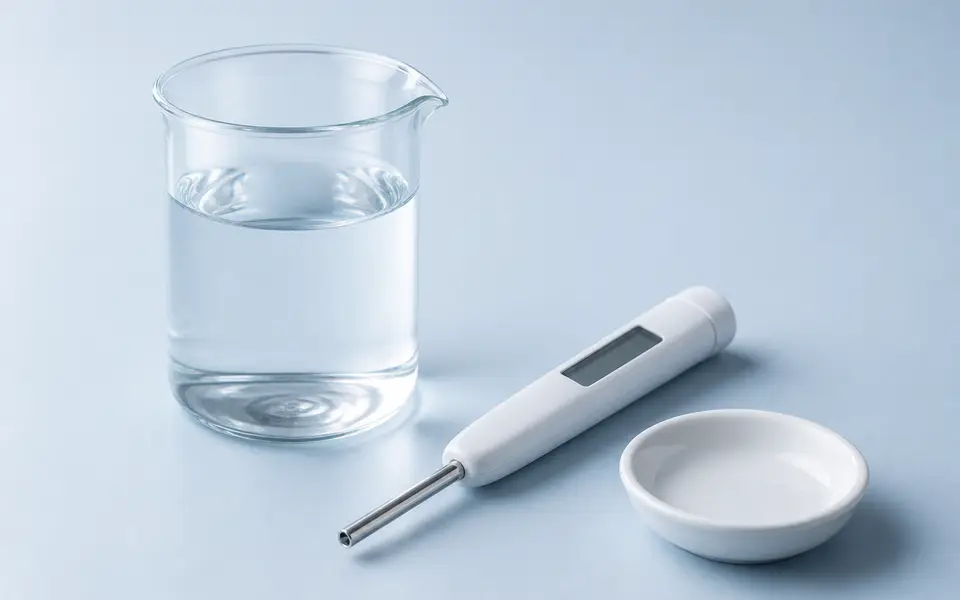
Home test strips and a TDS meter widen the picture, but they have to be read literally. A TDS meter measures electrical conductivity and converts it into a nominal dissolved solids figure: it will show whether there are a lot of salts in the water, but not which ones. Beneficial calcium and magnesium and unwanted sodium are all the same to the device, so a zero on the screen is not a top score, just very soft water.
The real picture comes from a report by an accredited laboratory: hardness, iron, nitrates, microbiology. For tap water it makes sense to have such a test done once, to find out whether you need a filter and which one. For bottled water the producer has already done it, and the only question is whether the producer is willing to show it when first asked.
In the end it all comes down to one habit: looking at the composition and the date, not at the bottle. Water whose origin and dissolved contents are known is fine for everyday drinking, whether it comes from the tap, a filter or a bottle. Everything else is decided by taste and by how convenient it is to have that water to hand.