





How children's water differs from ordinary water
It is not a sticker on a familiar bottle but a separate category with stricter standards. Its limits on mineralisation, hardness and sodium are tighter: in the first years of life a child's kidneys work at half capacity and clear excess salts less well than an adult's. Where adult table water has a range, children's water has a ceiling.
The second difference is disinfection. Chlorine is not used in this category at all: the water is treated by physical methods so that no smell and no by-products are left in the bottle. The third is batch control. Every bottling run gets its own lab report, and a decent supplier's report is fresh, not two years old.
- Total mineralisation — kept noticeably lower than in ordinary table water
- Hardness — calcium and magnesium are needed, but in moderate amounts
- Sodium — capped on a separate line of the report
- Nitrates and organic matter — stricter limits than for adults
- Disinfection — no chlorine, physical methods only
The bottle: material, cap, neck
Bottles for this category are chosen not by the picture on the label but by three things: what they are made of, how they close and what kind of neck they have. All three affect whether the water stays as it was bottled until the last sip.
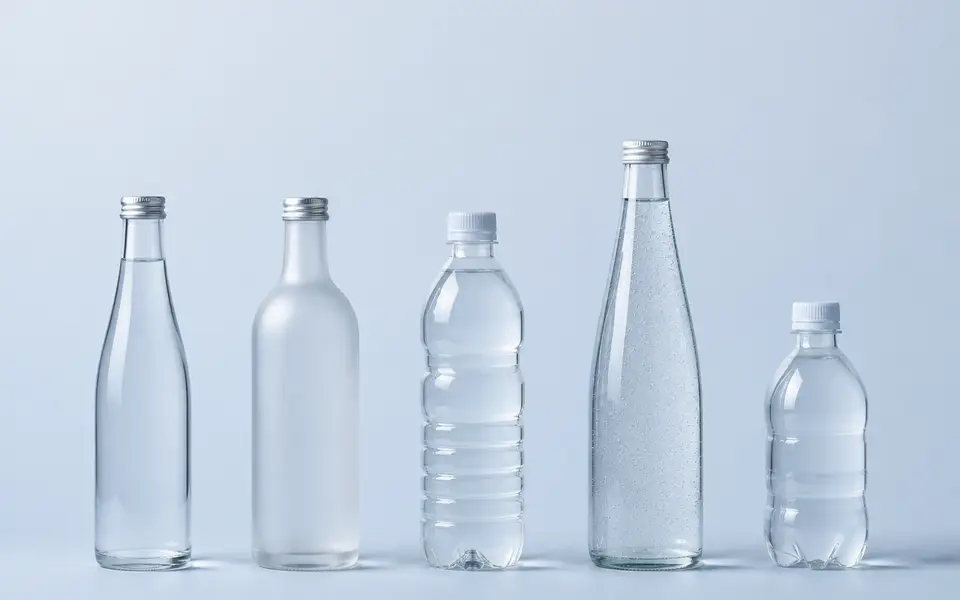
| Material | What makes it handy | What to keep in mind |
|---|---|---|
| PET, 0.33–1 L | Light, unbreakable, fits in a backpack | Dislikes heat: in the sun the bottle gives the water a smell |
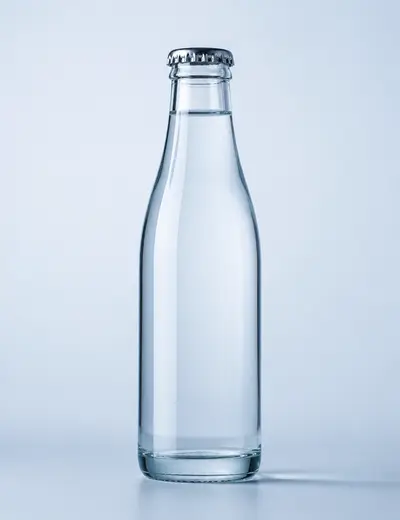
| Glass, 0.33 L | Gives nothing off into the contents, washes in hot water | Weighs three times as much and needs careful handling in transit |
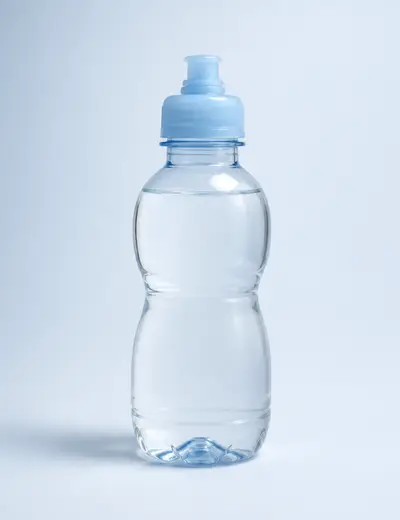
| PET with a sports cap | A child opens it alone and it doesn't leak in the bag | The valve needs rinsing — moisture stays inside it |
The cap matters more than it seems. An ordinary screw cap has a tamper-evident ring — the little band that tears off the first time you unscrew it. If it is missing or turns freely under your finger, the bottle has already been opened, and in this category that alone is reason enough not to take it.
Necks come narrow and wide. A narrow one is easier to drink from straight out of the bottle; a wide one makes it easier to pour into a sippy cup and make up food without spilling. A wide neck is also easier to rinse if you decide to reuse the bottle — although single-use bottles are not designed for that and have no second life.
A separate word on the marking on the bottom. The triangle with a number tells you what plastic the bottle is made of and whether it can be recycled. For water it is almost always the same number, and it is useful not for choosing but for sorting: an empty water bottle is one of the most straightforward kinds of recyclable.
Bottles here rarely exceed a litre, and the reason is explained below, in the section on small packaging. But they are hardly ever made smaller than a third of a litre either: a 100–200 ml bottle costs almost as much as a half-litre one and holds a single sip.
Another thing people only think about once they are home is the shape of the bottle. A faceted, slim one fits the side pocket of a backpack and doesn't fall out; a round one with a wide base stands steady on a table but won't go into a pocket. The difference seems trivial right up until the day the bottle slips out of the pocket on the way to nursery. If you are buying a month's pack, it is worth checking once where exactly this bottle will go every morning.
Drinking water for children: which figures to check
Three lines are worth checking. The first is total dissolved solids: for children's water it usually sits in the lower half of the drinking-water range. The second is hardness: water that is too soft tastes flat, water that is too hard leaves limescale and adds extra load. The third is the date of the analysis. A report older than three months says nothing about what is in the bottle today.
Our water comes from a 180 m well in the foothills of the Trans-Ili Alatau; mineralisation in the latest report is 220 mg/L, pH 7.2, hardness 1.8 meq/L, analysis dated 14.08.2026. We show the report on request in the chat — that is quicker than hunting for it on the website and more honest than promising a “perfect composition” in words.
| Line on the pack | What it means |
|---|---|
| Children's water, suitable from birth | The composition is suitable for making up formula without boiling |
| First category | Basic requirements for drinking water, not enough for a child |
| Premium category | Stricter on salts and organic matter — children's water is made to this one |
| Still and preservative-free | No carbonation, no silver and no carbon dioxide added for shelf life |
| Children's drinking water | The category is named outright, not hinted at with a picture on the pack |
What gets used instead: five common substitutes
Not everyone buys separate water for a child, and not straight away — people usually try to make do with what is already at home first. The substitutes vary, and each falls short of the category's requirements in its own way.
- Boiled tap water. Boiling deals with microbiology but does not change the composition: the salts stay, and with long boiling they become more concentrated. Boiling removes neither hardness nor nitrates.
- A filter jug. It removes chlorine and some of the hardness while the cartridge is fresh. People are bad at remembering when the cartridge is due, and a spent filter starts giving back what it has collected.
- Water from the cooler. In composition it is ordinary drinking water, and its figures are in the lab report. Its category is different, and the separate caps on sodium and hardness do not apply to it.
- Ordinary bottled water with a cheerful label. A picture does not create a category: if the back has no separate composition lines and no plain statement of purpose, what you have is simply drinking water.
- Table mineral water. Its total dissolved solids are higher than this category allows, and it is not taken for everyday drinking — it is a separate item with its own regime.
All five have one thing in common: they are not worse in themselves, they simply have not been tested against the standards the category was created for. The difference is not in taste or in how clean the bottle is, but in which set of parameters the water was released from the line against.
Whether a particular family needs a separate item is for the parents and the paediatrician to decide, not the delivery service. Our part of the conversation ends where the figures end: we name the category, show the batch report and never pass one water off as another.
A sixth substitute is rarer but deserves a line of its own: water from a jug in a café or from a cooler at a clinic, poured into your own bottle for the road. In itself it is no worse than water at home, but on the road it gets a different story — an open bottle without a cap, a warm backpack and a few hours of travel. The question here is not about the water but about how long it has stood open since.
Bottled children's water: why the bottles are small
It is almost always bottled in 0.33, 0.5 and 1 litre sizes, and that is not a seller's trick. Once opened, water keeps for a day or two even in the fridge: air gets in, and with it everything floating in the air. A 5-litre container opened on Monday and finished on Friday stops being children's water by Thursday, whoever's logo is on it.
Hence a simple calculation. A half-litre bottle costs 300 ₸, a litre bottle 310 ₸. Water for babies goes slowly: it is needed for formula, porridge and drinks between feeds, and a pack of litre bottles lasts a week. Once the child is older and drinks by themselves, half-litre bottles are handier: they finish one in a day and take it to nursery or to a club.
The bottle at nursery, at school and out and about
At home it is simple: the bottle stands in the kitchen, and once opened it lives in the fridge. The trouble starts when it goes off in a backpack for half a day.
- Label it. At nursery and in the lower school years there are a dozen identical bottles in a row, and a name written in marker on the label solves the problem faster than any stickers
- Don't leave it in the car. In summer the interior heats up to over fifty degrees, and the plastic gives the contents a smell that never goes away
- Don't refill an old bottle. Single-use bottles are not designed for refilling: there is nothing at home to clean the neck and valve properly
- Pack for the day's needs. Half a litre for half a day at nursery and a litre for a long walk: anything more the child will bring back untouched anyway
- Check the cap before heading out. A sports cap that isn't screwed on fully empties half the bottle into the backpack at the first turn
About temperature. An ice-cold bottle from the freezer doesn't go into the bag: while the backpack hangs on a shoulder it sweats and soaks the exercise books, and for the first half hour you can't drink from it anyway. A cool one from the fridge reaches lunchtime just as it was when packed.
Flask or bottle is a question of age and weight. A metal flask keeps drinks cool for half a day but weighs noticeably more and has to be washed every evening; a single-use bottle needs nothing and goes into the recycling bin. Before school a bottle is usually simpler; from the middle years on, a reusable one of their own that is filled at home.
A separate word about nursery. There water is more often poured from a shared container, and a bottle of their own isn't always needed — check the routine with the teacher before buying a month's pack in advance. At school it is the other way round: children drink whenever they like, and a bottle in the backpack saves both time and tuck-shop money.
A day trip is the third case, and it is worked out separately. Take not one big bottle but two or three small ones: an opened big one warms up halfway and gets finished reluctantly, while a sealed one waits its turn in the bag. Half-litre bottles are handier on a train or a plane, litre bottles with enough for the whole family in the car, and for the mountains the ones you don't mind carrying back empty.
It is worth planning for empty bottles on the trip too. A crushed bottle takes up a quarter of the space of a whole one in a backpack and travels to the nearest bin unnoticed. The habit forms faster than any talk about recycling: a child who crushed their own bottle and put it in the side pocket looks differently at litter by the path. On a mountain walk it is also a question of weight — you only carry back what you brought.
Mineral water for children: when it is fine and when it isn't
Still table mineral water is not off limits for older children, but it is not drunk every day: its total dissolved solids are higher than growing kidneys need. Medicinal table and medicinal waters are not given to a child at all without a doctor's prescription — they are not a drink but a remedy with a dosage.
A separate word on fizz. Children's mineral water is on sale, but it is rarely bought and almost always in its still version: carbonation irritates the stomach and makes it hard to tell how much the child has actually drunk. If there is still mineral water for children on the table, look at the same total dissolved solids line — it matters more than the word “children's” on the label.
Taste and temperature: why one bottle gets drunk and another doesn't
A child knows nothing about total dissolved solids but notices the difference between two waters faster than an adult. There are usually five reasons a bottle comes back from nursery full, and all of them are everyday ones.
- Temperature. Warm water tastes bad to almost everyone, while the same bottle from the fridge goes twice as fast
- The smell of the bottle. A bottle that has lain in the sun or next to household chemicals picks up a foreign smell, and the child refuses it before they can explain why
- Water that is too soft. With few salts there is almost no taste, and someone used to other water calls it flat
- Comparison with sweet drinks. After juice and fruit drinks, plain water loses by default for the first few days — a matter of habit, not composition
- An awkward bottle. A stiff cap and a wide neck put younger children off drinking before the first sip
So water for a child is chosen the same way as for an adult: buy two or three different ones and see which goes faster. By the figures the difference between brands in this category is small, but in taste it is there, and it usually comes down to the ratio of calcium to magnesium — the very things that make water hard.
There is also a trick that works better than any persuasion: keep the bottle in plain sight. One standing on the desk next to the exercise books gets drunk within a day without reminders, while one put away in a cupboard is still full by evening. Questions about drinking habits and how much to drink go to the paediatrician, but whether water is within reach is decided by how things are arranged on the table.
One last thing about taste: it changes with the vessel. From a thin glass water seems cooler and cleaner; from a plastic mug that last held a fruit drink, sweetish. If there are complaints about the water at home, start by checking the cups, not the brand: it costs nothing and explains everything half the time.
Switching from a familiar brand is noticeable too, usually for two or three days. It is not about the quality of the new water but about how people read the taste of water by comparison: any other water seems not quite right at first. So there is no point changing brand mid-week, when things are hard enough already — it is easier to wait until the pack runs out and start the new one fresh.
The small print on the pack: what to look for
The front of the bottle sells; the back is responsible for the contents. There are only a few lines, and all of them can be read in half a minute.
- Purpose. A plain line saying what the water is intended for is the first thing to look for: without it, nothing else counts
- Composition in figures. Total mineralisation, hardness and sodium — not “rich in minerals” but grams and milligrams per litre
- Disinfection method. In this category it is physical, and the word “chlorination” should not appear
- Bottling date and shelf life. The date is printed on the bottle itself or on the cap, not on a sticker over the label
- Storage conditions and the line on shelf life after opening — that is the one that tells you how long an opened bottle keeps
- Manufacturer and bottling address. The company on the label and the bottling site are not always the same, and it is useful to know that
A separate detail is where exactly the date is. With a conscientious producer it is embossed or laser-printed on the shoulder of the bottle or on the cap: a mark like that can't be re-stickered. A date on a paper sticker over the label is not a violation, but it is a reason to look more closely at everything else.
It is also worth knowing what cannot be on the pack. No water is allowed to print health promises: the permitted wording is the category, composition, purpose and storage conditions. Anything that sounds like a promise of results has nothing to do with it, whoever's typeface it is set in.
It is worth looking at the printing itself too. A factory label has straight edges, no glue oozing along the edge, and small print you can read without squinting. A crooked sticker, blurred letters in the composition and traces of glue along the edge are not proof of a fake, but they are a reason to ask about the bottling date and site before the pack ends up at home.
If the pack came from us, part of this work is already done: we name the item before the van leaves, and send the batch report to the chat on request. The habit of checking the back is still more useful than anyone else's word — the label speaks for itself and is quicker to read than this paragraph is to write.
Children's water at home: how much to buy and how to store it
A family with one child usually takes one pack a week plus a 19 L bottle for the adults — that is 1 490 ₸ per bottle when ordering 2 or more. There is no point stocking up: shelf life runs from the bottling date, and a fresh batch is always better than one that has been sitting around.
Storage is simple: a closed bottle stands in a dark place away from radiators and household chemicals; an opened one goes in the fridge for no more than two days. Children's water doesn't like the windowsill: in the light, in a warm bottle, whatever can grow there grows faster. Children's water in glass is more reliable in this respect than plastic — glass doesn't let light straight through and gives no smell to the drink — but it weighs noticeably more.
We put the order together in WhatsApp in a single message: how many packs, what size, where and when. Orders placed before 10:00 go out the same day, and you choose the delivery window — 9–13, 13–17, 17–21. Children's drinking water travels in the same order as the bottles, with no extra charge for it.