
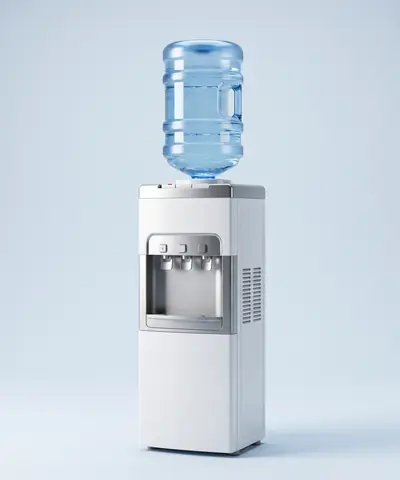
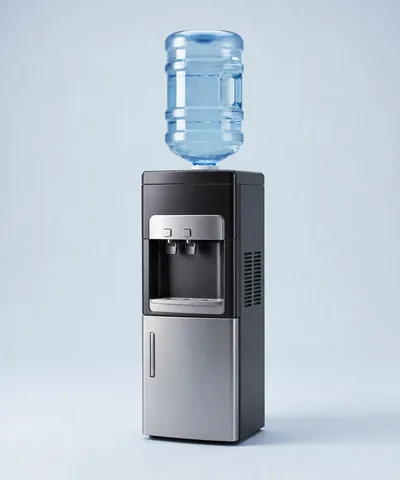
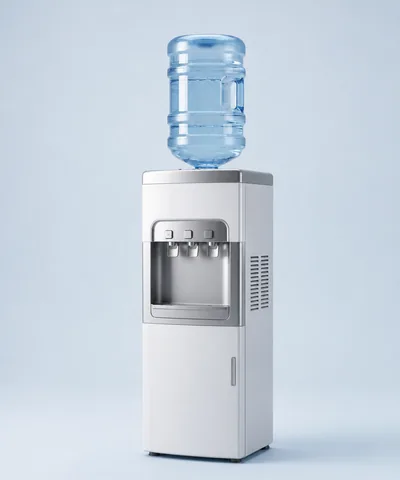


Water cooler with a fridge: two different things are sold under this name
The first is a cabinet with a cupboard: a door, a shelf, no cooling inside. Room for cups, tea, sugar and a packet of biscuits, nothing more. The second is a proper fridge compartment chilled by the same circuit as the water in the tank. The price difference between them is large, yet in shops both are called the same.
One question tells them apart: what temperature does the compartment hold. If the seller does not name it or says “cool” — you are looking at a cupboard. A model with a fridge compartment always lists the temperature in its specifications, because that is its main selling point.
There is also a third use of the name, more confusing than the first two. Some price lists use “fridge” for the way the water is cooled: a floor-standing unit with a compressor inside, that is, with a real refrigeration circuit, but no compartment at all. Its cabinet is empty. So do not ask about a fridge in general — ask whether there is a shelf behind the door and what temperature it keeps.
The rest of this page is about the second type. A cupboard without cooling is a nice extra, but not a reason to choose the unit: the same shelf costs less as any cabinet from a furniture shop.
Where the cold in the compartment comes from
There are two ways, and which one the unit has decides everything else: temperature, electricity bill and price. The first is that the compartment is chilled by the same compressor circuit as the water in the tank. The evaporator runs into the compartment wall, and it works like a small fridge because that is what it is.
The second is a separate thermoelectric module: a plate with one cold side and a fan blowing the heat out. Such a module is cheaper, lighter and quieter, but it cools relative to the room, not to a set temperature. In a cool office you will not notice the difference, but in July, when the room is near thirty, the compartment will simply be a little less warm than the air around it.
Three signs tell them apart, and all three are visible before you buy. Weight: a compressor model is noticeably heavier. Sound: a compressor clicks when it starts and hums in cycles, while a thermoelectric module's fan hums steadily and constantly. And the specifications: the first lists a temperature range in degrees, the second says something like “a few degrees below room temperature”, and that is an honest description, not a trick.
| What we compare | Shared compressor circuit | Separate module for the compartment |
|---|---|---|
| Temperature | set, independent of the room | a few degrees below room temperature |
| Weight and price | heavier and pricier | lighter and cheaper |
| Sound | clicks and hum in cycles | steady fan noise |
| In a hot room in summer | holds | warms up with the room |
| Switches off separately from the water | usually not: the circuit is shared | usually yes, with its own switch |
The shared circuit also explains the feature that surprises people most: on some models the compartment cannot be switched off without switching off the water cooling. There is one compressor and one circuit, and no switch can separate them. Models with a separate module usually have such a switch, and in summer it is used the other way round — the compartment is switched off to take load off the unit.
The door is the third part worth knowing about in advance. On a compartment built into a cooler it is light, with a magnetic or ordinary seal, and hangs on a low hinge. It is the seal, not the cooling power, that is most often behind the complaint that the compartment does not get cold: a one-millimetre gap along the edge cancels out any circuit, and you cannot see it without a sheet of paper.
Such compartments usually have no light inside, and people notice on the very first evening: they open the door in a dark reception area and feel around. There is no lamp not to save money — in a twenty-litre space it becomes a source of heat itself, and the room a light fitting would take is worth more than the light it would give.
What fits in the compartment and what does not
Such a compartment holds about twenty litres, with one shelf, sometimes two. By height it takes half-litre and one-litre bottles, cans and a lunch box. A saucepan, a cake or a large box will not fit because of their dimensions, not the volume: the compartment is narrow because it follows the width of the cooler body.
- Water and drinks in small bottles — what the compartment next to the tap is for.
- Milk and cream for the coffee machine: kept to hand instead of fetched from the kitchen.
- One person's lunch box, fruit, yoghurt.
- Medicines that need to be kept cold — if the compartment has a clear temperature and is not just a cupboard.
- No model has a freezer: this kind of cabinet never has a freezing section.
Medicines deserve a separate word because people ask about them often. Medicines whose instructions require storage between two and eight degrees go in here only if the compartment really holds that temperature and you have measured it. A cupboard without cooling or a thermoelectric module in a hot room does not meet that requirement, and the cost of a mistake here is higher than a spoilt lunch.
Measuring such a compartment by volume is almost pointless: twenty litres sounds solid, but what matters is not the volume but the height from the shelf to the top of the compartment and the width of the body, which in a cooler is inevitably small. So before buying, look not at the litre figure but at two measurements inside — the height of the compartment and the gap between shelves if there are two.
| What goes in | Does it fit | How |
|---|---|---|
| 0.5 litre bottle | yes | standing, in a row along the front |
| 1 litre bottle | usually yes | standing, if there is one shelf |
| 1.5 litre bottle | usually not | only lying down, and it takes up the whole shelf |
| Carton of milk | yes | standing, by the back wall |
| Lunch box | yes | one, on the shelf |
| Cake, saucepan, watermelon | no | too wide for the cooler body |
Floor-standing water cooler with a fridge: what temperature it keeps
The compartment holds roughly what the bottom shelf of an ordinary fridge does, and often a little warmer. Compressor models give deeper, steadier cold; models with a Peltier element depend on the room temperature: in hot weather the compartment warms up with the room.
There is one practical conclusion, and it matters more than any figures in the specifications. Food with strict storage requirements — meat, fish, dairy for several days — should not go in there: the door is opened often, the volume is small, and the temperature recovers slowly after each opening. Milk for today — yes; a week's supply — no.
Checking all this is easier than asking the seller. Ask them to switch the unit on, after an hour put a glass of water in the compartment, and an hour later measure it with a thermometer. The figure in the specifications describes laboratory conditions and an empty compartment; the glass shows what you will actually get.
One more consequence of the shared circuit: the compartment and the water tank share one supply of cold. In hot weather and when the door is opened often, the unit works on whichever part has warmed more, and on such days the water from the tap can be noticeably warmer than usual. Models with a separate module never have this problem, but their compartment is weaker — the gain in one place is paid for in another.
Why have one in an office
There is exactly one argument, and it is about space. A separate fridge means a metre of floor, its own socket, its own noise and the endless discussion of who defrosts it and throws out someone else's lunch. A unit with a compartment takes up the same floor area as an ordinary floor-standing cooler and runs from the same socket.
That is why such models most often end up where there is no kitchen at all: in a reception, a meeting room, a private office, a small studio or salon, a security desk, a showroom. In an office with a full kitchen, the compartment under the tap usually stands empty within a month.
A short check helps you tell in advance whether the compartment will be useful. The more points match, the higher the chance it will not stand empty in a month:
- There is no kitchen on the premises at all, but water, milk for coffee and someone's lunch are needed every day.
- There are few people — up to five, and each person's lunch fits in one box.
- Sockets and space are scarce: there is nowhere to put two units instead of one.
- The premises are rented and the equipment will have to be moved: one unit is easier to move than two.
- Guests are usually offered cold water, and a separate fridge in a hall or showroom looks out of place.
And one practical remark without which the compartment in an office turns into a dump within a month. There are no shelves for each person, the volume is small, and only one rule works: what goes in in the morning comes out in the evening. Written on the door, it holds noticeably better than when said aloud at a meeting.
How this model differs from an ordinary floor-standing cooler
The main difference is not the taps but the fact that the cabinet is occupied. From this follows something product listings do not mention: such a model never loads from the bottom — the bottle goes on top and is turned upside down, because the space below is given to the compartment. You can choose either the compartment or a bottle in the cabinet, but not both.
The second consequence is weight and electricity. The compartment adds mass, and one person can no longer move the unit alone. It runs continuously, like an ordinary fridge, and not every model lets you switch it off separately from the water.
Such a model is the same size as an ordinary floor-standing one, but it needs more clearance. The grille at the back now carries heat away from both the water and the compartment, so a hand's width from the wall is not enough: leave about ten centimetres, and the same above if there is a shelf over the unit. It cannot be built into a kitchen niche at all — there it will heat itself from both sides.
| What we compare | Ordinary floor-standing | With a fridge compartment |
|---|---|---|
| What is in the cabinet | empty, or the bottle with bottom loading | a compartment of about twenty litres |
| Bottle loading | top or bottom, your choice | top only |
| Price guide | from 29 990 ₸ | from 60 000 ₸ |
| Electricity | used only for the water | the compartment runs continuously |
| Moving it alone | possible | heavy, better with two people |
The third consequence concerns repairs. With an ordinary unit, a cooling failure means warm water; with a compartment model the same failure also means a thawed lunch. There are more parts, and each is a reason to call a technician. Part of the price difference pays for this too, not just for the compartment and the door.
Looking after the compartment and what goes wrong in it
A compartment in a cooler wears differently from a kitchen fridge because it lives in a different mode: it is opened less often and loaded less, but it usually stands somewhere warmer — by a window, in a reception, next to other equipment. Hence the list of what needs attention.
- The door seal: close a sheet of paper between the door and the body — if it pulls out without effort, the seal has sagged.
- The back wall of the compartment: drops and light frost on it are normal, a thick layer of ice is not.
- The drain hole, if there is one: when blocked, it leaves a puddle under the bottom shelf.
- The shelf and its supports: plastic becomes brittle in the cold, and a cracked shelf drops its contents.
- The cooling grille at the back of the unit: it is shared by the compartment and the water, and dust on it hits both at once.
Such a compartment is defrosted rarely and not by the calendar but by the look of the back wall. Every few months it is switched off for a couple of hours, left to thaw, wiped dry and closed only once the inside is dry: a closed damp compartment picks up a smell within a day. If there is no frost at all, there is nothing to defrost — it means the door is being closed firmly and nothing warm is put inside.
Smell is the main complaint about such compartments, and it almost always has one cause: the volume is small, there is no ventilation, and there is open food inside. Milk in an opened carton, yesterday's lunch without a lid, half a piece of fruit — in twenty litres you notice it immediately, and within a day it gets into the walls. Everything put inside must be covered, and that is not a matter of tidiness but of volume.
And what shortens the life of the whole unit. Warm food inside makes the circuit run longer, and on most models the circuit is shared with the water tank — so everything else overheats along with the compartment. Put lunch in once it has cooled, keep the door open for seconds, not minutes, and the unit will last as long as it should.
The compartment is cleaned the same way as a fridge: warm water with baking soda and a soft cloth, no abrasives and no solvents — its plastic is thin and scratches easily. The seal is wiped separately and dried: a fold where water is left turns black first, and it is replaced not as a separate part but together with the door.
Water cooler with a fridge price: why the range is so wide
In Almaty retail these coolers start from 60 000 ₸ and go up to 74 500 ₸ in our catalogue — these are shop prices, not our own price for a specific model. The range on the market is wide for exactly the reason this text began with: one search line brings up both a cabinet with a cupboard and a proper compartment with a compressor. Comparing prices only makes sense once you have found out what is actually inside.
For comparison: an ordinary compressor unit without a compartment costs from 54 000 ₸, and a model with a bottom-loading pump from 36 990 ₸. We give the exact price of the model we have in stock right now in the chat: our fleet changes, and there is no point in misleading you about availability.
There is a third reason for the range — the second-hand market. Compartment models are often sold off with an office when it moves, and in listings they sit next to new ones at half the price. They cannot be compared with retail directly: such a unit has two lifespans, water and cold, and the second cannot be seen from outside at all.
The scale of the difference is this. A cabinet with a cupboard adds little to the price of an ordinary unit: a door, a hinge and a shelf. A proper compartment adds a whole unit, and in money it is comparable to an inexpensive separate fridge. So a model with a compartment almost never comes out cheaper than an ordinary cooler plus a small fridge — people buy it for the space and the single socket, not to save money.
Buying a water cooler with a fridge: new or second-hand
A new unit comes with a warranty, installation and the first sanitising, and this is exactly the case where the second-hand market saves less than it seems. A second-hand unit has two weak spots: the compressor, whose remaining life cannot be seen from outside, and the hygiene of the compartment and tanks, about which the previous owner will tell you exactly as much as they remember.
If you buy a used one, do two things before the first glass: order sanitising of the tanks and taps, and keep the compartment empty with the door closed for an hour to see whether it cools at all or only looks like a fridge.
The inspection itself takes an hour and consists of five steps:
- Switch it on and let it run for an hour: the compartment should become noticeably colder than the room, not just stop being warm.
- Check the door seal with a sheet of paper all the way round, not at one point.
- Look behind the back wall: oil stains near the compressor are a sign of a refrigerant leak.
- Smell the compartment and both taps: a smell that does not go after washing stays for good.
- Check whether the compartment has its own switch: some models do not, and it is better to know before buying.
And one point not about the machine but about transport. A unit with a compartment is heavy, and getting it from the previous owner is harder than with an ordinary cooler: two people, with the door secured, otherwise the hinge will break at the first doorstep. It must not be carried lying down, and after being transported upright it is left to stand for a few hours before switching on — just like any fridge.
Water for this cooler
A unit without water is furniture, so the last point in order is the first in importance. Bottles cost from 1 490 ₸ each, delivery across the city is free from 2 bottles per order, the bottles are returned, and the deposit for them is 3 500 ₸ for PET and 4 500 ₸ for polycarbonate. We do not charge for cooler sanitising and installation as separate services. Message us on WhatsApp with where it will stand and how many people use it — we will pick a model and work out the water for a month.