





1.5 litre water — the fridge-door format
The 1.5 litre bottle is made for a specific spot, and that spot is the fridge door. It fits in almost any model, doesn't stop the door from closing and comes out with one hand while the other holds a cup. A 2 litre bottle already pushes against the door, and a 5 litre one will never fit there.
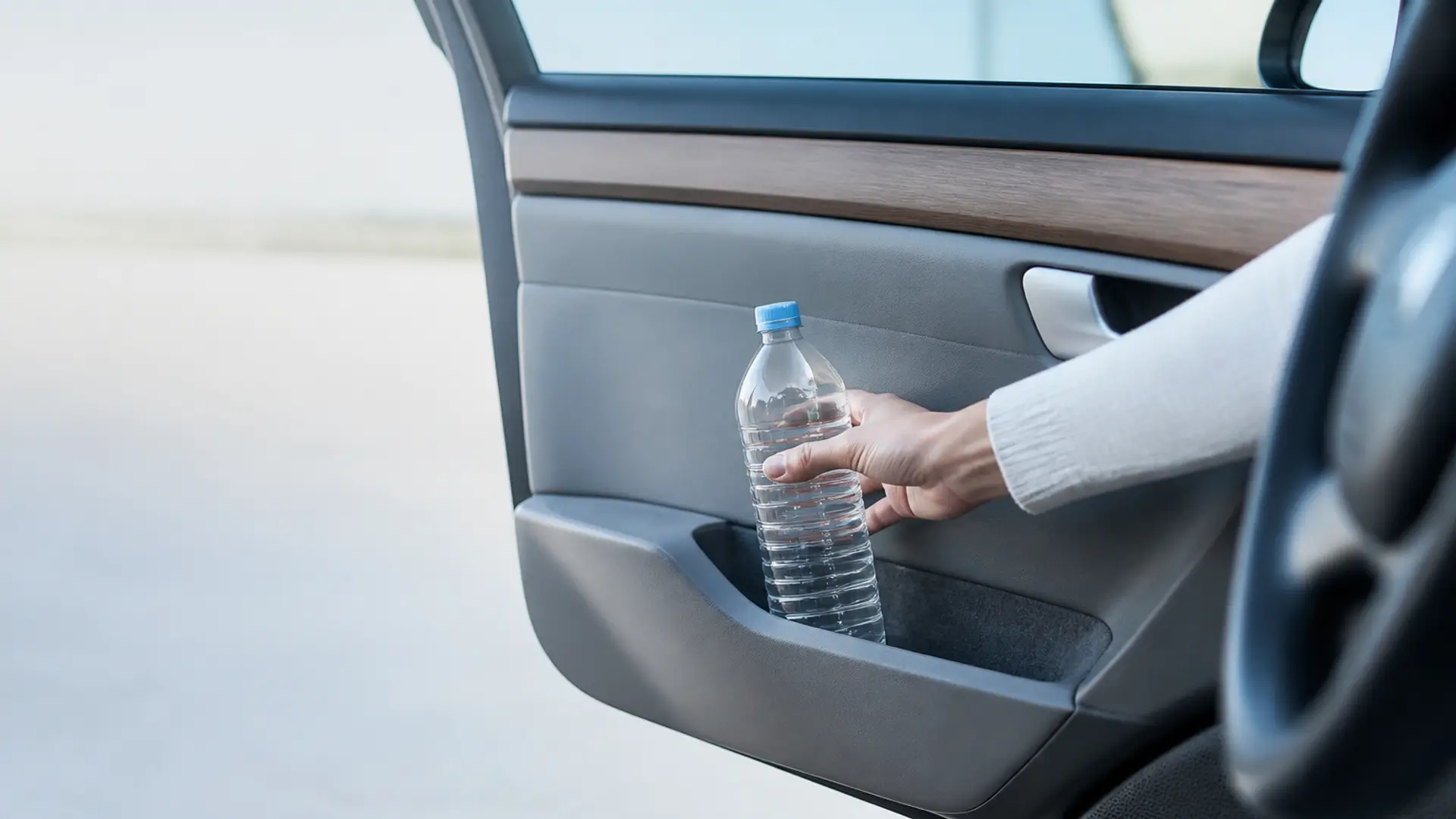
The second such spot is the car door pocket and the cup holder between the seats. One and a half litres is the upper limit of what stays put there and doesn't fall over on a bend. That is the whole point of the size: it is a bottle that stands where you reach for it, not where there happened to be room.
Our 1.5 L water comes from the same artesian well as the cooler bottles. Same bottling line, same lab tests, same taste. What changes is the bottle — and with it the routine: a big bottle goes on once a week, a 1.5 litre one comes out of the fridge ten times a day.
What one and a half litres means in numbers
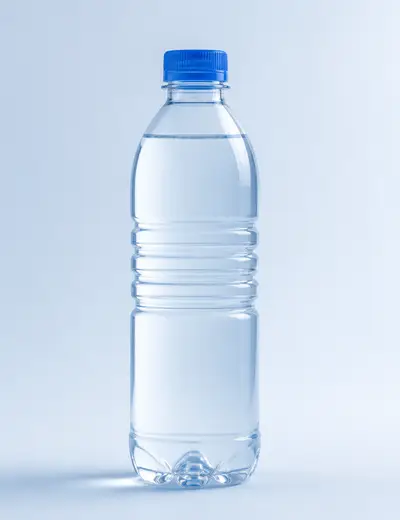
The 1.5 litre bottle is the most standardised of all household bottles. Height varies between manufacturers by two or three centimetres, diameter by one, and the neck is the same everywhere: twenty-eight millimetres for a screw cap. Because the neck is shared, other caps, sports spouts and drinking attachments fit it, and that is a property of the format, not of a particular brand.
An empty bottle weighs thirty to forty grams, and the whole economics of the size sits behind that figure. A thin wall is cheaper, but it also dents in the hand, doesn't hold its shape when empty and doesn't survive frost. A full bottle weighs a little over one and a half kilograms: one and a half is the water, the rest is the bottle, the cap and the label.
| Parameter | Typical value | What follows from it |
|---|---|---|
| Height | about thirty centimetres | stands upright in the fridge door |
| Diameter | eight to nine centimetres | stays in the car door pocket |
| Neck | twenty-eight millimetres | standard caps and sports spouts fit |
| Empty weight | thirty to forty grams | the thin wall dents and does not like frost |
| Full weight | a little over one and a half kilograms | can be lifted with one hand at any age |
| Material | PET marked 1 | single-use, but accepted for recycling |
The ribbed rings on the sides are not decoration. They hold the shape when the bottle is gripped in the middle and stop it from collapsing under the weight of the upper rows in a pack. For the same reason the base is petal-shaped: five feet spread the load better than a flat circle, and the bottle stands level even on an uneven shelf.
A cap with a tamper ring is the only sign that the bottle has not been opened. The ring itself stays on the neck after opening, so look not at the ring but at the little bridges: on a sealed bottle they are intact. The bottling date is on the label or stamped on the shoulder, and you can read it without a magnifying glass.
The colour of the bottle tells you something too. Clear PET is cheaper and shows the water, but it doesn't block light; the bluish tint of the wall, sometimes mistaken for an additive in the water, is a dye in the plastic itself that cuts a little ultraviolet. It does not affect the taste, and affects how long the bottle keeps in the light only slightly.
The label also lists the composition: mineralisation, hardness, source. For water from one well these figures are the same whatever the bottle, so the 1.5 litre bottle and the 19 L bottle differ in volume and price per litre, not in what is inside.
One and a half litres in the hand
This size has the best grip of all the larger bottles. One and a half kilograms can be held by a child and by an older person alike, and the waist of the bottle under the fingers lets you pour a glass without supporting the base with the other hand. With two litres that is already harder, with five it is impossible without resting the bottle on something.
Hence a simple rule for a household with different people in it: if children and older family members will be pouring, take 1.5 litres, even if a bigger size is cheaper. A bottle that is awkward to lift just stands there full and unused.
One more small thing people notice later: one and a half bottles a day is about six glasses, and that kind of count is easy to keep in your head. A full two bottles a day at this size means almost a litre above the usual norm, and that is already a hot summer or a workout.
The cap is a separate story. A twenty-eight millimetre screw cap opens with two fingers, and that matters where small bottles with a tight cap get carried to the kitchen with a request for help. If someone at home has a weak grip, check the cap before ordering a pack: the thread is the same everywhere, but the force needed to break the seal differs between manufacturers.
Pouring from a 1.5 litre bottle into a carafe is easier than it seems, and people often do it: the water goes onto the table once, and the bottle goes back into the fridge door. Glasses are filled from the carafe, the neck of the bottle touches neither dishes nor lips, and the opened water is gone by the end of the evening instead of standing half-open for three days.
One and a half litres on the go: car, bag, gym
The road is the second most common use after the kitchen, and it has different demands. In a car the bottle sits in the door pocket or between the seats, and it matters that it doesn't fall over on a bend or sweat so much that water runs down the trim. One and a half litres is a good limit here: a 2 litre bottle doesn't fit the door pocket of every car, and a 5 litre one doesn't fit at all.
In an Almaty summer the inside of a closed car heats up to sixty or seventy degrees, and the water in it turns warm within half an hour. You can drink it, but keeping a supply there for weeks is not a good idea: heated plastic gives off a smell, and it stays in the water. It is more practical to carry one bottle and swap it, and keep the supply at home.
In a backpack or a gym bag, one and a half litres is already the limit of what is reasonable. People take a bottle like this to a long workout, a weekend hike or a one-way trip to the dacha. For everyday carrying, half a litre or a litre is more convenient: a backpack with a 1.5 litre bottle pulls onto one shoulder, and you feel it by the second stop.
- Car door pocket and cup holder — a good fit: the bottle stands and doesn't fall
- Everyday backpack — too big, take half a litre or a litre
- Long workout, hike, a day at the dacha — a good fit, one is enough
- School bag — no: one and a half kilograms is too much for a child's back
- Office desk without a cooler — a good fit, covers a working day with some to spare
A word about children. A child will carry a 1.5 litre bottle from the kitchen to the table, but not to school — there is no reason to add one and a half kilograms to the textbooks. At home, though, it works better than small bottles: it doesn't get lost, isn't forgotten on a windowsill and isn't opened five at a time in an evening, as happens with half-litre ones.
1.5 litre water for a family: how much you need for a week
It is easier to count your supply in weeks rather than days: that is how long an average delivery order lasts. The guide for plain drinking water is about one and a half litres a day per adult, less for children, more for everyone in summer.
| How many people | Plain drinking water per week | 1.5 L bottles |
|---|---|---|
| One adult | about ten litres | seven |
| Two adults | about twenty litres | fourteen |
| Family of three | about twenty-five litres | seventeen |
| Family of four | about thirty litres | twenty |
The last row of the table is where the format ends. Twenty bottles a week means two trips with boxes and a bucket of empty plastic, and at this point families usually switch to big bottles: one nineteen-litre bottle covers almost the whole weekly supply, and the empty goes back to the courier instead of piling up at home.
The table assumes an even year, and a year is never even. In the Almaty heat consumption rises by about a third, and a family that managed on fourteen bottles takes twenty in July. In winter the figure drops: part of the norm goes into tea and soup. So look not at the calculation but at how fast the pantry empties in the second and third week.
Guests are counted separately and always rounded up. An evening with ten people uses three or four bottles on water alone, not counting tea. If the event is planned, it is easier to add a pack to your usual order than to look for water near home on the day.
A pack for the week: weight, carrying in and space
Hardly anyone buys this size one bottle at a time: it comes in shrink-wrapped packs, and it is easier to count in packs. A pack usually holds six bottles — nine litres and about nine kilograms including the plastic. We tell you in the chat how many bottles a particular batch has: the wrap depends on the manufacturer, and a number written on the page would one day differ from what arrives.
Nine kilograms is a weight you carry in one hand and not far. You hold the pack by the wrap between the bottles, and by the third floor without a lift the plastic starts cutting into your fingers. That is why the courier carries the packs into the flat rather than leaving them at the entrance, and that is also why it is worth giving the floor straight away in your order.
- Tell us the floor and whether there is a lift — that decides how long carrying in will take
- Clear space in advance: one pack takes up roughly a pantry shelf
- Open the wrap where the supply will be kept, not in the hallway
- Put one or two bottles in the fridge straight away and keep the rest sealed
- Crush the empties and screw the caps back on — uncrushed they take up more room than full ones
Space for the supply is found in advance, and it is not a trifle. Twenty bottles for a family of four is three packs, and three packs will not fit in the fridge door or on the balcony shelf with the plants. The usual answer is the bottom shelf of the pantry or a kitchen cupboard that gets no sun and has no radiator next to it.
If you take a supply regularly, it is easier to agree on a day of the week. Then the packs arrive before the last bottle runs out, and you don't have to keep double the volume at home just in case — and it is exactly that double supply that eats the space and later makes people give up on the format.
It is easier to tell when to order by what is left than by the calendar. The working sign for 1.5 litre bottles is an opened pack: while three or four bottles remain in the wrap, there is plenty of time for delivery, and the order comfortably lands in a convenient window. There is no need to wait for the last one: small bottles travel on the same run as the big ones, and their delivery follows the day's route, not your fridge.
Where the 1.5 litre bottle loses
An honest word about the downsides. This size is the most expensive way to buy a lot of water: you pay for each separate bottle, cap and label, and there are one and a half litres of water in it. While we are talking about a supply in the fridge door, you don't notice; once the count reaches tens of litres, the difference becomes noticeable.
- A lot of water on a regular basis — a 19 L bottle with a pump or a cooler is cheaper
- Water on the road for a whole day — take two litres, one bottle covers the daily norm
- Water in your hand and in your bag — that's half a litre, 1.5 litres is too big for a pocket
- Cooking and a supply for water outages — larger bottles from five litres
A separate cost is the caps, labels and wrap you pay for along with the water. At twenty bottles a week that is twenty caps, twenty labels and twenty separate packing operations at the plant, and all of them are already built into the price of the bottle. In a 19 L bottle the same work is spread over nineteen litres at once — that is where the difference in price per litre comes from, not from the quality of the water.
And one more thing people rarely think about when buying: empty 1.5 litre bottles take up almost as much room as full ones. If you are not going to take them for recycling, twenty bottles a week become a separate household chore.
One and a half litres next to the neighbouring sizes
With small bottles, the size is chosen not by price per litre but by the place it goes and the hand that holds it: the difference in money on one bottle is small, while the difference in convenience shows every day. Below are the same formats, sorted by task rather than by price list.
| Size | Where it fits | Who pours | When to choose it |
|---|---|---|---|
| 0.5 L | bag, backpack, cup holder | anyone | water with you for a few hours |
| 1 L | work desk, backpack, fridge door | anyone | a day at the office without a cooler |
| 1.5 L | fridge door, car door | children and older people too | kitchen and road, where different people pour |
| 2 L | fridge shelf | an adult | the daily norm in one bottle, the kettle |
| 5 L | bottom shelf, car boot, kitchen corner | an adult, two-handed towards the end | a supply for several days without a cooler |
The table is easier to read from the bottom up. Larger bottles win while one person pours and does so rarely. As soon as the bottle is picked up ten times a day by different people, the one that is easy to lift wins. One and a half litres sits exactly on that line, and that is why it is bought more often than its neighbours.
There is also a mixed option that many people arrive at. A 19 L bottle with a pump stands in the kitchen and covers the main consumption — drinking at home and cooking. The 1.5 litre bottles live next to it and go where the big bottle can't: into the car, to work, on a walk. In this pair the cheap litre and the handy bottle don't compete, they share the job.
Storage, shelf life and empty bottles
A sealed bottle keeps for a long time: the best-before date is on the label and is measured in months. It is not time that spoils water but conditions — sun, heat and being next to household chemicals. Clear PET doesn't block light, and a bottle that has spent the summer on a windowsill picks up a taste it didn't have on bottling day.
Frost is a particular enemy of thin bottles. When it freezes, water expands by roughly a tenth of its volume, and a thirty-gram wall is not designed for that: the bottle splits at the seam or the base bulges out. So a balcony in winter is the worst place for a supply, even though it looks the most convenient — it's cold there and it doesn't take up the kitchen.
- Direct sun: a clear wall gives no protection, an aftertaste appears within a few weeks
- Radiator and underfloor heating: heated plastic passes a smell into the water
- Frost on the balcony: ice expands and splits the thin wall
- Next to washing powder and solvent: the smell passes through the wall
- Drinking from the bottle and then storing it: an opened bottle stops being sterile from the first sip
An opened bottle is kept in the fridge and finished within a couple of days. This rule is not about the quality of the bottling but about the fact that with every sip air gets inside, and with it everything that was in the air. For the same reason water from a bottle someone has drunk from is not poured into the kettle or left on the table until tomorrow.
We don't take the empty bottles back: small bottles carry no deposit and don't go back to the line. PET marked 1 is accepted at the city's recycling points. If you crush each bottle straight away and screw the cap back on, a family's weekly supply turns into one small bag instead of half a balcony — the very downside of the format mentioned above.
How to order 1.5 litre water in Almaty
Send us the number of packs and your address on WhatsApp. We deliver small bottles together with the big ones: delivery in the city is free from 2 bottles per order, delivery windows are 9–13, 13–17, 17–21, day off Sunday. Orders placed before 10:00 go on the same day's run.
If you need 1.5 litre bottles regularly and without big bottles, tell us straight away: for a standing volume we plan the route and the day of the week separately, and that works out cheaper than delivering a pack every time the water runs out.
Three things help with an order: how many packs, where to and which floor. Everything else — the delivery window, payment, confirmation — is sorted out in the same chat in a couple of messages. If you haven't settled on the amount yet, tell us how many people live at home: the weekly supply from the table above takes a minute to work out, and it makes sense to base the first order on the lower end and see how long it lasts.