
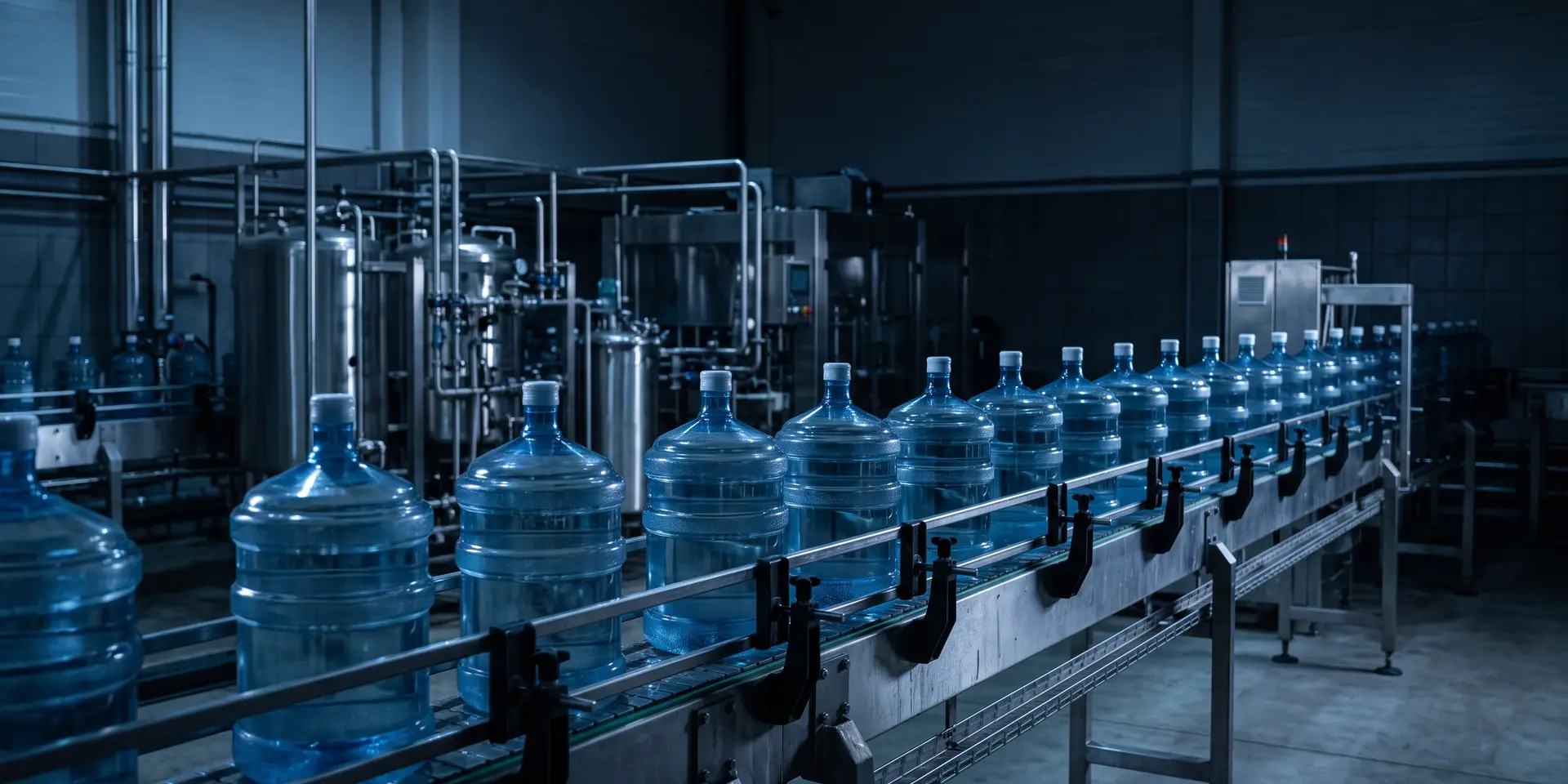






Water has almost nothing to describe it. A bottle looks the same everywhere, the numbers on the labels are similar, and you end up choosing by things no product card mentions: how many bottles to order, what happens to the empty ones, why there is a deposit on them and how polycarbonate differs from PET. This text covers exactly those points — the ones where the short answer on the page above is not enough.
There is no advertising here. The prices in this article are the same as in the price list above: you can check them against any section.
The order is this: first volume and how to work it out, then the deposit and the bottles, then prices, delivery and quality. Each section stands on its own, so there is no need to read straight through: if all you care about is the deposit or choosing a cooler, go straight there.
How many bottles a home or an office needs: a calculation instead of a guess
The first question when switching to bottles is the same for everyone: how many to order. It takes two steps. At home, allow 2 litres per person per day; in an office, 1 litre per person per working day. Then divide the total by 19: that is how many litres a standard bottle holds, and the 19 litre bottle remains the main format for both the kitchen and the meeting room.
The arithmetic almost always overshoots. By the formula, a family of three should drink 180 litres a month — nearly ten bottles — yet in practice they get through four or five. The reason is simple: soups, tea, fruit and juice cover part of the need, and the physiological 2 litres are not two litres drawn from the cooler. So treat the calculation as a ceiling, not a shopping plan.
| Scenario | Calculation | By the formula | Usually in practice |
|---|---|---|---|
| Family of 2 | 2 × 2 L × 30 ÷ 19 | 6–7 bottles | 3–4 |
| Family of 3 | 3 × 2 L × 30 ÷ 19 | 9–10 bottles | 4–5 |
| Family of 4 | 4 × 2 L × 30 ÷ 19 | 12–13 bottles | 6–7 |
| Office of 5 | 5 × 1 L × 22 days ÷ 19 | 5–6 bottles | 5–6 |
| Office of 10 | 10 × 1 L × 22 days ÷ 19 | 11–12 bottles | 10–12 |
| Office of 30 | 30 × 1 L × 22 days ÷ 19 | 34–35 bottles | 30–34 |
Unlike the home figure, the office one matches practice: at work people drink more evenly, with no competition from the kettle and fridge at home. In summer the office rate goes up by about a quarter, while in August it drops — holidays and remote work show up in what is left on the cooler better than any bookkeeping.
Real consumption becomes clear after two or three weeks. A sensible start is to order for that period and see how fast it goes; ordering too little is no disaster, as more can be brought quickly. Water delivery is free on orders of 2 bottles or more, so there is no point splitting orders into small batches — it is cheaper to bring a week's worth at once.
Allow extra for guests separately. Budget one and a half to two litres per guest for an evening: a dinner for fifteen means one or two extra bottles, and a children's party more, since children reach for plain water more often than adults. If you are on a delivery schedule, it is easier to warn us about a one-off increase a day ahead than to order express on the day of the party.
It is easier to tell when to reorder by what is left than by the calendar. At home, the signal is the second unopened bottle: while it is still standing there, you have time, and the order comfortably fits a convenient window. In an office, the reserve is one bottle above the weekly rate — it covers the day when the route has shifted or the headcount suddenly grows with visitors and contractors.
The bottle deposit: why it exists and when you get it back
The deposit worries first-time customers: it looks like a hidden charge. In fact it is a refundable amount for the container itself and has nothing to do with the price of the water. The water in the bottle is the product; the bottle is the supplier's returnable property that simply stands in your kitchen for a while.
A polycarbonate bottle is reusable: it is washed, disinfected, inspected and refilled — dozens of times over. Each one has a number and a history, so on return you can see that it is the same bottle and what has happened to it. Without a deposit, bottles would simply stay with customers and the whole cycle would grind to a halt.
The amounts are fixed: 4 500 ₸ for polycarbonate and 3 500 ₸ for PET. The difference reflects lifespan: polycarbonate is built for repeated washing, PET for a single use. The deposit does not grow with the size of the order: it is the same for the first bottle and the tenth.
Returning a bottle is simple. You do not need to wash an empty one or store it separately: the courier takes it at the next delivery and leaves a full one. If you decide to stop ordering, just let us know a day ahead — the courier will collect the bottles and the deposit is refunded in full. The only thing that cancels it is a chipped neck or a crack: such a bottle cannot be treated and put back into use. Minor scratches on the body do not affect the deposit.
Bottles are most often damaged not on the road but at home. Two typical cases are a drop while putting it on the cooler and storing it on a balcony in winter: in the frost, polycarbonate turns brittle. Keep bottles somewhere cool, out of direct sun and away from radiators, and the deposit question will never come up.
Changing supplier is a separate story. Someone else's bottle stays someone else's: no service will accept it, because bottles are tracked by number and handled on the owner's own line. So when you switch, you first return the old bottles and get the deposit back, and only then place the first order. You can keep bottles from two services at home, but there is no point: the deposit is tied up twice, and you still have only one cooler.
Polycarbonate, PET and volume: bottled water in two kinds of container
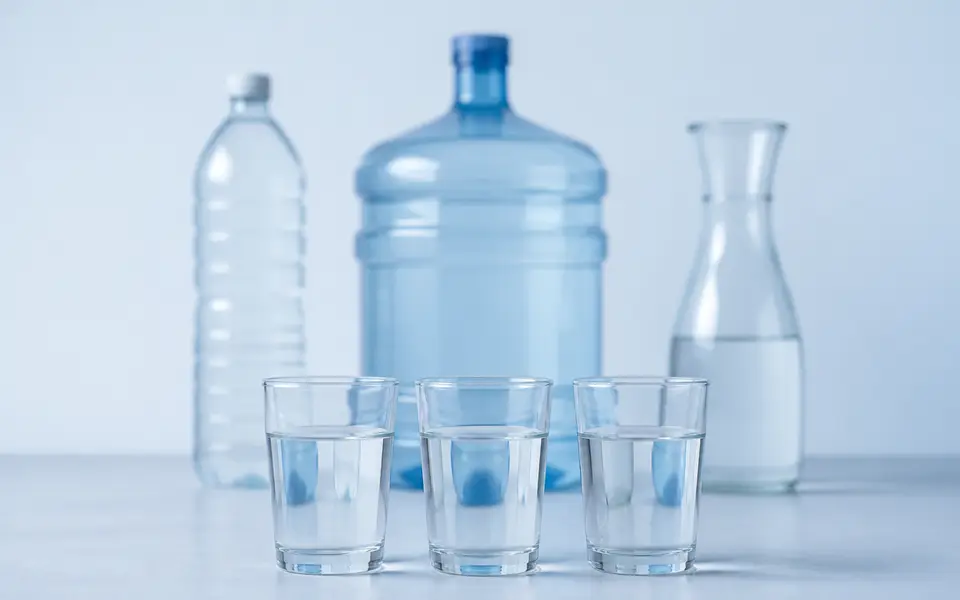
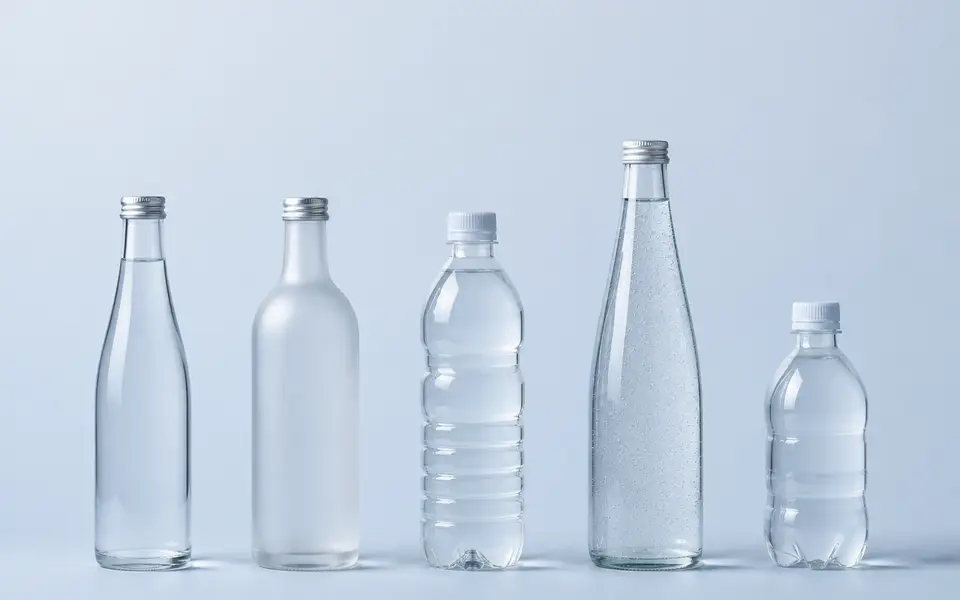
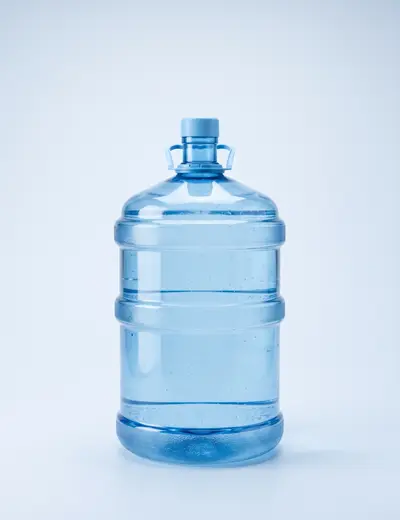
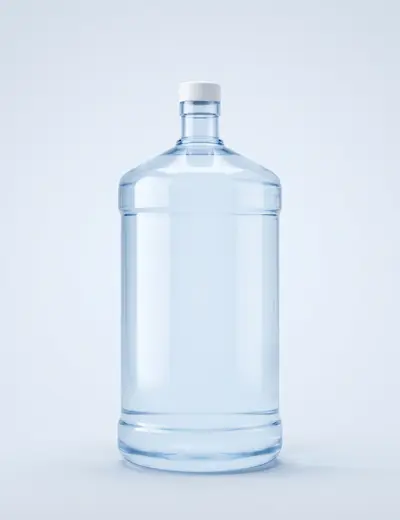
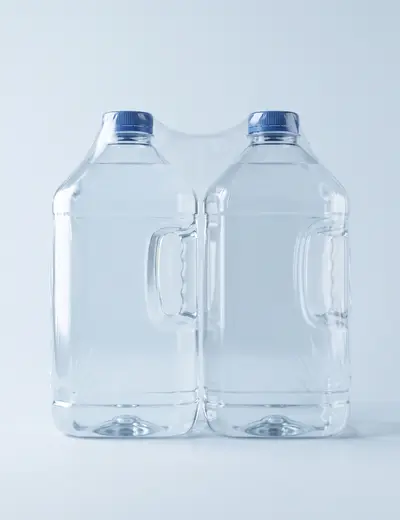
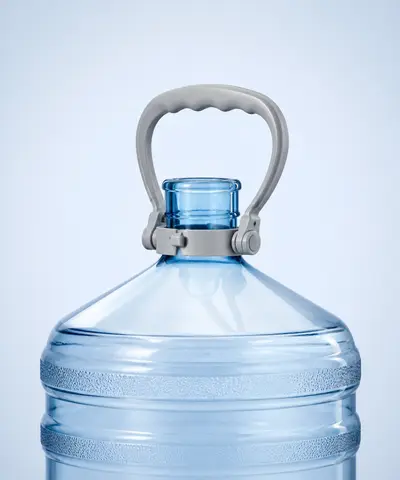
Bottled water arrives in one of two kinds of bottle, and the choice between them is not about water quality but about how you use it. Polycarbonate is sturdier and stays in circulation: it is washed on the line, checked for chips and hairline cracks, then refilled. PET is lighter and carries a smaller deposit, but it deforms with heat and is not designed for many cycles — after use it goes for recycling.
| Feature | Polycarbonate 19 L | PET 19 L | Water 5 L |
|---|---|---|---|
| Deposit | 4 500 ₸ | 3 500 ₸ | none |
| Use | returnable | single-use | single-use |
| Sanitising | on our line | not needed | not needed |
| Fits a cooler | yes | yes | no |
| Best for | steady consumption | one-off order | car, dacha, reserve |
| Price | 1 490 ₸ from 2 bottles | 1 490 ₸ from 2 bottles | 530 ₸ per bottle |
For a home or office with steady consumption, polycarbonate is the more practical choice: the deposit is higher, but there is no bottle to dispose of, and its condition is the supplier's responsibility. For a one-off purchase for an event, PET is more convenient — it does not have to be returned or kept until the courier comes.
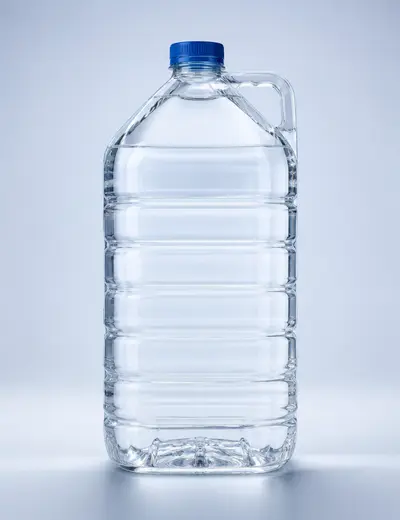
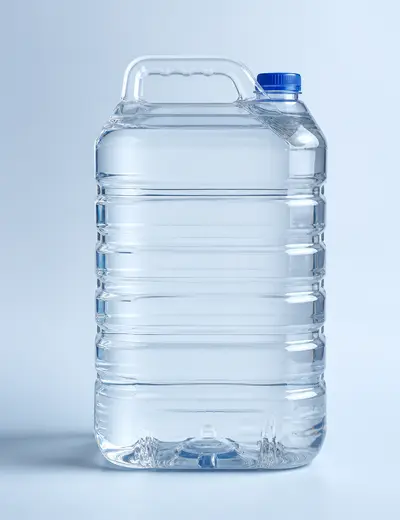
Volume is chosen the same way, by how you will use it. A 19 L bottle is a quarter to a third cheaper per litre, but it needs a cooler or a pump: tipping nineteen kilograms over by hand is awkward. A 5 L bottle is not a substitute but a companion — for the car, the dacha or a cupboard reserve for when the main bottle runs out early.
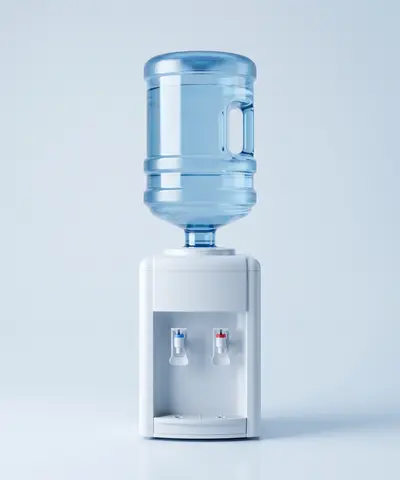
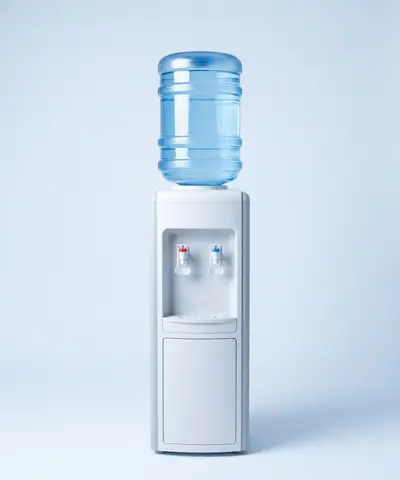
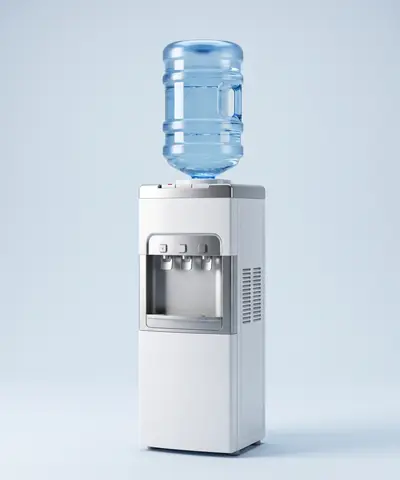
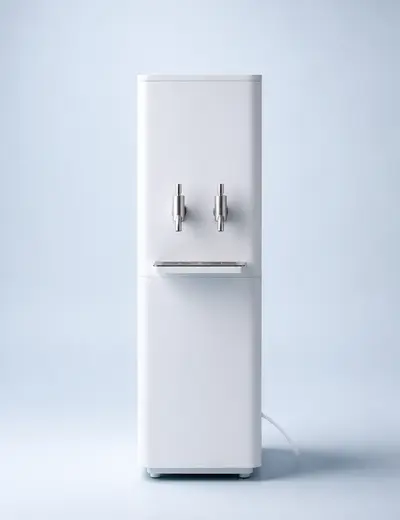
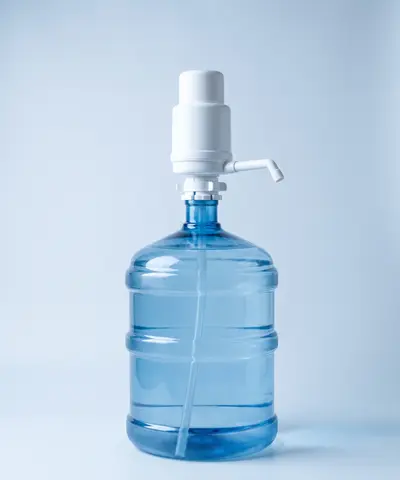
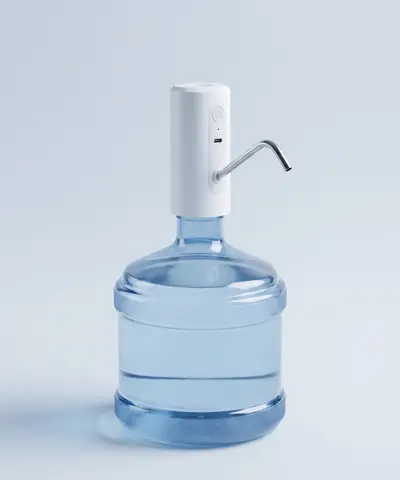
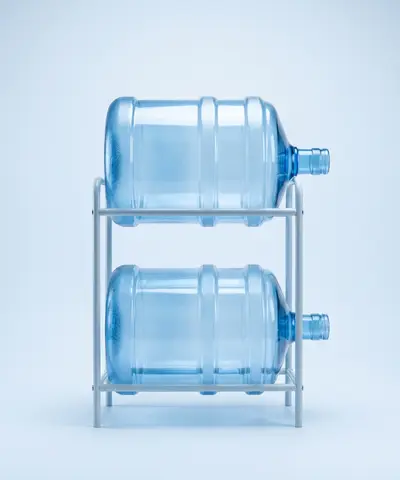
Choose a cooler by the number of people. A desktop cooler suits one or two people and a kitchen where a floor-standing model would take up the whole corner; a floor-standing cooler holds the bottle without a stand and keeps the water cold under constant use. Rental is 1 500 ₸ per month for a desktop cooler, 2 500 ₸ for a floor-standing one and 3 500 ₸ for a compressor model, and with 15 bottles a month or more the rental is free. If you do not need a cooler, a pump will do: a mechanical pump costs 4 500 ₸, an automatic one 8 900 ₸, and with a first order of 4 bottles or more the pump comes free. For empty and full bottles there is a bottle stand at 7 900 ₸ — it settles the question of where to keep them all.
An opened bottle lasts longer than people think, but not forever. On a cooler with a sealed intake, water keeps comfortably for two or three weeks, less in hot weather. It is not time that spoils it but air and warmth, so do not put the bottle by a window or next to a radiator, and keep the spares somewhere cool. If the water has stood for over a month and picked up an aftertaste, the cause is usually not the water but the cooler's tank.
Prices: what makes up the bill and where it comes down
The price of a bottle depends on the size of the order, and the ladder is simple: 1 590 ₸ for one, 1 490 ₸ from 2 bottles, 1 420 ₸ from five and 1 350 ₸ from ten. Delivery is a separate line: from 2 bottles it is free, and for a single bottle it costs 500 ₸. So the gap between ordering one bottle and two is bigger than it seems: the second works out cheaper than the first.
If your consumption is steady, coupons are cheaper: 25 / 50 / 100 prepaid bottles at a fixed price that never expire. Prepayment locks in the price for the whole amount — seasonal changes to the price list do not touch bottles already paid for. If your consumption jumps around, it is simpler to order water as needed from 2 bottles and not tie up money: the price still drops with the size of a single delivery.
The third format is regular scheduled delivery. It is not about a discount but about not having to watch what is left: the courier comes on a fixed day, brings the right number of bottles and takes away the empties. For an office of ten, it is the only arrangement in which nobody goes around asking who is ordering water today.
We are a direct supplier: we bottle water from our own well, look after our own bottles and deliver with our own couriers. There is no third-party commission in the price — that is the whole difference between a supplier and a middleman who passes the order on. One question settles it: does the company have its own bottling and its own stock of bottles, or does it only take orders?
When budgeting, remember the deposit. It is charged for every bottle that stays with you, so a reserve of five bottles is also money sitting idle. A home usually needs one spare, an office two or three, so as not to run dry on a day when the route has shifted.
Payment is accepted in three ways, and the choice depends on who is ordering. A private customer finds it easiest to pay the courier on the spot — in cash or by transfer, once the bottle is already on the cooler. For an office, an invoice is more convenient: it is issued to the company, paid by bank transfer and closed with the paperwork. Coupons are paid once in advance, and each delivery then simply deducts bottles from the balance.
Water delivery in Almaty: timing, windows and zones
Delivery in Almaty rests on three things: the route, the delivery window and the return of empty bottles. Routes are built by district rather than order by order, so an order placed before 10:00 goes out the same day, while one placed later joins the next round. We deliver Mon–Sat 9:00–21:00, Sun — closed.
A delivery window is not “sometime after lunch” but one of three slots: 9–13, 13–17, 17–21. We confirm it in the chat before the courier sets off, and that is the only promise worth making: nobody can name the exact minute in a city with traffic like ours. When you need water right now, there is express delivery — up to 59 minutes across the city.
People search for the same thing in different words: water delivery Almaty, Almaty water delivery, order water Almaty — the wording varies, the task is the same. Behind it is a simple request: for the bottle to arrive at a clear time and be carried into the kitchen, not left at the building entrance.
We deliver to every district of Almaty — from Almaly and Medeu to Nauryzbay and Alatau. The suburbs are handled separately: we go there for orders of 4 bottles or more, and agree the route when confirming the order. Couriers are assigned to districts, so they know the courtyards, the entry phones and that the bottle has to be carried into the kitchen, not left on the landing.
Over twenty years the word “water carrier” has changed its meaning: it used to mean a tanker truck, and now it means a service that brings bottles on a schedule and takes away the empties. That also changes what to ask when ordering: not “how much per cubic metre” but which window they will come in, whether the couriers are their own and what happens to the bottles.
Companies need paperwork more than a schedule. The contract, invoice and closing documents are drawn up before the first delivery, the price is fixed in the contract, and the delivery itself runs on the same route as private orders. For the accounts department this settles the reporting question; for the office manager, the question of who exactly will turn up on Monday morning.
The courier does more than hand over a bottle at the door: they carry it up to your floor, put it on the cooler and take the empty bottle away — this is part of delivery and is not charged separately. Because of that, a visit takes a few minutes rather than thirty seconds, and the route allows for it. If the building has no lift or the van cannot get into the courtyard, mention it when confirming the order: the visit time will shift, but the bottle will still end up in the kitchen.
Quality: what to look for in a lab report and how to check a supplier
Water quality cannot be judged by taste — that is what a laboratory report is for. Our water source is a 180 m well in the foothills of the Trans-Ili Alatau, and three of its parameters are shown in the section above: mineralisation 220 mg/L, pH 7.2 and hardness 1.8 meq/L. The date of the analysis is given there too, and it is not a formality: a report older than three months says nothing about today's bottling.
- Mineralisation: the total salt content. Low means soft water with no aftertaste and no deposit in the kettle or cooler.
- pH: acidity. A value around seven is neutral, what we are used to for everyday drinking.
- Hardness: what causes limescale. The lower it is, the longer appliances last.
- Report date: the fresher the document, the closer it is to the water on your cooler.
Well water and water after reverse osmosis are different products. The first keeps its natural composition; the second is close to distilled water, and minerals are added back artificially after filtration. Neither is “bad”, but it is worth knowing what goes into the bottle before your first order, not after.
Cooler water depends not only on the bottling but also on the bottle. A reusable bottle without proper sanitising ruins quality faster than any source: a container with traces of previous use starts to smell of plastic within a week. So ask about how bottles are treated just as you ask about the source.
- Source: their own well, water brought in, or treated tap water — the answer should be specific.
- Report: recent, dated and with figures; it is shown before you buy, not after.
- Bottles: how they are washed, what they are disinfected with, whether each bottle has a number and a history.
- Couriers: in-house or hired — both the schedule and the condition of the bottles depend on it.
- Paperwork: whether the supplier is ready to work with a company and provide closing documents.
The check takes about fifteen minutes and saves months. A vague answer about the source, a report without a laboratory signature or a refusal to show the document — any of these is a reason to look for another supplier. A confident supplier publishes the figures without waiting to be asked.
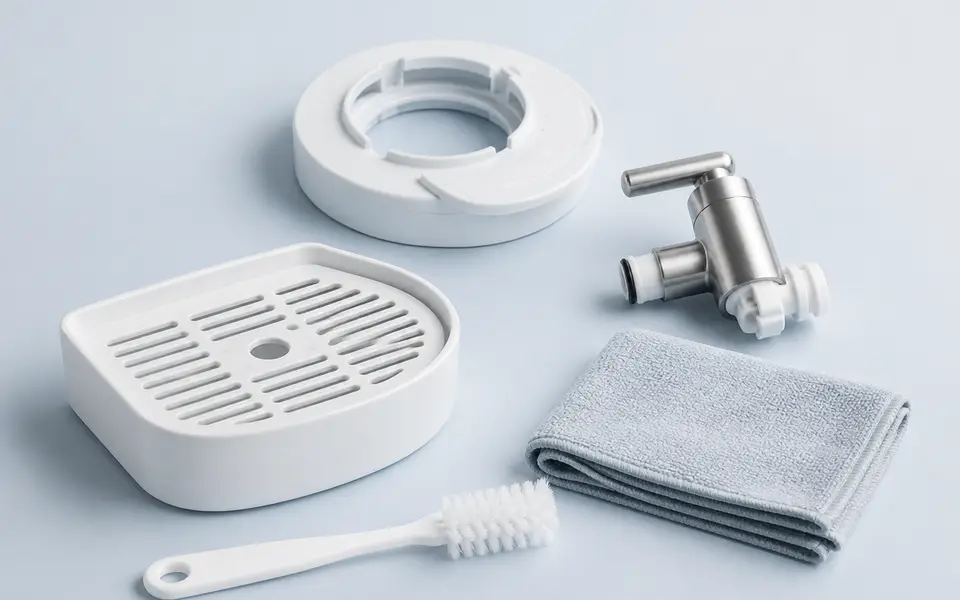
The cooler needs attention too. It is cleaned every two or three months, more often in an office with heavy use: in a warm tank and taps, microorganisms multiply within days. The signal for an unscheduled clean is simple — a stale aftertaste with a fresh bottle. If it appears, the cause is almost always the equipment, not the water.
Take delivery of a bottle more carefully than it seems you need to. An intact seal on the neck, a legible bottling date and no chips or cracks on the body — three things you can check in ten seconds that head off almost every later question. If any of them is wrong, it is simpler not to accept the bottle: the courier will swap it from the van or bring a replacement on the next run.
The main points in brief
If you remember only a few things from this whole text, let them be these.
- Volume: the formula gives a ceiling, not a plan. Real consumption shows after two or three weeks, and the schedule is built around it.
- Deposit: it is not a charge but a refundable amount for the bottle. You get it back in full if the bottle is intact.
- Bottles: polycarbonate for steady consumption, PET and 5 L bottles for one-off needs and reserves.
- Price: it drops with the size of the order, and prepaid coupons lock it in for the whole period.
- Quality: the source, a recent lab report and bottle sanitising — three questions worth asking before your first order.
Everything else — windows, confirming the delivery time, returning empty bottles — is sorted out in a couple of messages. Prices for bottles and equipment are in the price list above, a rough estimate for your own consumption is in the calculator, and if it is easier to ask — message us and we will answer.