

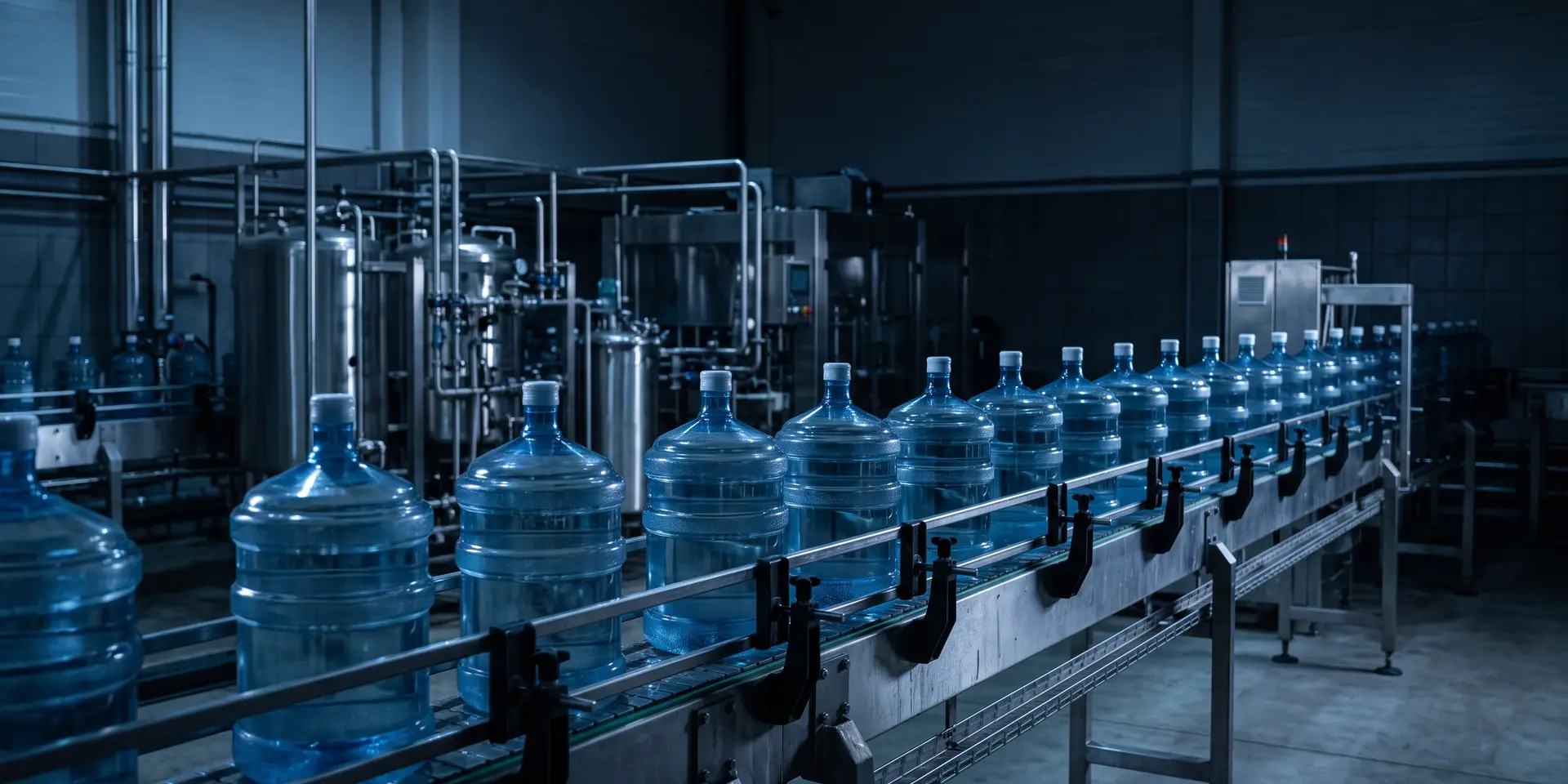






Wholesale drinking water: where the discount starts
Wholesale starts earlier than people tend to think. The bottle price drops from the second unit and then goes down in steps: from five bottles per delivery and from ten per delivery. Ten bottles is roughly a week’s supply for an office of twenty people, so we are not talking about a warehouse or a lorry, just an ordinary regular order.
The bottom step for a single delivery is 1 350 ₸ per bottle. Below that the price goes only with coupons, and that is a different mechanism: not a one-off volume but a prepaid stock.
- From 2 bottles delivery within the city is free; this is the basic condition for everyone
- From 5 bottles per delivery: the next price step
- From 10 bottles per delivery: 1 350 ₸ each
- Coupons for 25 / 50 / 100: a fixed price for a prepaid volume
- Suburbs: from 4 bottles, with the route agreed in advance
What that means in bottles: working out the volume for your site
A wholesale order starts not with the price but with the volume: until consumption is worked out, any discount is just talk. The calculation is the same for everyone: a litre per person per working day in an office, twice as much where the work is physical or hot, and then the total is divided by the 19 litres in a bottle.
| Site | People | Litres per week | Bottles per week |
|---|---|---|---|
| Office | 10 people | about 50 | three |
| Office | 30 people | about 150 | eight |
| Office | 60 people | about 300 | sixteen |
| Café with 40 seats | staff and guests | about 250 | thirteen |
| Warehouse or workshop | 15 people | about 150 | eight |
| Building site in summer | 20 people | about 400 | twenty-one |
Guests and meetings usually do not make it into the calculation, yet they drink a noticeable amount. In a company with many visitor days, about a tenth is added to the office norm: that covers water on the meeting-room table and the cups people carry away with them. For a venue the same thing is calculated by seating and by average bill rather than by headcount.
The office figure usually matches reality: people at work drink more evenly, with no competition from the kettle at home. On a building site, in a workshop or in a café, though, consumption follows the weather and the workload: in the heat it grows by half, and between seasons it falls. So a site with variable consumption gets a schedule set by the upper limit, not the average.
In any case, the first month is calculated from actual use. We take the estimated figure, deliver it and watch how fast it goes: after three or four deliveries the real consumption is clear, and a permanent schedule is built around it. Underestimating is not a problem: it is easier to bring more than to deal with a stock that has nowhere to go.
It is also worth counting by water points, not just by heads. A company over three floors with a cooler on each one drinks more evenly than the same company with a single point by the entrance: where the walk is long, people drink less and buy bottles in the shop with their own money. That is why the starting estimate tends to be closer to the truth where the water stands next to the workplace.
The weekly figure also tells you the price step straight away. Three bottles a week means twelve a month, that is, single deliveries on the ladder; sixteen a week is already a volume at which it makes sense to consider a coupon and a regular run. The whole difference in the bill lies between these two situations, not in the discount percentage.
Bottled water wholesale: coupons and the price ladder
A coupon is a set of prepaid bottles at a fixed price. You pay once, then simply message us in the chat when to bring the next batch. It never expires: use it up in a month or in six months, and the price per bottle stays what it was on the day you bought the coupon.
| Coupon | Price per bottle | Total |
|---|---|---|
| 25 bottles | 1 450 ₸ | 36 250 ₸ |
| 50 bottles | 1 390 ₸ | 69 500 ₸ |
| 100 bottles | 1 330 ₸ | 133 000 ₸ |
The difference between the one-off ladder and a coupon is simple. The ladder counts the volume of one delivery: bring ten bottles at once and you reach the step. A coupon counts the volume over the whole period, so it gives a lower price even to those who take three bottles once a week. For an office with steady consumption a coupon is almost always the better deal.
Delivery schedule and who keeps track of it
The main point of regular purchasing is not the price but the fact that the water stops running out. An order placed when the water is gone is always a day or two late: the empty bottle is noticed in the morning, the order goes out in the afternoon, the van arrives in the evening or the next day, and all that time the office drinks tea from the kettle. A schedule removes this story entirely.
- We work out weekly consumption from the first month’s actual use, not from a norm
- We set the day of the week and the window in which the van arrives
- The courier brings the calculated volume and takes the empty bottles on the same visit
- Once a month we reconcile: how much was delivered, how many empty bottles came back, how much is left on the coupon
- The volume or the day can be changed with a single message when staff numbers or the season shift
Usually there is nobody on the client’s side to keep track of this, and that is fine: water is not on the office manager’s to-do list until it runs out. So we do not ask to be reminded; we keep the schedule ourselves and come on our day. All we need from you is to tell us if something has changed, and that is one message, not an order form.
The season shifts consumption more than any calculation. From June to September demand grows by about a quarter, while in August it drops instead: holidays and remote work show up in the leftovers better than any accounting. Venues have their own wave: a summer terrace doubles consumption, and closing it in October brings it back to the winter figure.
Sites with several addresses are a separate case. A café chain, branches, or a warehouse with an office count as one order and one volume, but each point has its own schedule: where consumption is twice as high, the van comes twice as often. The documents stay the same, and the price per bottle is calculated on the total volume, not on the smallest point.
A spike between runs is covered in two ways. The first is a reserve: one or two bottles over the weekly norm that stay on site so you are not left without water on a day when the route has shifted. The second is an unscheduled run: a single delivery within the city ordered before 10:00 goes out the same day, and if water is needed right away, there is express delivery in 59 minutes.
Wholesale water delivery in the city and out of town
Within the city delivery is free from 2 bottles, so any wholesale order travels without a separate charge for the van. An order placed before 10:00 goes out the same day, and you choose the window: 9–13, 13–17, 17–21. If the volume is large, it is better to agree the day in advance: for twenty bottles or more we send a separate van, and it is easier to put it into the schedule than to squeeze it into the current route.
Out of town we deliver from 4 bottles: building sites, warehouses and suburban offices fall into this group. We discuss the route and the day in the chat: the suburbs are served by arrangement, not on the first call, and it is fairer to say so straight away than to promise an hour.
Bottles at volume: turnover, deposit and tracking by number
At volume, empty bottles become a job of their own. Twenty bottles on site means twenty refundable deposits and twenty containers that have to be kept full somewhere and put down empty somewhere else. With two bottles at home the question does not arise; from ten or so it appears by itself, and it is solved not by talking but by a routine.
The deposit is refundable and fixed: 4 500 ₸ for a polycarbonate bottle and 3 500 ₸ for PET, regardless of the order size. With a large fleet this is a noticeable sum, but it is not an expense, it is frozen money: when the bottles come back, the deposit is returned in full. It turns into an expense only where bottles have been broken or lost, and that condition is set out in the supply contract, not decided on a whim.
It is worth agreeing separately who signs for the delivery. On a site with a checkpoint or at a warehouse this is usually not the person who ordered the water, and the delivery note goes nowhere. It is enough to give the name and phone number of the person receiving it once: after that the courier asks for them rather than searching for someone to hand the papers to.
Tracking is by number: each container is assigned to a specific address from the moment it is delivered there. So at the end of the month you can see how many bottles you are holding, and reconciling against that figure takes a minute. It also settles the most common dispute in regular supply: how many bottles are assigned to whom and how much deposit is held.
Storing full bottles on site is a question of the same kind. Bottles go in a dark, cool corner, not next to a radiator or under a window, and no more than two high: polycarbonate holds such a stack, PET folds under its own weight. A bottle stand removes the question entirely and also takes the bottles out of the walkway where people trip over them.
The exchange is one for one: as many full bottles as are delivered, that many empty ones are collected. Empties usually pile up for one reason: they get carried around offices and floors, and by the time the van arrives nobody has managed to gather them. The cure is a single collection point by the entrance or the lift: then the exchange takes the courier the same five minutes as at a flat.
How to order wholesale water and what a company receives
An order goes through WhatsApp in one message: the volume, the addresses and how often to deliver. We reply with a volume price and a schedule. You can buy bottled water wholesale without a contract too, paying on delivery in cash or by transfer, but companies usually need a different set.
- A supply contract for a set volume and term
- An invoice and accounting documents for each batch
- Electronic delivery notes and a reconciliation at the end of the month
- Several delivery addresses in one order
- Coolers for your sites and free rental with orders from 15 bottles a month
A word on equipment. A wholesale client is usually not sold a water cooler but has one installed: delivery, installation and sanitising are part of the service, and rental with a regular volume costs nothing. Working out whether buying pays off only makes sense with a very large number of points.
On the invoice and the delivery note the item is named the way accounts departments are used to seeing it: bottled water wholesale, with the bottle volume and quantity. It is a small thing, but it removes half the questions at reconciliation: the line in the document matches the line in the order, and nobody has to work out what “drinking water” arrived last Thursday.
Coolers and water points on site
Equipment on site is counted not by headcount but by the number of points where people come for water. Sixty people on one floor are served by one floor-standing cooler by the kitchen; the same sixty on three floors need three points, otherwise people walk up the stairs for water and in the end stop going at all. The rule is simple: no more than forty steps from the workplace.
- Desktop cooler: meeting room, private office, kitchen for two or three people; rental 1 500 ₸ per month
- Floor-standing with electronic cooling: shared kitchen and corridor; 2 500 ₸
- Compressor: where water is drawn continuously and cold is always needed; 3 500 ₸
- Bottom-loading cooler: if the staff change the bottles themselves rather than a porter
- Pump: warehouse, site cabin, a site without a socket; a mechanical pump costs 4 500 ₸
When supply is regular, there is usually no reason to buy equipment. Rental starts from 1 500 ₸ per month, and with orders from 15 bottles a month it costs nothing; it also covers delivery, installation and sanitising. Buying from 34 900 ₸ pays off only where there are many points and the fleet is kept for years, and even then servicing has to be ordered separately.
Sanitising an office cooler goes in the calendar rather than being done on a whim: every two or three months with normal use and more often where water is drawn continuously. In a warm tank and in the taps microorganisms multiply within days, and a stale taste from a fresh bottle almost always points to the equipment, not the water.
Working out whether a purchase pays off makes sense in one case: when there are many points and they stay for years. Then two figures are compared: the monthly rental for the whole fleet and the cost of owning the same fleet plus servicing. With ten points the difference becomes noticeable in two or three years; with two or three, rental always wins, because it also comes with replacement equipment in case of a breakdown.
The spot for a water point is chosen in advance, and that saves reinstalling it. A cooler needs a socket, half a metre of free floor and a passage that does not block a door; nearby it is worth leaving a corner for a spare bottle and for the empties. A bottle stand for 7 900 ₸ solves this for two or three bottles and gets them out from under people’s feet.
Buying bottled water wholesale: small bottles and packs
Wholesale is not only nineteen-litre large bottles. Cafés, hotels and event organisers more often take small bottles in packs: half a litre for the table, a litre for a hotel room, glass for a banquet. The price of such a batch depends on the number of packs and the brand, so we quote it in the chat rather than posting a list, otherwise the list would be out of date within a month.
You can buy water wholesale in one order combined: some in large bottles for the cooler, some in packs of small bottles. There is no need to split it into two orders on different days: everything comes in one van and is covered by one set of documents.
What to ask a supplier before the first batch
A one-off purchase can be made blind, a regular one cannot: the supplier becomes part of your working day, and changing them midway costs more than choosing once. The check takes about twenty minutes and consists of six questions, each of which must have a specific answer.
- Their own bottling line and their own bottles, or someone else’s water resold under their name
- A lab report that is recent, with a date and figures, not a certificate from years ago
- Their own couriers or hired ones: both keeping to the schedule and the condition of the bottles depend on it
- What the contract says about breakage, lost bottles and a missed delivery
- Who cleans the coolers, how often, and whether sanitising is part of the service
- How the volume is counted for delivery to several addresses: in total or per point
A vague answer to the first question costs more than all the others. An intermediary passes the order on and cannot keep to a schedule: their own supplier may cancel a run, and the one answering to you will still be them, with words. The sign is simple: a direct supplier has their own bottling line, their own fleet of bottles and their own vans, and names them without hesitation.
Switching suppliers works the same way for everyone, and the order of steps matters more than speed. First the old bottles are returned and the deposit is collected, then the new ones are brought in: someone else’s bottle stays someone else’s, and no service will accept it, because bottles are tracked by number and serviced on their own line. You can keep two companies’ fleets on site, but then the deposit is frozen twice, while the coolers are still the same ones.
It is worth asking about people too. Regular supply means the same courier who knows your entrance, your lift and where to put the bottles; staff turnover in that role shows at once in having to explain the way again every time. The answer “we have our own drivers assigned to districts” can be checked over three deliveries and is worth more than any discount.
It is easier to start with a trial supply for one or two weeks. It commits you to nothing: you see what time the van arrives, what the bottles look like, what the delivery note says and how quickly the chat replies. If everything adds up, a contract is signed and a schedule is set, and ordering for months ahead turns into a single message.