
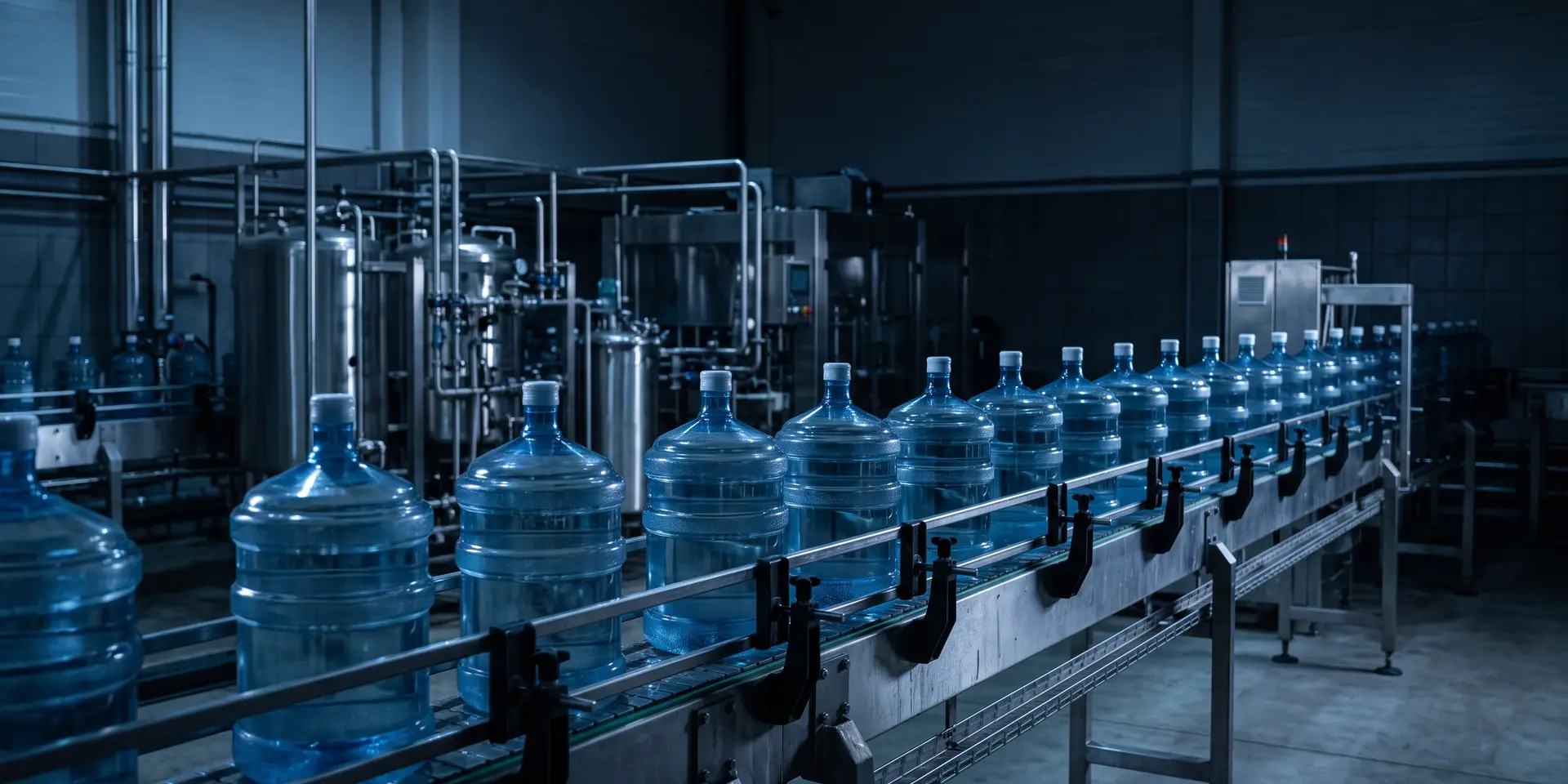






The 19 litre bottle: what it is and where the size comes from
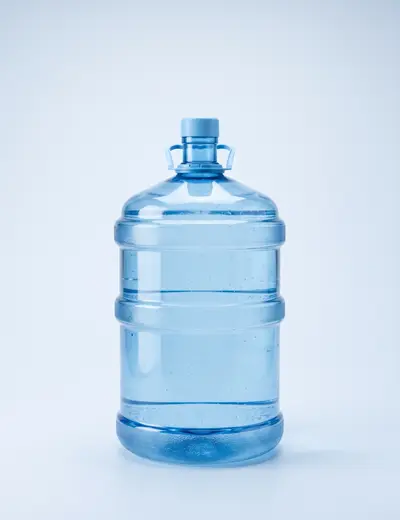
This bottle stands roughly knee-high, a little wider than two palms around, with a wide neck for the cap and recessed sides that are easy to grip. The volume comes from an American measure: originally it is 5 gallons, that is, just under nineteen litres. That is also where the second common size comes from, the 18.9 L bottle — the same container, just converted more precisely.
In the city you will also come across a 20 litre bottle: some suppliers use exactly that shape. All three have a standard neck, so they fit a cooler and a pump the same way, and the difference of a litre or two only shows on the delivery note. We deliver the nineteen-litre one.
It has as many everyday names as it has shapes: a water jug, a water container, big water bottles. They are all the same thing, and there is no confusion when ordering: in the city there is essentially one size.
Polycarbonate or PET: how 19 litre bottles differ
There are two materials on the market, and the choice between them is not about the taste of the water — it is the same — but about how the bottle lives in your home. A polycarbonate water bottle is rigid, clear blue and barely dents: you can roll it across the floor, stack one on another and carry it around for years. It is the one that circulates between the warehouse and the customer.
PET is softer, more matt and noticeably lighter when empty. It is easier to lift onto a cooler and easier to wash, but the walls give under your hand, and after a few dozen washing cycles the bottle turns cloudy and goes for recycling. The deposit on it is lower precisely because it does not last as long.
| What we compare | Polycarbonate | PET |
|---|---|---|
| What it looks like | clear blue, rigid | matt, soft |
| Deposit | 4 500 ₸ | 3 500 ₸ |
| Service life | dozens of washing and filling cycles | noticeably shorter, turns cloudy sooner |
| Empty weight | heavier | lighter |
| Who it suits | those who take water regularly | those who find lifting the bottle hard |
Dimensions and neighbouring sizes: what you find in the city
The dimensions of the standard container are almost the same across manufacturers: about forty-nine centimetres tall, about twenty-seven in diameter, with a forty-five millimetre neck. An empty polycarbonate one weighs around eight hundred grams, PET about half that. Everything else follows from these three figures — from whether the bottle fits in the cooler cabinet to how many fit in the corner of a storeroom.
The body shape differs between factories in the pattern of ribs and the depth of the recessed sides, but the fitting dimensions do not depend on it. The ribs are not for show: they hold the wall when the container is full, and they also show the bottle’s condition — if the ribs have flattened out and the body has become smooth, the container has been overheated or dropped.
Allow some extra space for it. A full container takes up a circle about a hand and a quarter across and needs a level floor: on a carpet or uneven tiles it stands crooked and tends to slide sideways when you put it on a cooler. For a bottom-loading cooler the bottle goes into the cabinet, and there the dimensions decide everything — cabinet height varies between models, while the container is the same.
| Volume | Where you find it | Fits a cooler | What to bear in mind |
|---|---|---|---|
| 11–12 litres | rarely, with a few services | yes, the same neck | easier to lift, a litre costs more |
| 18.9 litres | often, it is the same five gallons | yes | only the figure on the delivery note differs |
| 19 litres | the city’s main format | yes | our size, the price ladder is based on it |
| 20 litres | with some suppliers | yes | an extra litre of weight with the same grip |
| 5 litres | shops and delivery of smaller bottles | no | single-use, no deposit on it |
All large bottles share one neck, and that is their main convenience: a container of any of the four sizes fits any cooler, pump and stand bought in the city. Small bottles fall out of this range — their neck is narrow, and no adapter changes that. So the compatibility question comes up exactly once when ordering: large bottle or small.
An empty container takes up exactly as much room as a full one, and that is its only inconvenience. Spares are kept lying down in a corner or in a stand: upright they take up twice the floor space and fall over at any knock. In a flat, two or three bottles usually fit in a corner of a north-facing balcony or under the kitchen table — as long as it is not by a radiator or in the sun.
In practice a difference of a litre or two between neighbouring sizes means nothing except the price per litre. What matters more is weight: not everyone can lift twenty litres onto a cooler, while a teenager can lift twelve. If the bottles at home are changed by someone who is not the strongest in the family, look at this rather than at the volume as such.
The bottle deposit: how much, what for and when it comes back
We do not make you buy bottles — instead we take a refundable deposit: 4 500 ₸ for polycarbonate and 3 500 ₸ for PET. It is not the price of the bottle and not a rental, but security: return the bottle and we refund the money in full. The deposit is paid once, on the first delivery, and after that an empty is simply swapped for a full one.
From then on everything goes round in a loop: the courier brings full bottles and takes your empties, with no need to call anyone separately. The deposit stays in place for exactly the number of bottles you have at home. Stop ordering, hand the bottles to the courier and get your deposit back.
A separate case is a bottle that has been broken or lost. Then we keep the deposit on it, which in effect is buying the bottle at cost. There are never any penalties on top of the deposit.
Cooler bottles: washing, the number on the neck and service life
Every returned cooler bottle goes through the same path: inspection, washing, disinfection, rinsing and filling. A bottle with a scratch inside, a foreign smell or a deformed neck never reaches filling — it is rejected. That is the main reason people get bottled water from a service rather than filling up at a vending machine near home.
Every container has a number and a history: when it arrived, how many times it was washed, when it was rejected. Thanks to the number, the cooler water bottle you received today can be traced back to a specific wash. Polycarbonate lasts dozens of rounds, PET fewer, and it is inspection that decides, not the calendar.
You do not need to do anything with the bottle at home, and you should not wash it yourself: without industrial disinfection, washing at home does more harm than good. It is enough not to pour anything but water into it and not to leave an empty one open.
How to accept a bottle and what to check in ten seconds
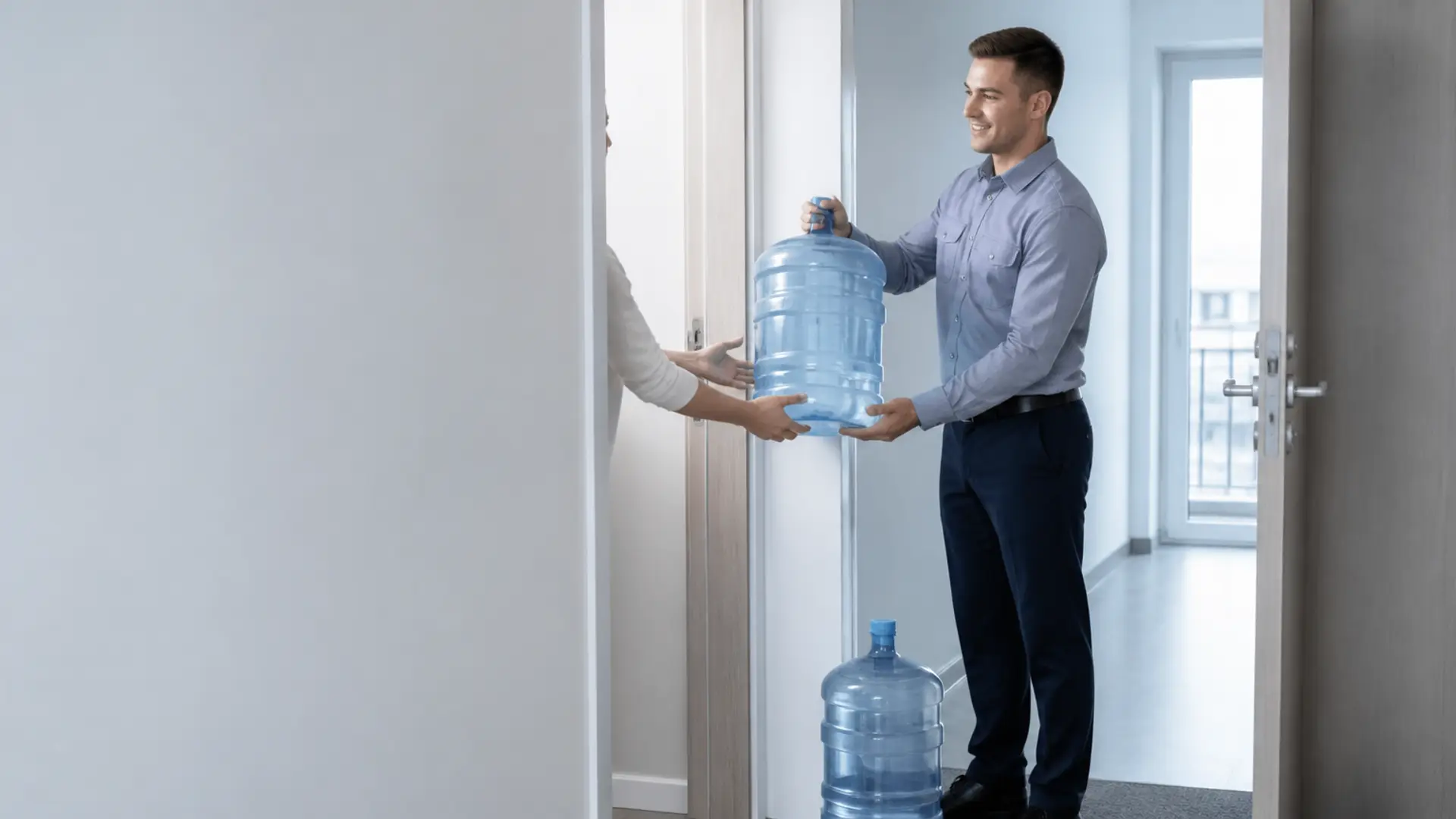
Handover is the only moment when any issue is solved by a swap on the spot. Once the container is on the cooler and the first glass has been poured, sorting things out takes longer and is less pleasant for both sides. The check takes ten seconds and has six points.
- The cap and seal film on the neck are intact, and the film is not torn at the edge
- The filling date is legible and recent, not worn down to a grey smudge
- The rim of the neck has no chips — run your finger along it
- Held to the light, the body has no cracks, cloudiness or deep scratches
- The water is clear, with no suspended particles and no flakes at the bottom
- The number on the shoulder or the neck is legible
If anything on the list is wrong, it is easier not to accept the container. The courier will swap it from the van or bring a replacement on the next run — an ordinary working situation, not a dispute or a complaint. The faulty bottle goes back to the line, where it is inspected again and either washed again or taken out of circulation for good.
In winter the bottle arrives cold, and it is best not to put it straight next to a radiator: a sharp temperature change causes condensation on the walls, and after the frost the plastic stays more brittle than usual for a while. Let the container stand in the room for an hour, and only then lift it onto the cooler. In summer the same logic works the other way round: a bottle that has warmed up in the van is not squeezed into the fridge whole — shade is enough.
A separate word on the seal. The cap with its film is not decoration: it shows that nobody has opened the container since filling. It is removed right before the bottle goes on the cooler, not in advance and not in the van; an opened container that has stood open even for an hour collects dust in its neck, and the first glass from it does not taste of water.
You do not have to put an accepted container on the cooler straight away. Water in a closed bottle keeps for months as long as light and heat do not get to it, so the stock is kept closed and opened one at a time. An open container on a cooler is a different story: two to three weeks with normal use, less in the heat, and what spoils it is not time but the air that comes in to replace the water you drink.
It is also worth checking that the right number has arrived. On a large order, counting in front of the courier takes half a minute and removes half the questions at reconciliation, and on a one-for-one swap it also settles how many empties went back. It is not mistrust but ordinary practice that keeps the deposit recorded against exactly the bottles you have.
How much a 19 L bottle weighs and where to keep it
A full bottle weighs about twenty kilos together with the container. That is a weight one adult can heave onto a cooler and two can carry easily. If there is nobody to lift it, there are ways out: a handle for the neck, a pump instead of a cooler, or a bottom-loading model where the bottle stands in the cabinet and is never lifted.
The stock is best kept in a dark, cool place away from radiators: in the sun, water in a clear bottle turns green within a couple of weeks. Only polycarbonate bottles can be stacked, and no more than two high: PET buckles under its own weight. Empties are easier to keep lying down in a corner — that way they take up half the space.
What you pour from it with: a cooler, a pump, a stand and a handle
A large bottle does not give up its water by itself: its neck is designed to be turned upside down and placed on a receiving unit. So something else always goes with it, and the choice of that “something else” decides how many times a week someone will have to lift twenty kilos.
- Desktop cooler — 34 900 ₸, rental 1 500 ₸ per month: a kitchen or an office for two or three people
- Floor-standing cooler — 45 000 ₸, compressor model 69 000 ₸: a shared kitchen and constant use
- Bottom-loading cooler — 70 000 ₸: the bottle stands in the cabinet and is never lifted
- Mechanical pump 4 500 ₸ and automatic pump 8 900 ₸; with a first order of 4 bottles or more the pump comes free
- Bottle stand for full and empty bottles — 7 900 ₸: gets the containers out from underfoot
- Handle for the neck — 990 ₸: not for pouring, but for carrying without dropping
A pump and a cooler solve different problems, and they should not be confused. A pump only lifts the water up: it neither chills nor heats, but it needs no socket, does not break and costs several times less than any cooler. A cooler adds cold and boiling water, but takes up space, uses electricity and needs sanitising — that is, it becomes an appliance you have to look after.
The choice depends on two things: how many people drink and who changes the bottle. For one or two people a pump is enough, and it is the only option where there is no socket — at a dacha, in a site cabin, in a warehouse. A cooler comes in when you need cold or hot water instantly, and bottom loading when the bottles will be changed by people who cannot lift twenty kilos above their heads.
Not everyone needs a bottle stand, but in a flat it solves two questions at once: where to put the spare container and where to keep the empty one until the courier comes. It frees the floor entirely, and full bottles sit secured on it, so they cannot be knocked over by accident.
Installing on a top-loading cooler takes one movement and no spills if you do not rush. Lift the container by both sides of the body, not by the neck, hold it upright and lower it onto the receiving unit all the way down without turning it over in advance: water only starts to flow once the spike has pierced the cap. A spilled glass at this point means the bottle was turned over too early.
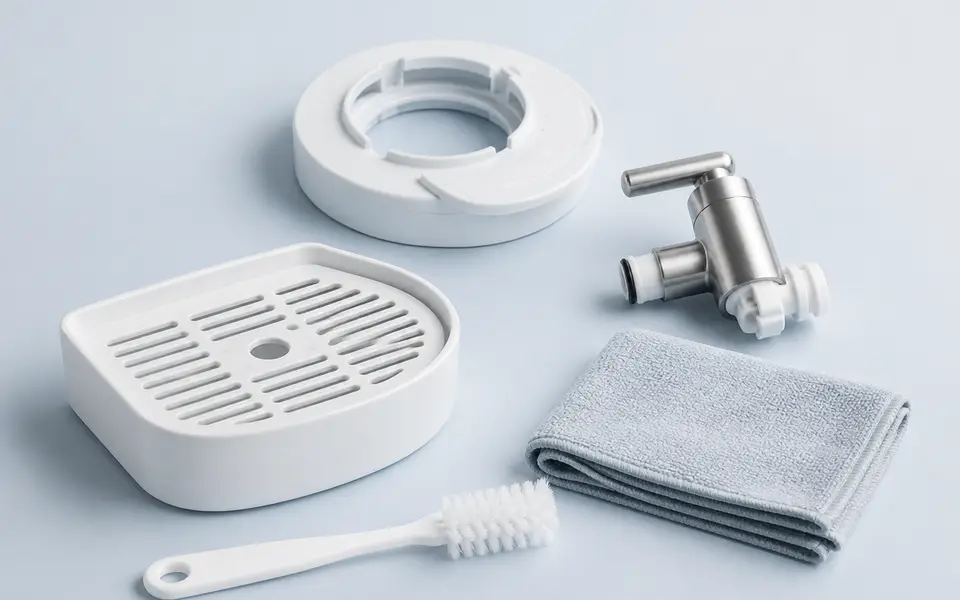
The receiving unit of a cooler or pump also needs care, although it has nothing to do with the bottle itself. The spike that pierces the cap and the tube under it are in direct contact with the water, and they should be washed together with the tank — every two to three months with normal use. A stale taste from a freshly installed container almost always points to the equipment, and it is cured by cleaning, not by changing supplier.
A handle for the neck costs less than any other solution and deals not with pouring but with carrying. With it you pick up twenty kilos with one hand and carry them up the stairs without hugging the container; without it the bottle is carried on a shoulder or by two people. For a flat without a lift or for a dacha, it is often a more useful purchase than a second cooler.
Buy a 19 litre water bottle or take one for a deposit
Buying bottles outright makes sense in two cases: you fill water yourself and are looking for something to put it in, or you keep more stock at home than your current order needs. In every other situation the deposit scheme is better value: the money is the same, but it comes back to you.
An order for drinking water bottles takes one message on WhatsApp: how many bottles, which material and where to deliver. Delivery across the city is free from 2 bottles, an order placed before 10:00 usually goes out the same day, the delivery windows are 9–13, 13–17, 17–21, and there is one day off: Sunday.
What takes a bottle out of circulation
Service life is counted not in years but in rounds, and it is decided by inspection before each filling. Handled carefully, polycarbonate goes through dozens of such rounds, and it usually leaves circulation not from old age but because of a single incident. There are few such incidents, and almost all of them happen at home rather than on the road.
- Frost: on a balcony in winter the plastic becomes brittle and cracks on impact
- Sun: the clear walls let light through, and the water turns green within a couple of weeks
- Dropping it on the neck while putting it on a cooler — the most common cause of a chipped rim
- Any liquid other than water: tea, fruit drinks and juice leave a film, and such a container is rejected
- Washing at home with household chemicals: the smell stays inside, and the neck cannot be rinsed properly at home
- Stacking more than two high: the bottom container warps under the weight and no longer sits straight on a cooler
If a container does get broken or lost, the supplier keeps its deposit — that is buying the bottle at cost, and there are never any penalties on top. Chips and cracks show at once on inspection, while scratches on the body do not affect the deposit refund. Disputes here are almost unheard of precisely because bottles are tracked by number and their history is visible to both sides.
A separate question is water refill points and vending machines near home, where people come with their own container. The difference is not in the water but in the fact that nobody washes or inspects the bottle between two fills: the cycle of washing and disinfection that the deposit exists for is simply absent there. That is why we do not fill your own container — not on principle, but because there is no way to vouch for what was in it before us.
Three habits extend a bottle’s life more than anything else: keep it in the shade and above freezing, stand it on a level floor, and pour nothing into it but water. Everything else — washing, disinfection, inspection and rejection — happens on the line without your involvement, and that is what the supplier is responsible for, not you.