





5 litre water — when you don't need a cooler and a 19 L bottle is too heavy
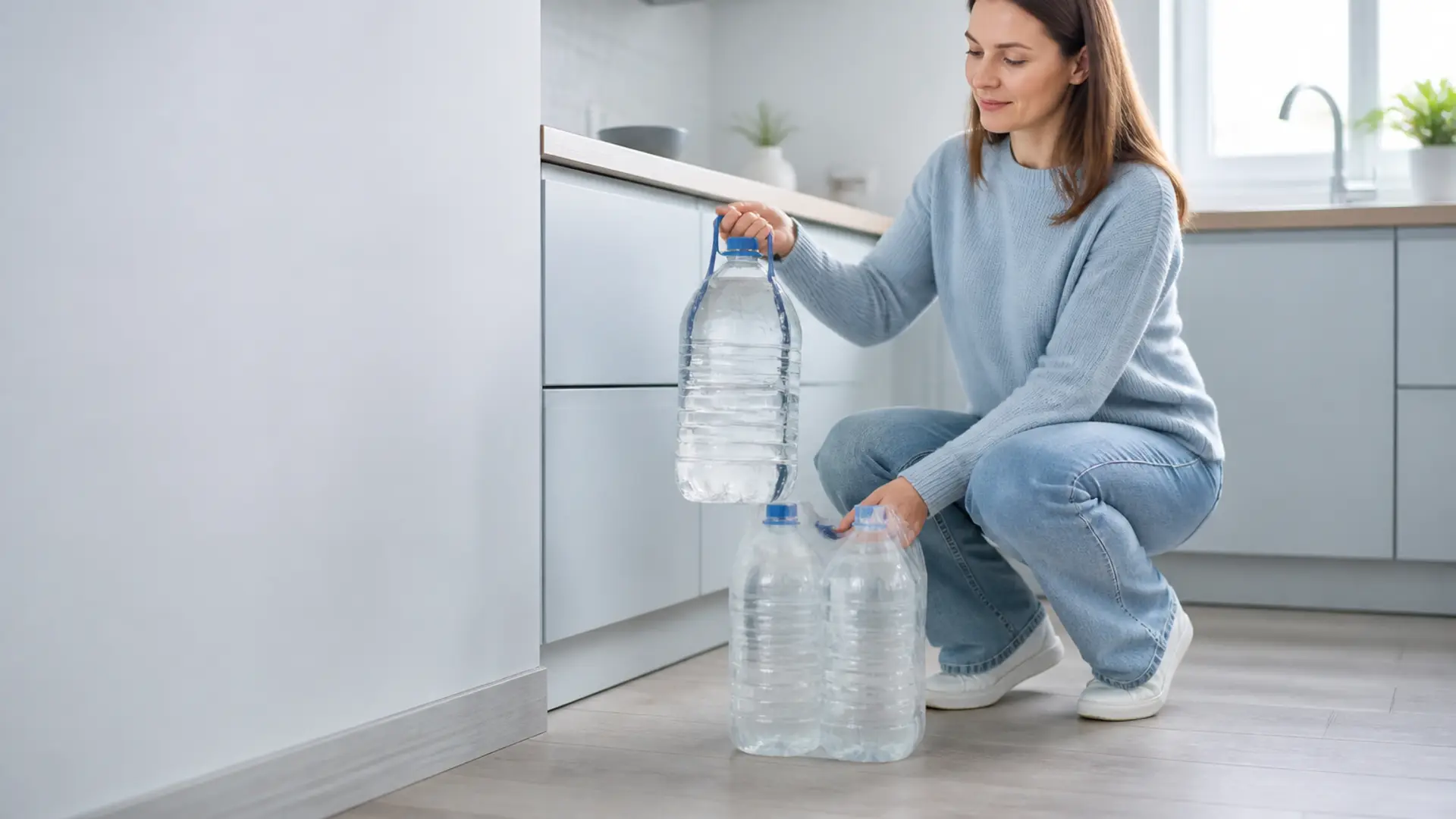
Five litres is the size where a “bottle” ends and a “big bottle” has not yet begun. You lift it with one hand, carry it from the car to the flat without help and put it anywhere: on a fridge shelf, under the sink, in the car boot, in a corner of the kitchen. No cooler, pump or stand is needed.
That is why 5 litre water is the format for a rented flat, a dacha, a renovation, a business trip and any place where you live temporarily and don't want to set up equipment. The second regular buyer is a family with nobody to haul a nineteen-litre bottle up to the fourth floor without a lift.
The third regular case is an office of three or four people where a cooler doesn't pay off. One bottle on the kitchen counter covers the day with some to spare, needs no maintenance and doesn't make anyone negotiate whose turn it is to change the bottle. As soon as there are more than ten people, the picture flips: nobody wants to carry five bottles a week.
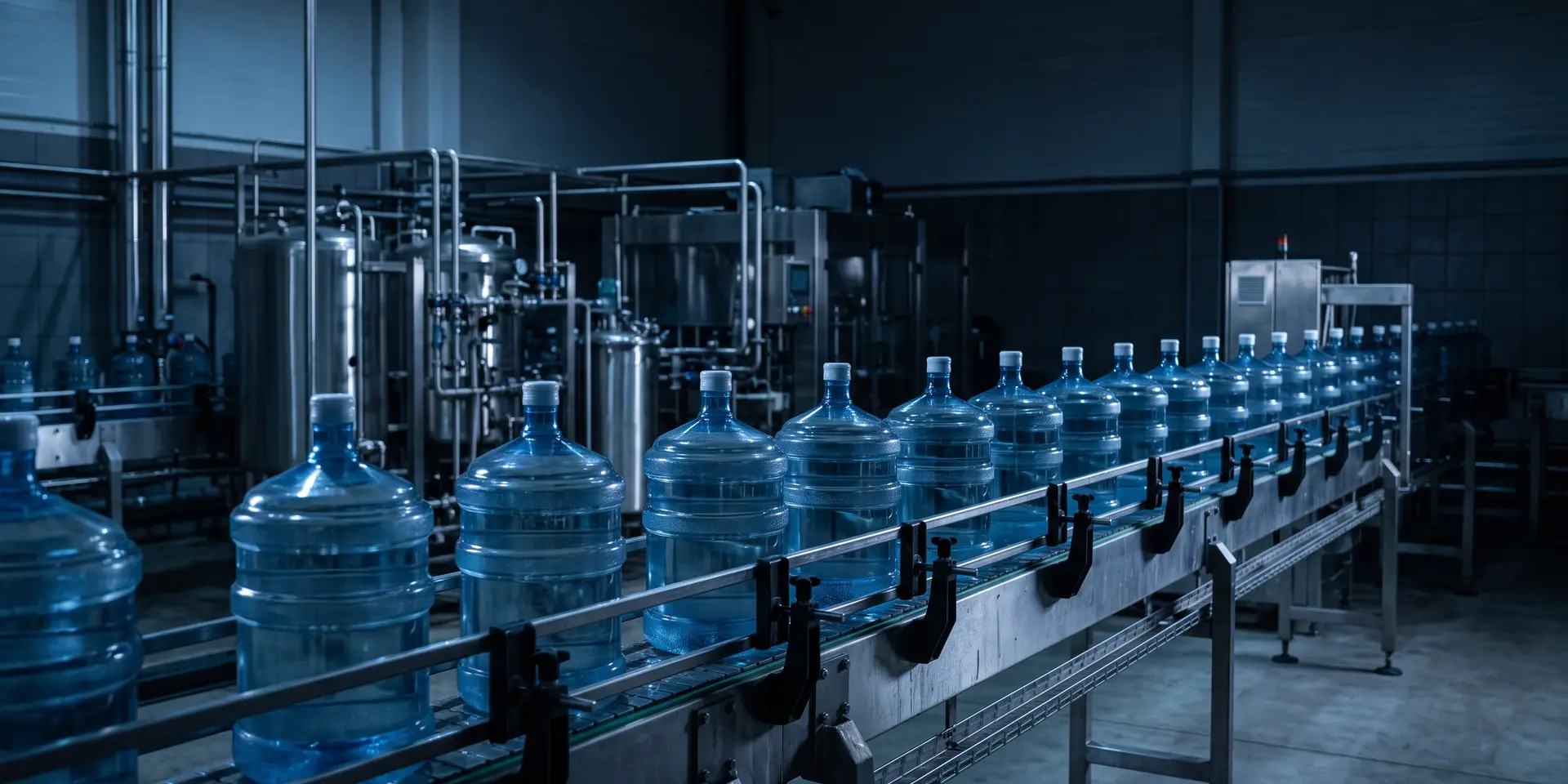
Our 5 L bottled water comes from the same artesian well as the cooler bottles. Same bottling line, same lab report; the only difference is the bottle, and that it needs no deposit and doesn't have to be returned to the courier.
How many bottles you need and how long they last
This size is easier to count in weeks: that is how long an average order lasts. The guide for plain drinking water is about two litres a day per adult and less for a child, plus what goes into tea, coffee and cooking if the water is used in the kitchen too, not just for the glass.
| Who drinks | Drinking only | Drinking and cooking | 5 L bottles |
|---|---|---|---|
| One adult | about 14 litres | about 20 litres | three or four |
| Two adults | about 28 litres | about 40 litres | six to eight |
| Family of three | about 35 litres | about 50 litres | seven to ten |
| Rented home for a month | about 60 litres | about 80 litres | sixteen a month |
| Weekend at the dacha, four people | about 12 litres | about 20 litres | four for the trip |
The second and third rows are where the format ends. Three or four bottles a week one person carries easily; eight is forty kilograms that someone has to get up to the flat. This is usually the point where people start looking at big bottles with a cooler or a pump.
In summer the figure goes up by about a third: in the Almaty heat the norm grows, and a supply that lasted a week runs out by Friday. In winter it falls — part of the water goes into tea and soup rather than the glass, and consumption evens out by itself.
Real consumption becomes clear after two or three weeks, and that is what to look at, not the calculation. A sensible start is to take a week's worth at the lower end and see when the last bottle empties. Getting it wrong on the low side is no problem: an order placed before 10:00 goes on the same day's run.
A supply for guests and events is counted separately. An evening with ten people uses two or three bottles on water alone, a children's party more: children drink plain water more often than adults. If the event is planned, it is easier to add a pack to your usual order the day before than to look for water that same evening.
The 5 litre water bottle: weight, handle and fridge space
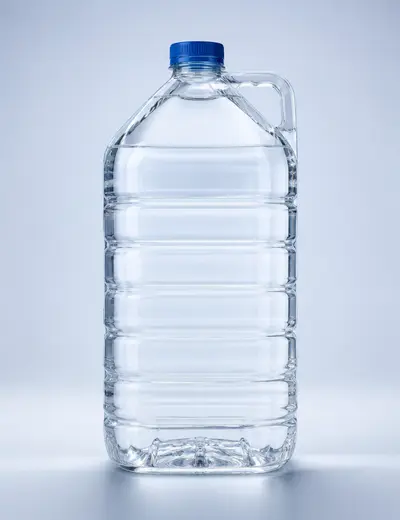
A full 5 litre bottle weighs about five kilograms — roughly like a bag of groceries. That is the upper limit of what a person carries in one hand without switching hands on the way. The handle on the neck decides almost everything: without it you have to hug the same weight, and you end up carrying it to the flat with both hands.
The second reason people choose this size is the fridge. A 5 litre bottle fits on the bottom shelf of almost any model, but doesn't fit in the door at all. If you want cold water from the door, look at one and a half or two litres; if you want a cold supply, look at five.
It is easiest to pour from while the bottle is full: after that the leverage grows, and the last litre is poured with both hands. There are dedicated pumps for this kind of bottle, but buying one for five litres makes little sense — it is simpler to open the bottles one at a time.
The dimensions of this bottle are almost standard too: about thirty centimetres high and eighteen to twenty across. That is exactly the size that fits on the bottom shelf of the fridge and under the sink, but doesn't go into the door and won't squeeze between shelves set for small dishes. A shelf for the supply is usually cleared in advance, not at the moment of delivery.
The last litre from a full bottle really is hard to pour, and there is a household trick for it: put the bottle on the edge of the counter and slip a rolled-up towel under the base so that it tilts without being lifted. The method is simple and removes the main complaint about the format without needing a pump or a stand from the shop.
What to check when buying and on delivery
People inspect large bottles less often than small ones: they are delivered rather than taken off a shelf. That makes it all the more important to know what to look at the moment the courier sets the pack on the floor. The check takes about twenty seconds, and sorting things out later takes noticeably longer.
- Handle: moulded or firmly fitted to the neck, not loosely threaded through a ring
- Seal: the bridges of the tamper ring are intact, the cap doesn't turn freely
- Bottling date: readable on the label or stamped on the shoulder of the bottle
- Wall: no dents or cracks, the water is clear, with no particles or flakes
- Base: flat, the bottle stands level and doesn't rock
- Label: composition, mineralisation, source and best-before date are written, not implied
If anything on the list is wrong, it is simpler not to accept the bottle: the courier will replace it from the van or bring a replacement on the next run. The rule works in our favour too — it is better to return a batch with damaged bottles to the warehouse in full than to learn about it from one complaint a week.
A word about the handle. Here it is not decoration but a load-bearing part: the whole weight hangs from the neck, and this kind of bottle has one weak spot — the attachment point. Don't carry the bottle by the middle of the body: the thin wall flexes, and water squeezes out past the cap even if it is screwed on tight.
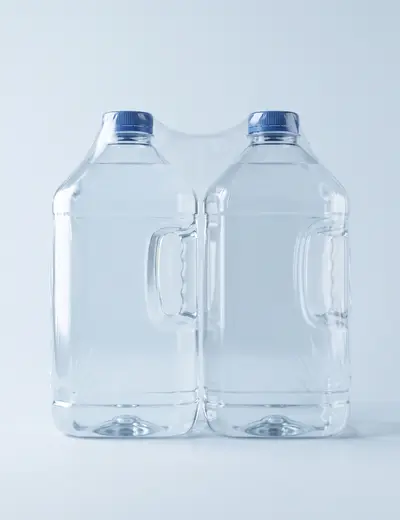
A pack of two bottles is checked the same way as a single one. The wrap should be intact and tight: a torn one means the pack has already been dropped or dragged, and that is the first cause of dents and leaking caps. Carry it by the wrap between the necks too, not by one of the handles — otherwise the second bottle hangs on the seam.
Before opening, the water should smell of nothing. If you can smell something through a closed cap, it is almost always down to storage next to household chemicals, and a bottle like that is returned. Send us the bottling date from the label — we will check the batch against the lab report and tell you what's going on.
5 litre water: the price and what it depends on
We show the price per bottle, not per block: on a size page people choose a size, and how many bottles go into the order is a second question. One bottle costs 530 ₸, the popular pack of two 1 190 ₸.
This price rests on exactly one thing: the bigger the bottle, the smaller the share of the bottle itself and of delivery, and the bigger the share of the water. A litre in a 5 litre bottle costs less than in a 1.5 litre one, and noticeably less than in a half-litre one. That is exactly why 5 litre water is bought not one bottle at a time but two to four at once.
5 litre water in bulk is a conversation about regularity, not a discount percentage: it suits us better to bring you a month's supply in one trip than to come every week. We discuss volume, schedule and price in the chat: a dacha community, a building site and a coffee shop are three different calculations.
The delivery method also affects the final figure. A separate trip for two bottles is charged separately, while the same bottles as part of a regular order travel with it and add nothing to the bill. That is why it pays to tie small bottles to a schedule rather than order them urgently and one by one.
5 litre drinking water or a 19 litre bottle
An honest comparison looks like this: the 19 L bottle is cheaper per litre, the 5 litre bottle is lighter and doesn't require buying anything. What you should count is not the shelf price but how much water you use a week and who will carry it.
| What we compare | 5 litre water | 19 litre bottle |
|---|---|---|
| Weight when full | about five kilograms | about nineteen |
| Where it fits | fridge shelf, car boot, kitchen corner | cooler, pump or stand |
| Price per bottle | 530 ₸ | from 1 490 ₸ |
| Deposit | none, the bottle is not returned | 3 500 ₸ for PET, refundable |
| Who it suits | rented home, dacha, trip, one or two people | home and office with steady consumption |
A word about switching. You don't have to start with a big bottle: many people take packs first, see their real consumption and only then order a bottle with a pump. The reverse also works — the big bottle is returned together with the deposit, and small bottles take its place if, say, the house is empty for the summer.
A simple rule: if you use less than fifteen litres a week, there is no point bothering with big bottles. If more — a big bottle pays for both the cooler and the pump in a couple of months, and water in 5 litre bottles stays at home for water outages and trips.
There is also a third way people forget: keeping both formats at once. A big bottle with a pump covers steady consumption at home, and two or three 5 litre bottles stand in the pantry for water outages, trips out of town or guests. This supply needs neither a deposit nor a return and doesn't go off while it stays sealed in the shade.
Storage: sealed, opened and the one riding in the car
The shelf life of a sealed bottle is measured in months and is printed on the label. Conditions matter more than the date, though: clear PET doesn't block light, and in the light processes take place in water that don't happen in the dark. That is why the supply is kept in the shade, not on the windowsill where it is easier to see.
- Sealed: a dark, cool place, away from the radiator, the stove and household chemicals
- Opened: the fridge and a few days — air gets in every time you pour
- In the car: one bottle per trip, not a month's supply; in summer the inside of the car reaches seventy degrees
- On the balcony in winter: no, ice expands and splits the wall at the seam
- On the garage floor: no, plastic draws the smell of petrol and paint through the wall
Five litres are rarely drunk in one go, and the question of an opened bottle is sharper here than with small bottles. A working trick: right after opening, pour some into a carafe or a small bottle for the fridge and keep the main one sealed somewhere cool. That way the water doesn't stand open all week and doesn't pick up kitchen smells.
Screw the cap all the way down every time. Large bottles are often laid on their side in the fridge — otherwise the shelf isn't tall enough — and a loosely closed cap leaks in that position. If the bottle is lying down, check after an hour: there should be no traces on the shelf.
And about temperature. Getting cold water out of a bottle like this is awkward: you have to lift and tilt it, and in the heat you don't want to do that ten times a day. The usual answer is to keep a small bottle in the fridge and use the large one as a supply to top it up from as needed.
A month's supply makes sense only where there is nowhere to restock: a dacha without a shop, a renovation, a long business trip. In the city it loses to a schedule — water doesn't get better with keeping, and sixteen bottles take up a whole pantry shelf. There is one sensible horizon for this kind of bottle: from one delivery to the next.
What kinds of 5 litre water there are besides ordinary
This size doesn't only come as drinking water. Children's 5 litre water has stricter composition requirements and separate labelling — it is used for formula and first solid foods. Mineral water in 5 litre bottles is rarely seen in shops: mineral water is drunk in measured amounts, and it is hardly ever bottled in large sizes.
Sparkling water in 5 litre bottles is an even rarer format: in a big bottle the gas escapes within a few days of opening, and the point of it is lost. If you want sparkling, it makes more sense to take it in small bottles and keep the 5 litre ones for ordinary drinking and cooking.
One more product in the same kind of bottle gets confused with drinking water — distilled water. It is sold in household departments, is meant for irons and batteries, and you shouldn't drink it: it contains no salts at all, and tastes like it. Look at the label and the department, not at the shape of the bottle and the handle.
The mistakes that come up most often
Almost all complaints about water in large plastic bottles are explained not by the bottling but by how the bottle is handled at home. The mistakes repeat from flat to flat and depend neither on brand nor on price — they are habits, not properties of the product.
- Washing and refilling: the wall gets scratched inside, and residue stays under the handle and in the folds of the neck
- Carrying it by the body instead of the handle: the bottle flexes and water squeezes out past the cap
- Freezing: ice expands by roughly a tenth of its volume and splits the thin plastic
- Keeping it in the car for weeks: heated plastic gives off a smell, and it stays in the water
- Looking for a cooler adapter: the cooler fitting is designed for the wide neck of a 19 L bottle
- Putting it next to washing powder or paint: the smell passes through the wall in a few days
A separate word on decanting. Sometimes people try to pour 5 litre bottles into an empty 19 L bottle to put it on the cooler. Don't: a returned bottle is washed and disinfected on the line, it can't be treated like that at home, and the water would stand for several days in a bottle nobody prepared for filling. It is no better for the cooler either — along with the water, everything that was in the neck gets into the tank.
A common idea is to buy a pump for a large bottle so you don't have to lift it. Such pumps exist, but you have to top up every two or three days, and the gain is soon lost. If pouring is hard, the honest comparison is not a pump versus a bottle, but the whole idea versus a 19 L bottle, where both the pump and the cooler work as intended.
Another mistake is buying a bigger supply than fits in the shade. Bottles that found no room in the pantry end up on the balcony or by the window, and a month later the supply bought to save money has to be drunk faster than you would like. Count not only the money but the shelves too.
And finally. Empty bottles don't come back to us: they carry no deposit and don't go back to the line. If you crush each bottle straight away and screw the cap back on, ten empties become one bag instead of a corner of the balcony; PET marked 1 is accepted at the city's recycling points.
5 L water delivery across Almaty
You can buy 5 L water from us in two ways, and both start with one message on WhatsApp. The first is to add packs to your regular order of big bottles: delivery in the city is free from 2 bottles, and the 5 litre ones travel on the same run. The second is a separate order of small bottles only: then we work out the delivery cost and tell you before you confirm the order.
The courier takes the packs up to your floor and carries them where you show — this is part of delivery and not charged separately. When confirming, tell us whether the building has a lift and whether a car can drive into the courtyard: that shifts the time of the visit, but the water still ends up in the kitchen, not on the ground-floor landing.
An order placed before 10:00 usually goes out the same day. Delivery windows are 9–13, 13–17, 17–21, there is one day off: Sunday. Out of town we deliver from 4 units per order — exactly the case where 5 litre bottles are taken to the dacha by the box.