





6 litre water is the next size up, not a separate product
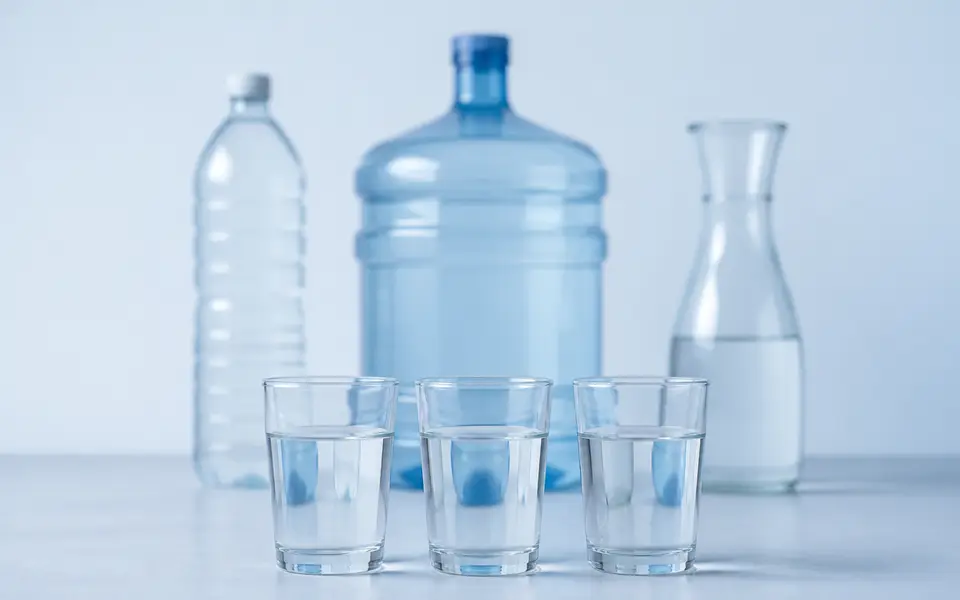
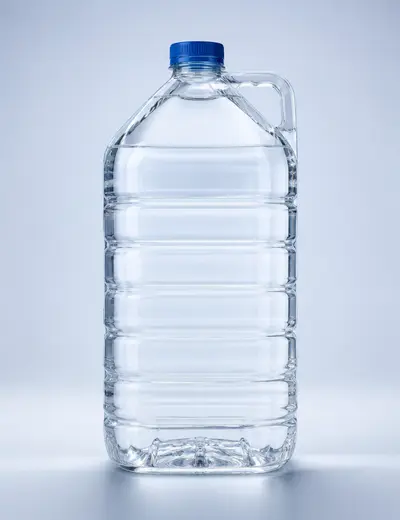
The six-litre bottle is made on the same mould and from the same plastic as the five-litre one: the same neck, the same handle, the same shape that fits the hand. What differs is the height of the body and one extra litre of water inside. So there is no need to choose between them as if they were different products — it is one format in two sizes.
The difference is where you will find them. Five litres is a staple that everyone stocks; six litres is bottled by only a few plants and turns up on the shelf every other time. In our experience it is asked for by people who once bought such a bottle and remembered that it lasted their family exactly one day.
The water in our six-litre bottles is the same artesian water as in the cooler bottles: one well, one bottling line. The bottle is single-use, there is no deposit on it, and you do not need to return it to the courier.
What the extra litre gives you
One extra litre seems trivial until you count it per day. A family of three needs around five to six litres a day for drinking and tea: a five-litre bottle runs out by evening, a six-litre one lasts until morning. That one litre is exactly why people take the next size up — so that a purchase covers a full day, not a day minus a couple of glasses.
| What we compare | 5 litres | 6 litres |
|---|---|---|
| Weight of a full bottle | about five kilograms | about six |
| How often it is in stock | always | to order, availability confirmed |
| Price per bottle | 530 ₸ | 690 ₸ |
| Who it suits most often | one or two adults | a family for whom five is not enough for a day |
The extra litre makes almost no difference to the weight: people carry six kilograms just as easily as five. But not every fridge shelf takes a six-litre bottle — it is taller, and in narrow models it hits the shelf above. Measure before you order, not after.
How many six-litre bottles go in a week
Consumption of smaller bottles is easier to count in bottles than in litres: you see straight away how many times a week you will carry shopping home and how much kitchen space the stock will take. The starting point is the usual one — about two litres per adult per day, including tea and cooking. Children are counted at less volume but more often, and in hot weather add roughly a quarter to any figure.
| Who drinks | Litres per day | Bottles per week | How people usually order |
|---|---|---|---|
| One adult | about two | two to three | one order a week |
| A couple | three to four | four to five | one order a week |
| Family of three | five to six | six to seven | one order with a reserve, or two |
| Family of four | seven to eight | eight to nine | two orders a week |
| Office of five | five per working day | four to five | a 19 L bottle is more convenient here |
The table gives a ceiling, not a plan. The norm covers all the water a person takes in during the day, while the bottle only supplies drinking water and tea: soups, fruit and coffee at work are not part of it. In practice consumption comes out about a third below the estimate, and you will see your real figure within two or three weeks — from how quickly the stock in the cupboard empties.
The season shifts the estimate more than the size of the family does. From late May to September people in Almaty drink noticeably more, and a family of three goes from six bottles a week to eight; in November it drops back, and during holiday weeks it falls by almost half. So planning a year of purchases on a single figure makes little sense — it is easier to revisit how often you order once a season.
A day with guests is counted separately. An evening for ten people adds one and a half to two bottles to a normal week, and a children's party adds more: children drink plain water more often than adults. It is easier to tell us about such a day in advance than to look for water that same evening — we confirm this less common size by batch, not by what is left in the warehouse.
The estimate also sets the rhythm of your orders. Keeping a week's supply at home plus one extra bottle is exactly what stops water from running out unexpectedly: while an unopened spare is standing there, you have a day or two to place an order calmly and pick a convenient delivery window. A reserve of more than two bottles above the norm is pointless: it takes up a shelf and gets drunk in rotation anyway.
The same table shows where counting in bottles stops adding up. From eight or nine a week you are carrying about fifty kilograms home and paying every time for the bottle as well as the water. With a returnable bottle of the same volume the container is never bought again, and the price per litre drops by about a third. That is the point beyond which the next size up no longer helps.
How the six-litre bottle is made
The body is blow-moulded from food-grade PET, with a wall a few tenths of a millimetre thick and stiffening ribs along the sides: these are what keep the bottle in shape while it is full. On top there is a moulded handle, at the bottom a flat base on several feet, and the neck takes a screw cap with a tamper ring. The mould is the same as for the five-litre bottle — only the body is taller, so all the differences come down to height and one litre inside.
On a large small-format bottle the handle is not decoration but the only way to lift six kilograms with one hand. You hold the bottle by the handle and support it from below: if you carry it by the handle alone, the neck acts as a lever, and on a long walk the cap starts to leak. For the same reason the bottle is not laid on its side in the boot — it travels upright, leaning against the side.
- The tamper ring on the cap is intact, and the cap itself does not turn
- The bottling date on the label is legible, not smudged by the print
- The base is flat, not bulging: a bulge means the bottle was heated or frozen
- No deep dents in the walls — a crushed bottle stands badly and leaks along the seam
- The water is clear against the light, with no suspended particles and no sediment at the bottom
A separate habit is not grabbing the bottle by its body. A full bottle gives under your fingers, and the wall remembers the dent where you pressed; later it starts to leak along that crease. Lift it by the handle, set it on a flat surface, and never put it in a bag with groceries: six kilograms on top will flatten everything underneath.
The check takes about ten seconds and settles almost every question that would otherwise come up a week later. If a bottle shows any of these signs, simply do not accept it: tell the courier on the spot, it will go back and another one will come instead. Trying to sort something out after the water has stood in the cupboard for a week is too late and pointless.
The label on such a bottle tells you more than it seems. It carries the bottling date, the batch number and the composition of the water — mineralisation and the main ions; using the batch number, the supplier can pull up the lab report for that specific bottling run, not for the product in general. Water in PET is usually given a shelf life counted in months from bottling, and the fresher the date, the less time the bottle has spent in a warehouse under the lights.
The neck of the six-litre bottle is narrow, about the same as an ordinary drinking-water bottle, and this is the main difference from a 19 L bottle. It also answers the question about the cooler: the cooler seat is made for a wide neck, and a small-format bottle will not fit it, with or without an adapter. A pump can be found, but by neck diameter rather than by litres — name the model in the chat and we will tell you whether it fits.
Buying 6 litre water: how it works with us
We do not keep six-litre bottles in permanent stock: demand for them in Almaty is small, and water is a product with a shelf life — nobody needs boxes that sit for months. So the process is this: you write on WhatsApp how many bottles and to what address, we check the batch and give you the delivery day.
If there is no batch at that moment, we say so directly and offer the nearest size — five litres of the same water, or a 19 L bottle if your consumption is steady. Promising stock that is not there makes no sense: people find out the truth on delivery day anyway.
The price sits roughly where the neighbouring sizes are: in essence you pay for the water and for the bottle, and the bottle's share falls as the litres go up. On the page we show the price per bottle — that makes it easier to compare with the five-litre bottle and with a 19 L bottle.
Where to keep the bottle and how to pour from it
Three things are bad for water in clear plastic: light, heat and being next to household chemicals. So keep the stock in a dark, cool place — a pantry, the bottom drawer of a kitchen cupboard, a corner away from the stove and radiator. Balconies and windowsills will not do, in summer or in winter: in direct light the water picks up an off taste within two or three weeks, and in the frost the plastic becomes brittle and cracks along the ribs.
The fridge solves the question of cold water, but not of the whole stock. The six-litre bottle is taller than the five-litre one and simply does not fit under the shelf in narrow models, and when full it is heavy enough that you would rather not test a glass shelf with it. Measure the clearance to the shelf in advance: if there is not enough, keep a smaller bottle in the cold and leave the main volume in the cupboard.
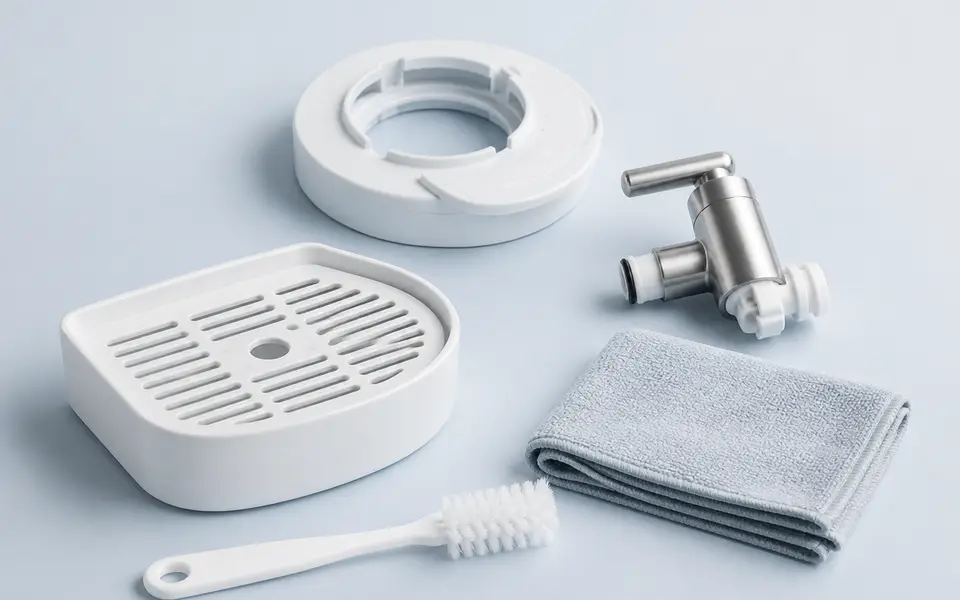
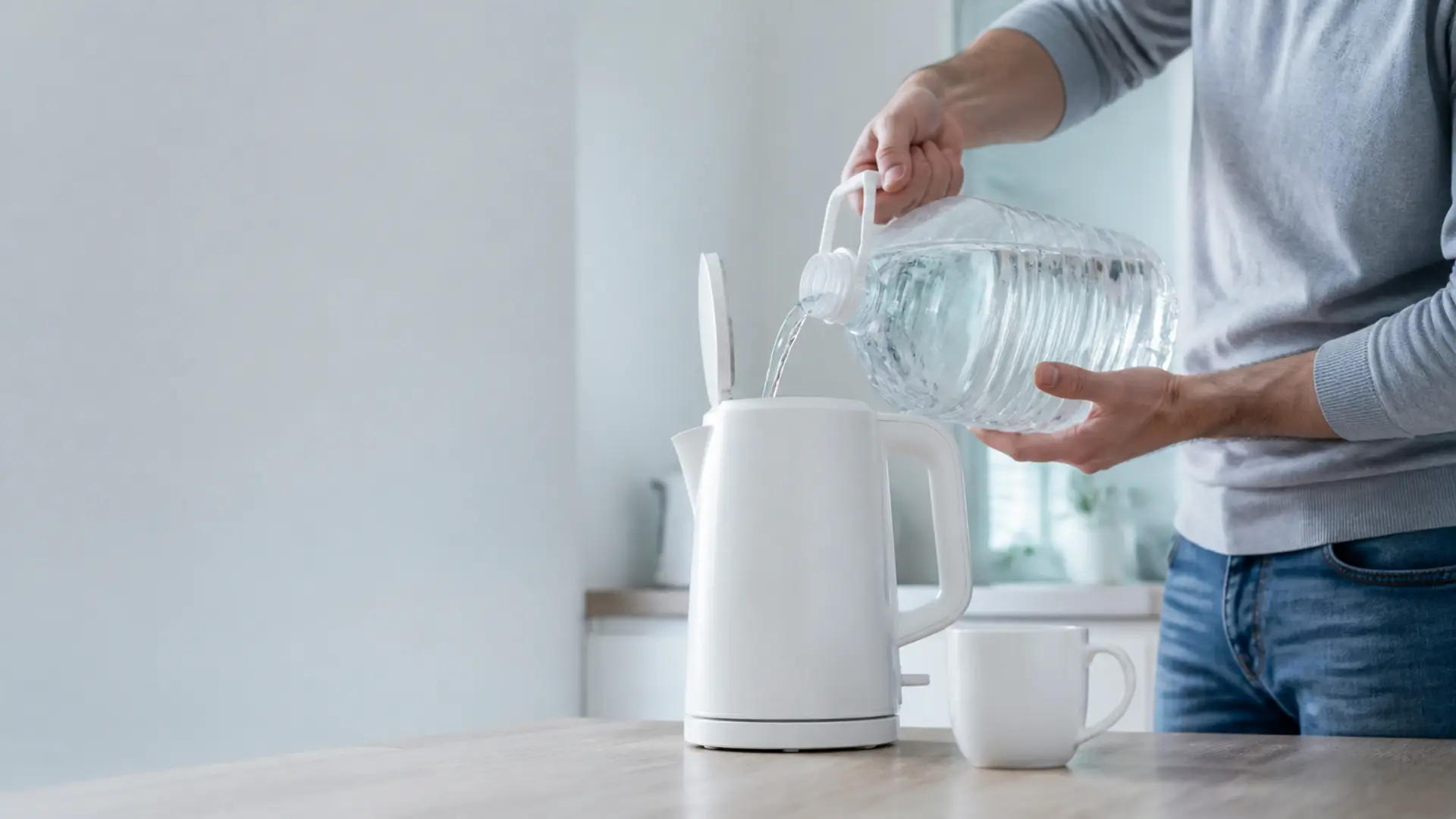
Pouring from a full bottle is awkward exactly once — the first time. After that the weight goes down and it is easy, but until it is half empty people usually do not lift it at all. There are four practical ways, and you choose by where the bottle stands.
- From a stand: the bottle sits at the edge of the table and is tilted without being lifted
- With a tap attachment on the neck — the water flows by gravity and the bottle stays put
- With a pump for small bottles, if it fits the neck of your bottle
- By pouring a day's worth into a jug, while the bottle itself stays closed in the cupboard
Carrying it yourself needs the same care as storing it. In the car the bottle goes in the footwell behind the front seat, not on its side in the boot: in the heat a closed boot gets hotter than the cabin, and a bottle lying down presses on the cap with all its weight. In summer a half-hour drive home will not affect the water, but a bottle that has spent a day in the sun already tastes of plastic, and chilling it will not fix that.
The last option usually turns out to be the most convenient. An open bottle takes in air every time you pour, and the less often it is opened, the longer the water stays free of off tastes. A family finishes six litres in a day or two, so storing an open bottle is never an issue for them; for one person it makes more sense to buy this size less often and keep it closed in the fridge.
Six litres and the neighbouring formats: which covers what
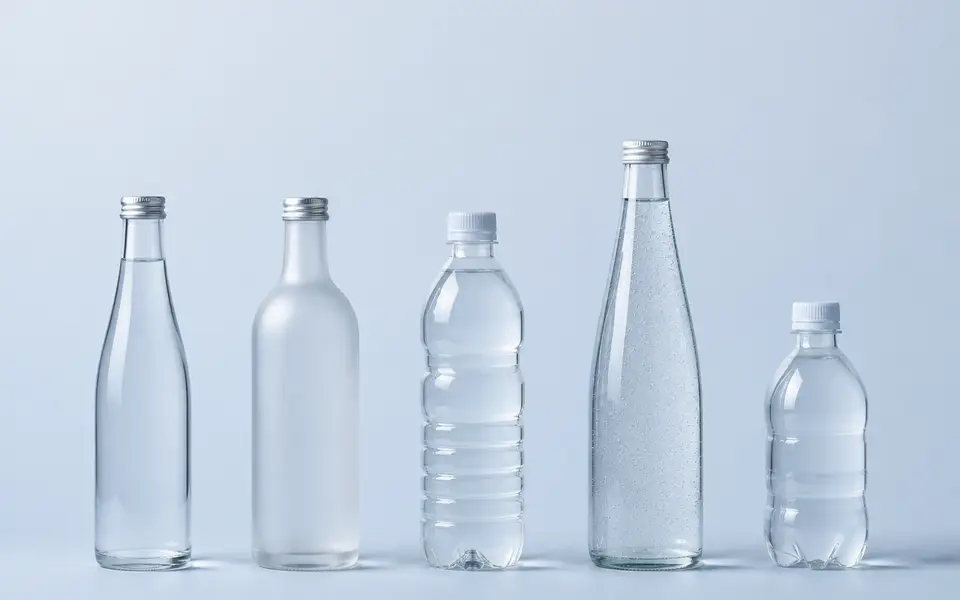
Drinking water in the city comes in a clear ladder of sizes: half a litre, a litre, one and a half, two, five or six, and then straight to nineteen. Each step covers its own need, and comparing them by price per litre makes no sense: by that measure the 19 L bottle always wins, yet people still buy different things.
| Size | What it covers | What is inconvenient | Price per bottle |
|---|---|---|---|
| 1.5 litres | the road, a bag, the car | runs out in a day | 620 ₸ |
| 2 litres | the fridge door, tea in the kitchen | does not create a reserve | 360 ₸ |
| 5 litres | a day for one or two people | does not last a family until morning | 530 ₸ |
| 6 litres | a day for a family of three | brought to order, not from stock | 690 ₸ |
| 10 litres | two or three days for a family | does not fit in the fridge | 750 ₸ |
| 19 litres | a week or more | needs a cooler or pump and a bottle deposit | from 1 490 ₸ |
The table shows why the in-between size exists at all. Between five and nineteen litres there is a gap in the range: the next step requires a cooler or a pump, room for the 19 L bottle and a refundable bottle deposit. Six and ten litres fill that gap for people who have no reason to get equipment — in a rented flat, in a three-desk office, at a dacha lived in for the season.
The price per litre is worked out in one line: the bottle price divided by its volume. With smaller bottles the difference between neighbouring steps is small, because you mostly pay for the bottle itself and for bringing it; with the 19 L bottle it drops at once, because the bottle is not bought at all. So it makes sense to compare not the steps with each other but two whole scenarios: single-use bottles delivered as needed, and returnable ones with a cooler and a schedule.
The choice between six and ten litres comes down to who will carry it. Six kilograms can be picked up with one hand and taken to any floor; ten already means stopping on the stairs. If you carry the water yourself and live above the second floor without a lift, six litres is a sensible ceiling, and it is the number of bottles you should increase, not the size of each.
When you do not need six litres
There are three cases when it is fairer not to take the in-between size. The first is when you need water regularly and in quantity: from fifteen litres a week it is cheaper, and produces less waste, to switch to 19 L bottles that go round in rotation. The second is when older people carry the water up the stairs: here it is better to take more bottles of a smaller size.
- Steady consumption from fifteen litres a week — a 19 L bottle with a pump is cheaper
- Carrying up the stairs yourself — take five-litre bottles, but more often
- You need cold water from the fridge door — that means one and a half or two litres
- You need water today, for certain — take a staple size; a six-litre bottle means waiting a day or two
The third case is urgency. We almost always bring 6 litres of water with the next supply rather than within the hour, so if you need water today it is wiser to take what is in the warehouse right now.
What is left afterwards: empty bottles and waste
Single-use bottles have a part of the price that is not on the price list — what is left afterwards. A family that takes six or seven bottles a week throws out about thirty empties a month. An empty bottle takes as much space as a full one, so the bin fills up in a couple of days, and the only remedy is to crush the body and screw the cap back on so it does not spring back.
When recycling, the cap is usually taken off: the body and the cap are made of different plastics and go into different streams. There is no need to remove the label; it is separated on the line. It is a small thing, but it decides whether your bag reaches recycling or goes to landfill with the rest of the rubbish.
Refilling such a bottle with water is not a good idea. The wall is thin, micro-cracks appear at the folds after the very first refill, and the narrow neck does not let you rinse the inside so that nothing is left in it. For non-drinking water — for plants, the dacha, building work — the bottle will still serve; for drinking water it will not.
There is also a middle way that many people come to: keeping both formats. The 19 L bottle on the cooler covers everyday drinking and tea, while the six-litre bottle lives in the cupboard as a reserve for when the 19 L bottle runs out ahead of schedule, and goes with you to the dacha or on a day out of town. With this set-up there is hardly any waste, and the unpleasant “water has run out, delivery is tomorrow” situation never comes up.
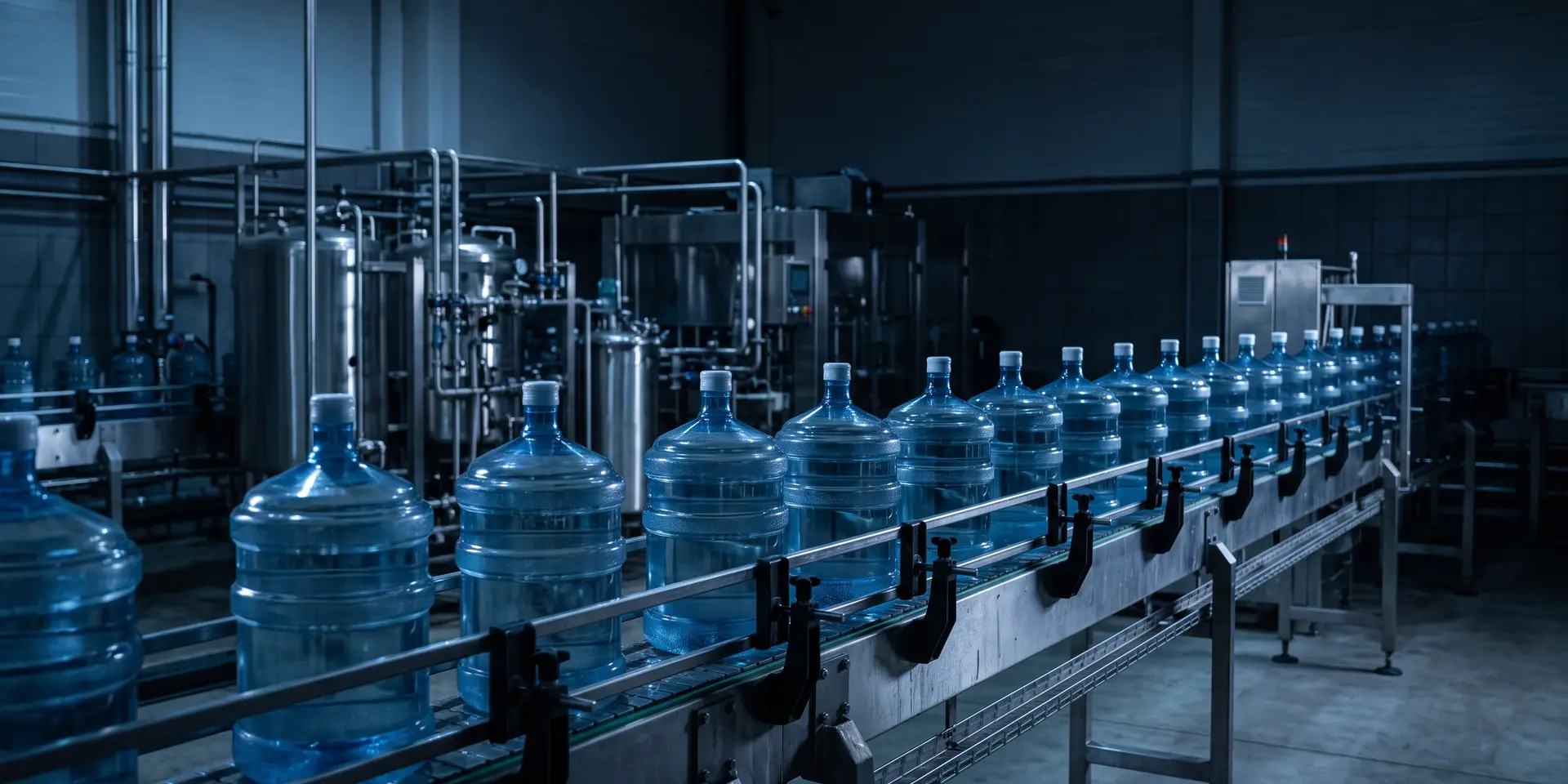
That is the main argument for 19 L bottles when consumption is steady, and it is not about price. A returnable bottle goes back to the line with the courier, leaves no waste at all, and the money for it sits as a refundable deposit that is returned in full when you hand the bottle back. A single-use bottle has no way back: it goes to recycling and is bought anew with every order.
Delivery and timing
Six-litre bottles come with a regular order: delivery across the city is free from 2 bottles, delivery windows are 9–13, 13–17, 17–21, day off Sunday. An order placed before 10:00 goes on the nearest run, but for this size we always confirm the day separately: it depends not on the route but on when the batch arrives.