





3 litre water — you won't find this size on shelves in Almaty
The short answer: nobody in Almaty bottles or delivers drinking water in three-litre bottles. We went through the public price lists of fifteen or so suppliers in the city — this item isn't in any of them. The range of sizes goes from two litres straight to five, with no step in between.
Yet the request is real, and we understand where it comes from. Three litres is a familiar household measure: that is how much the glass jar held, the one generations used for compote and juice. The measure stayed in people's heads, but modern bottling never produced a container for it.
We could put a product card with a made-up price here to make the page look like a shop. We won't: the customer would learn the truth on delivery day anyway, and that is the most costly way to tell them.
A search for three-litre water usually turns up something nearby: a preserving jar, a canister for household use, distilled water in a five-litre bottle or a big bottle for a cooler. This is not a swap or a trick by shops — the product you are looking for doesn't exist, and the search shows the closest thing. It is easier to work out which of the results fits by the task, not by the number in the name.
Where the habit of three litres comes from
Three litres is a rare case of a volume living on in the language longer than on the shelf. The measure came from the glass jar: it stood in every kitchen, it was used for compote, pickled cucumbers and a water supply in case of an outage. The jar set both the number and the very idea of what a household supply of liquid looks like.
The jar had two properties that no modern bottle has. First, it was reusable: it was washed, scalded and put back in the cupboard, and the lid was sealed again. Second, glass gives off no smell and isn't afraid of boiling water, so you could keep anything in it for as long as you liked.
The price was weight and fragility. An empty three-litre jar weighs about seven hundred grams, a full one almost four kilograms, and dropping it meant broken glass all over the kitchen. As soon as light single-use bottles appeared, the jar left everyday use and stayed in home preserving, where its properties are still irreplaceable.
People still keep a jar at home in case the water is cut off, by the way, and in this role it works as well as ever: glass gives off no smell, and water under a lid keeps for weeks. Its downside is the same as always — four kilograms of glass and water on the top shelf of the cupboard.
Hence a conclusion that helps when choosing a substitute: the familiar number describes not a volume of water but a familiar spot on the shelf. If you are looking for three litres, you almost certainly don't need exactly that volume, but a container that fits where the jar used to go and that you can lift with one hand.
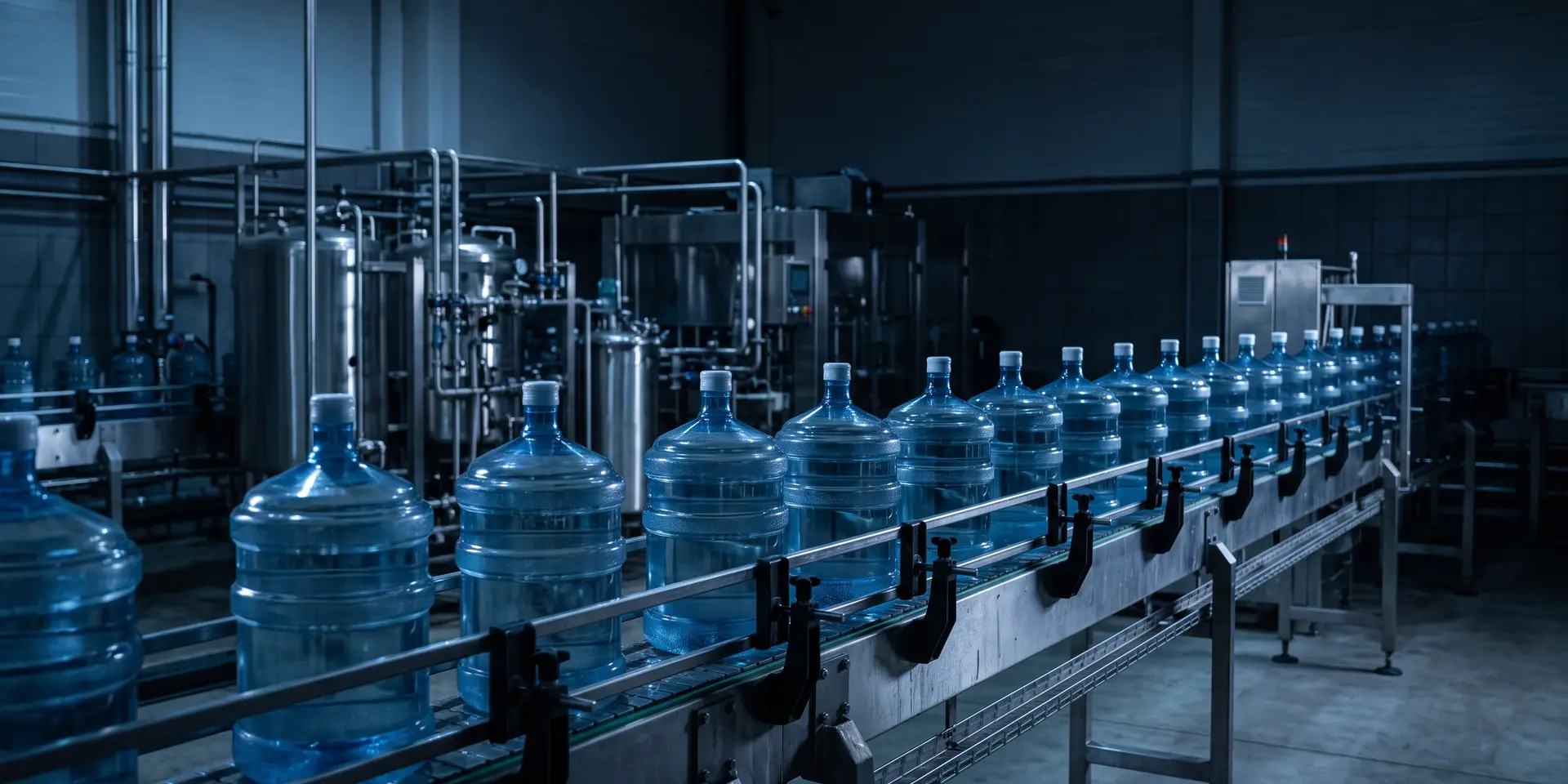
There is a second line to the habit — a three-litre cooler bottle, which people sometimes ask about. There is no such bottle in circulation either: a cooler is designed for the wide neck of the 19 L bottle, and for small volumes what gets made is not big bottles but desktop pumps with a narrow fitting. There is no in-between size between a bottle and a big bottle in this range.
Why the range jumps from two litres to five
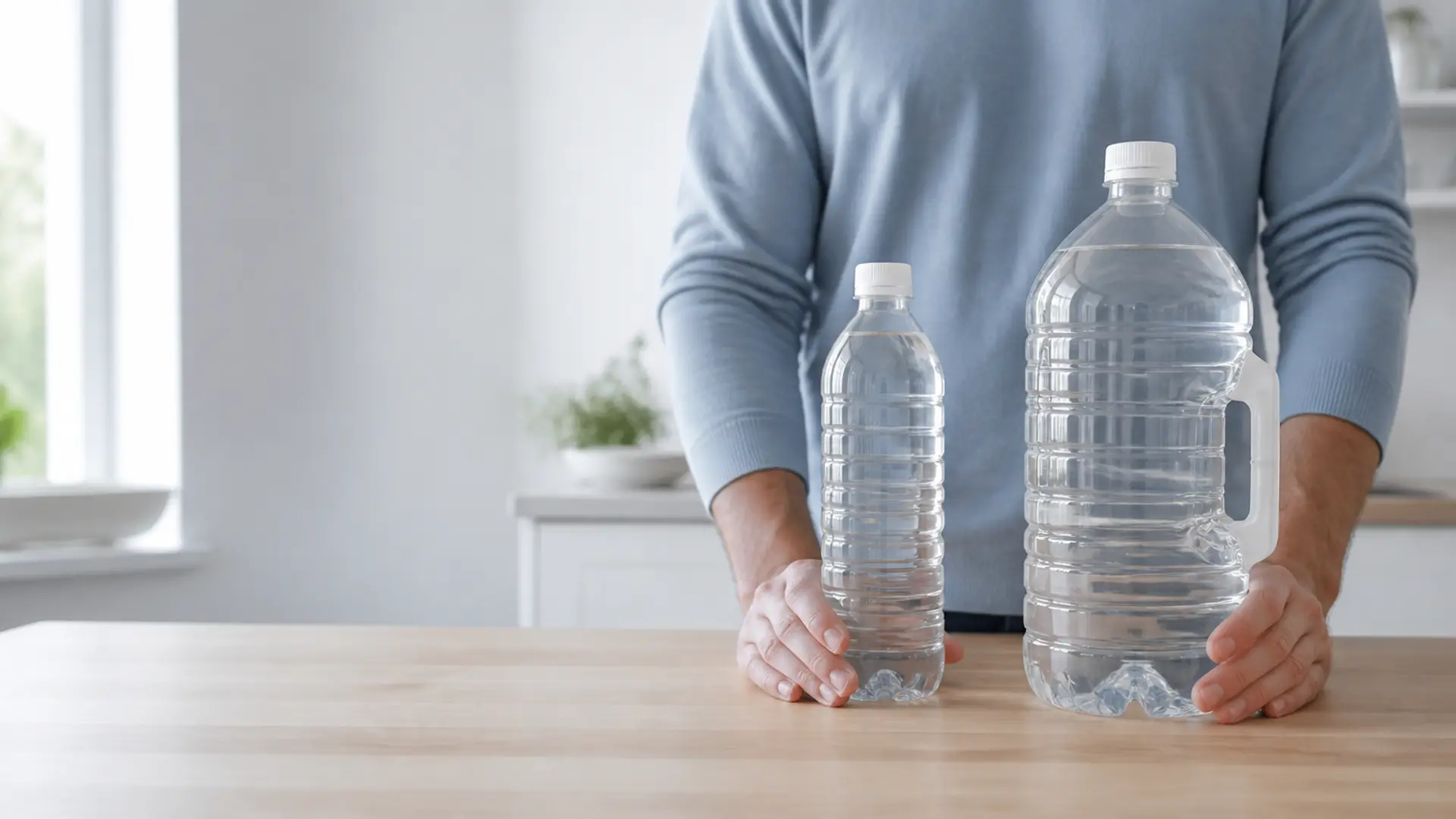
Every size in the range has its own job. Two litres is one person's daily amount and a bottle that still fits on a fridge shelf. Five litres is the first real reserve size: it is carried by the handle, put on the bottom shelf and opened for several days. There is no free space between these two jobs.
Then production comes in. Every new size means its own preform, its own blow mould, its own label and its own pallet-stacking pattern. A plant sets up a line only for a format that will be bought every day; 3 L water doesn't make that list in any country where the range has developed the same way.
And third: three litres lose to both neighbours. They are heavier than two litres by just enough to lose the comfortable grip, and more expensive than five litres per litre, because the bottle costs almost as much. A format that doesn't win on at least one count doesn't survive on the shelf.
There is also a purely warehouse reason. Bottles travel on a pallet in layers, and a layer is calculated so that the pallet doesn't shift on the road and fits in the truck without gaps. This pattern is worked out separately for each size, and a new format breaks the existing patterns for everyone along the chain — from the plant to the shop. Nobody does this work for a step nobody needs.
The range of drinking water sizes: how it came about
The range of sizes is neither invented nor random. Each step in it covers its own job, and neighbouring steps differ not by percentages but by multiples — otherwise buyers would have to choose between two almost identical bottles, and half of the range would sit in the warehouse as dead stock.
| Size | Whose job | Where it stands | Sold in Almaty |
|---|---|---|---|
| 0.33 L | a sip on the go, serving in a café | bag, table | yes |
| 0.5 L | water with you for a few hours | backpack, cup holder | yes |
| 1 L | a working day without a cooler | desk, fridge door | yes |
| 1.5 L | kitchen and car | fridge door | yes |
| 2 L | the daily amount, the kettle | fridge shelf | yes |
| 3 L | no job of its own | nowhere to put it | no |
| 5 L | a supply for several days | bottom shelf, car boot | yes |
| 6 L | the same supply with a bigger handle | pantry, dacha | yes |
| 19 L | steady consumption at home and in the office | cooler, pump, stand | yes |
The empty row in the middle is not an oversight but a consequence. Above it is everything you carry in your hands and open every day; below it is everything you set up once and pour from where it is stored. Three litres fall into neither group: too heavy to carry, and pointless to set up — the volume would run out in two days.
There is a similar but gentler drop further up the range. Between six litres and nineteen sits the ten-litre bottle, and it is bought noticeably less often than its neighbours: ten kilograms already take two hands to carry, and a bottle like that doesn't fit a cooler. A format survives where it is either handier than its neighbours or cheaper, and neither of those comes by halves.
Food service has its own range, and there are no three litres there either. Cafés take either small bottles for serving or big bottles for the cooler and the coffee machine. An in-between size is awkward in a restaurant kitchen too: there is nothing to pour it into a dispensing tap with and nowhere to keep it in a fridge where every shelf is taken up by food.
The bottle material and its own range of sizes
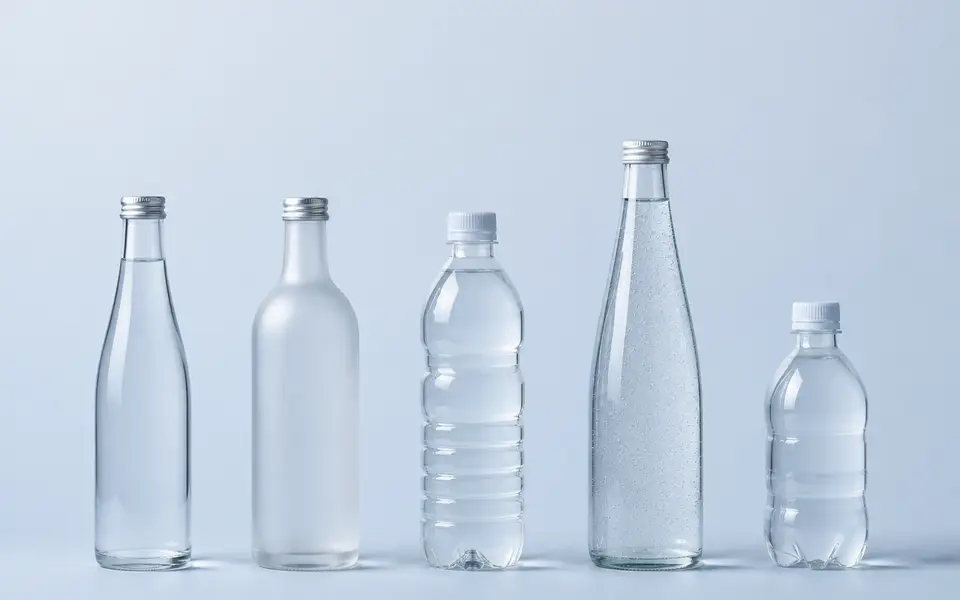
The second answer to the three-litre question lies in the material. Glass, PET and polycarbonate have different ranges of sizes, and their limits are set not by demand but by physics: each material holds its shape and weight only up to its own limit.
- Glass: 0.33, 0.5, 0.75 and a litre. Beyond that the bottle is heavy in itself and breaks under its own weight
- PET: from 0.25 to six litres. The wall is cheap but holds its shape only up to a certain volume
- Polycarbonate: 11 and 19 litres. The material is expensive and pays off only in returnable bottles
- Bag-in-box with a tap: from five litres, found in food service, hardly ever seen in retail
A three-litre PET bottle is technically possible — the limit is economic, not physical. Every format needs its own preform, its own blow mould, its own label, its own pallet-stacking pattern and its own warehouse space with every seller along the chain. Nobody will set all that up for a step that takes buyers away from both of its neighbours.
Service life also follows from the material. Glass doesn't age at all, polycarbonate withstands dozens of washing and filling cycles, and PET is designed for one: a thin wall cannot be treated so that it becomes sterile again. That is why the range of sizes in single-use bottles is wider and in returnable ones shorter — a returnable format has to pay for washing, inspection and tracking of every unit.
A three-litre glass jar still exists, by the way — but as a preserving jar, not as a water container. Drinking water can't be bottled into it industrially: a neck made for a seaming lid isn't built for a conveyor, and the weight of a full jar makes delivery cost more than what is inside.
What covers three litres
The task usually sounds like this: you need a water supply for a couple of days that fits in the fridge and can be lifted with one hand. It can be solved in any of four ways, and the choice depends on what matters more — space or price.
| What to take instead | How much you get | What you gain |
|---|---|---|
| Two 1.5 litre bottles | exactly three litres | both fit in the fridge door, easy to pour |
| One and a half litres plus two | three and a half litres | one in the door, the other on a shelf, nothing gets in the way |
| One 5 litre bottle | five litres | each litre costs less, but you need a bottom shelf |
| A 19 litre bottle | nineteen litres | the lowest price per litre, you need a cooler or a pump |
Most often people choose the first option: two 1.5 litre bottles give exactly the same volume, fit where a three-litre bottle wouldn't and are opened in turn — the second stays sealed and fresh until the first is finished. One large bottle doesn't have that advantage.
The fourth row of the table stands apart: it is not a substitute for three litres but a change of approach. A 19 L bottle is not matched to a fridge shelf — it needs a spot on the floor or on a stand, and in return it takes the whole question of supply off the table. That is why it comes last in the table: people get to it not straight away, but when it becomes clear that water is needed every day and in quantity.
The second most common option is one and a half plus two. It gives half a litre more than you were looking for, but wins in another way: bottles of different sizes don't get mixed up, and you can always see which one is open. In a home where several people take water, that matters more than an exact volume.
If you really need three litres
Sometimes three litres is not about the bottle but about consumption: that is how much a family or a shift uses in a day. Then you should count not bottles but the week. Three litres a day is more than twenty litres a week, that is, a little more than one nineteen-litre bottle.
- Three litres a day at home — one 19 L bottle a week plus small bottles to take with you
- Three litres once, for a trip — two 1.5 litre bottles or one 5 litre bottle
- Three litres for cooking — a larger bottle, it is easier to pour into a pot
- Three litres a day for an office — one-litre bottles in the fridge, one per person
In this calculation the 19 L bottle almost always wins: it is cheaper per litre, leaves no empty plastic and arrives on a schedule, not when the water has already run out. All it asks in return is space for a cooler or a pump and a deposit for the bottle, which you get back together with the bottle.
The pump deserves a word of its own here. A mechanical one costs 4 500 ₸, an automatic one 8 900 ₸; either fits onto the neck in a few seconds, takes no floor space, and the mechanical one doesn't even need a socket. For people switching from small bottles to a big one, it is the cheapest way in: you can get a cooler later or not at all.
Three litres a day: a week and a month in bottles
If three litres for you is not a bottle but consumption, it is easier to count in weeks and months. Then you can see at what volume small bottles stop making sense, and you can see it without any price list — by the number of bottles and the number of times they are carried into the flat.
| Period | How much water | In 1.5 L bottles | In 5 L bottles | In 19 L bottles |
|---|---|---|---|---|
| Day | 3 litres | two | less than one | none |
| Week | 21 litres | fourteen | four or five | one and a bit |
| Month | 90 litres | sixty | eighteen | five |
Sixty 1.5 litre bottles a month means ten packs, ten trips carrying them into the flat and a sack of plastic. Five 19 L bottles over the same month mean five courier visits, zero empty plastic at home and the lowest possible price per litre. You can see the gap without a calculator.
The middle column also explains why the three-litre question comes most often from people who haven't yet switched to big bottles. When you are used to small bottles, a 19 L bottle seems like a lot. In fact, 3 L of water a day is covered by one big bottle in a little over a week, and the next order comes at the same time as the next pack of small bottles would have.
Counting the other way round is useful too. If a big bottle seems excessive, look at how many times a month you buy water now: ten trips with a pack mean ten decisions, ten payments and ten climbs up the stairs. A big bottle turns them into five visits agreed in advance, which you don't have to remember.
How to choose a substitute for your space
A substitute is chosen in the opposite order to habit: first the place, then the person who will pour, and only then the volume. Do it the other way round and you end up in exactly the situation that makes people search for three litres: there is a number, but nowhere to put it.
- Measure the space: the height of the fridge shelf, the depth of the pantry, the clearance under the sink
- Consider who will pour: if children or older people, the upper limit is one and a half litres
- Count your consumption per week, not per day: the weekly figure immediately shows whether it's small bottles or a big one
- Decide who carries: five kilograms is taken with one hand, nineteen only goes onto a cooler or a stand
- Check for a socket and a level floor if you are considering a cooler
The most common mistake along the way is to take a large bottle without checking the shelf. A 5 litre bottle doesn't fit in the door and doesn't go under the ceiling of the freezer compartment; if there is no free bottom shelf in the fridge, it stays warm in the kitchen, and the whole idea of a supply is lost.
The second most common is to count by price per litre where the volume is small. At three litres a day the difference between formats over a month is noticeable; at half a litre there is almost none, and it is worth choosing by convenience. Price starts to decide from the moment water goes not only into drinking but into cooking too.
It makes sense to base the first order on the lower end of the estimate and see how long it lasts. Real consumption becomes clear after two or three weeks, and it almost always differs from the estimate: tea, soup and fruit cover part of the norm, and in summer the figure grows. Getting it wrong on the low side is no problem — an order placed before 10:00 goes on the same day's run.
What we deliver across Almaty
We have small bottles from a third of a litre to two, larger ones of five and six litres, and nineteen-litre bottles. Delivery in the city is free from 2 bottles per order, windows are 9–13, 13–17, 17–21, day off Sunday. An order placed before 10:00 goes on the same day's run.
Small bottles travel on the same run as the big ones, and that affects the best way to order. A separate delivery of a couple of packs is charged separately, while the same packs as part of a regular order travel with it. So when choosing a substitute for three litres, it makes sense to decide first what covers your main consumption and add small bottles to that, not the other way round.
Tell us on WhatsApp how much water you use a week and where it will stand — we will match the volume to the space, not to a familiar number. If three-litre bottles ever appear in Almaty, this page will be the first to tell you.