





Desktop water coolers: where they go
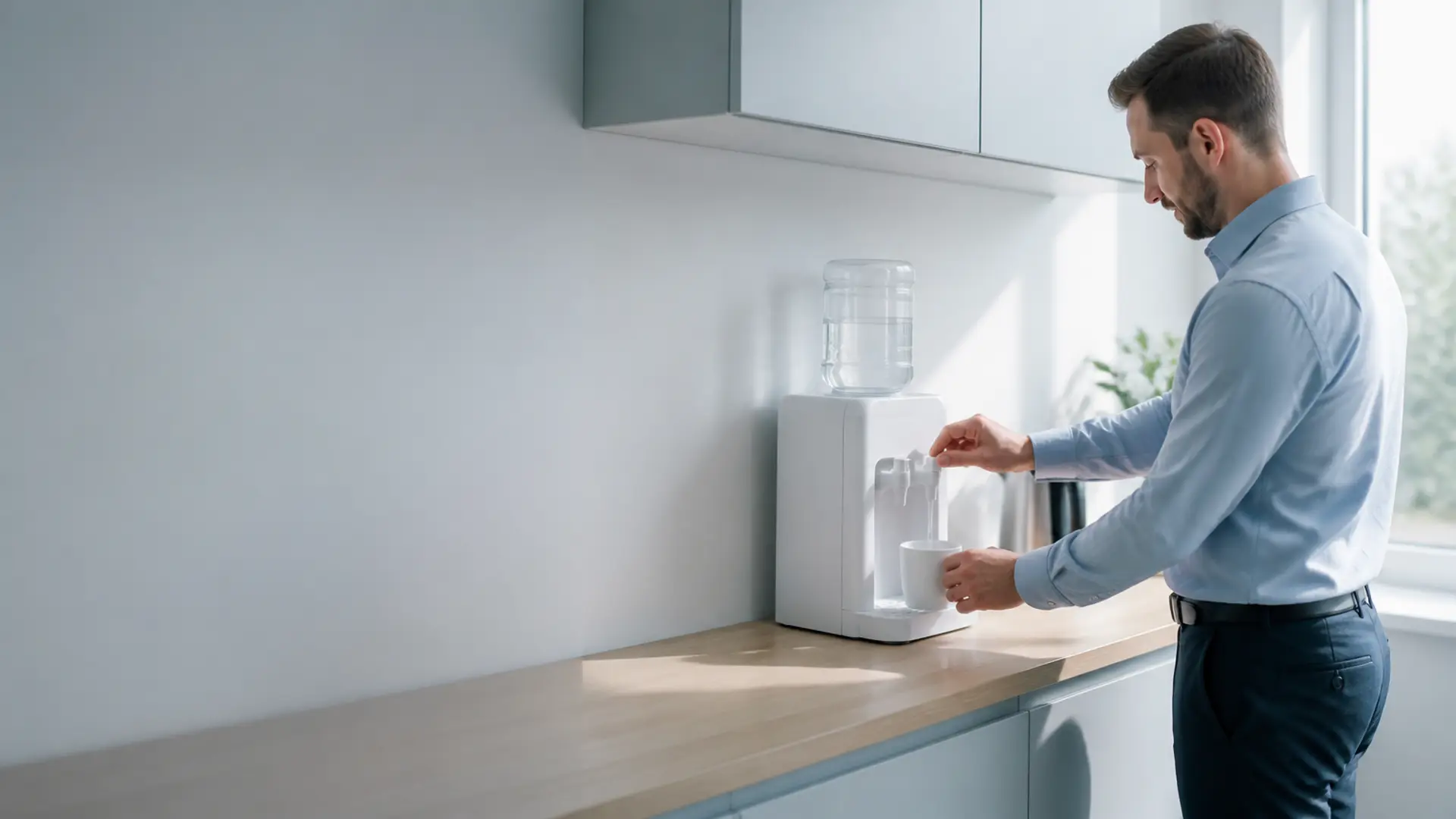
There is exactly one difference from a floor-standing model: this one has no legs and no cabinet, it rests on whatever it stands on. That gives the whole list of places — a kitchen worktop, a cabinet by the window, a meeting room table, a shelf in a back room, a reception desk. Wherever there is a level surface and a socket within reach of the cord, the appliance will fit.
The second consequence is that the bottle is lifted not from the floor but to table height — that is, higher. Nineteen litres have to be carried up to the worktop and turned over there, and that is the only action in which a desktop model loses to a floor-standing one. For those who find the lift hard, it is usually placed on a lower cabinet.
Price lists write this item in different ways, and all of them mean the same thing: desktop cooler, desktop water dispenser, tabletop water dispenser. Whichever wording you search for, you will end up at the same product.
What is inside and why it is so light
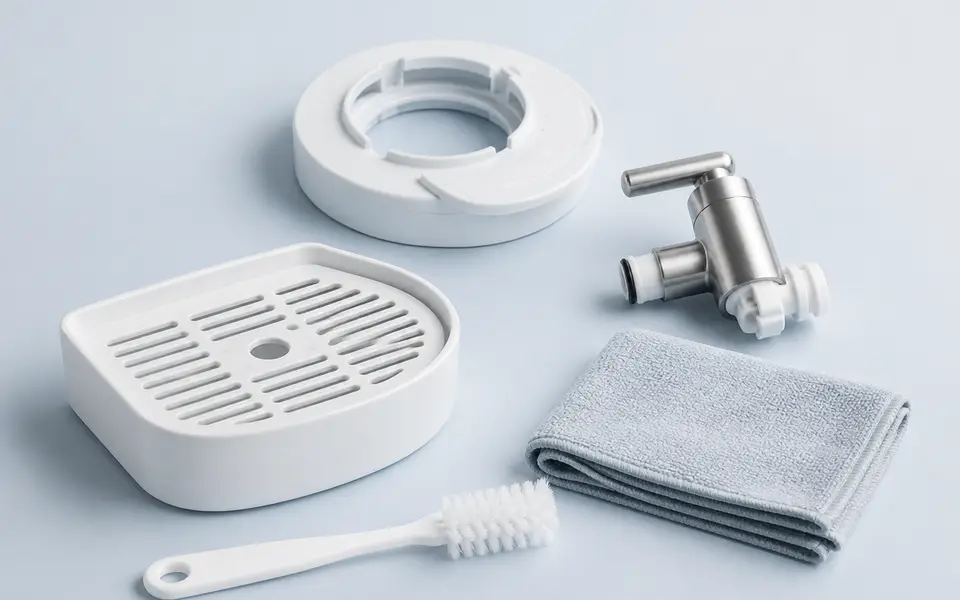
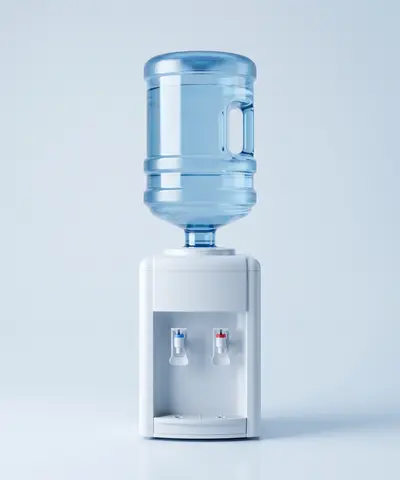
A compact model's body is simpler than a floor-standing one not to save money, but because what took up volume has been removed. Inside remain the bottle seat with a probe and a silicone seal, a cold water tank, a hot water tank, two taps, a removable drip tray and a heat-exchange grille on the back panel. There is no cabinet, cupboard or legs — their place is taken by the surface the appliance stands on.
Hence the weight. The empty body weighs seven to eight kilograms, roughly the weight of a small television: one person can lift and carry it. Most of the mass is in the tanks and the cooling unit at the back, so the centre of gravity is shifted backwards — when carrying it, hold the body from below, not by the taps.
The body is made of impact-resistant plastic and the back panel of painted steel. The cold water tank, however, comes in two kinds, and it is the one specification worth looking at carefully when choosing a compact model: plastic is cheaper, stainless steel does not pick up odours and copes better with sanitising. After a year you can taste the difference, even though in the specifications it takes up a single line.
The tanks are smaller too, and that is the only thing that has really shrunk along with the body: the cold one holds about a litre, the hot one roughly the same. The water is heated and cooled by the same technology as in a full-size model, and the way the appliance cools has nothing to do with its size: the cooling method is chosen separately from the size.
The full list of what is inside is short, and almost every item on it answers some question you will have when choosing:
- The bottle seat with a probe and a seal — the neck of the upturned bottle sits in it, and it is usually this, not the tank, that leaks.
- Two tanks of about a litre each, cold and hot, with separate switches on the back panel.
- A removable drip tray: you take it out and empty it. A fixed drip tray on a compact model is a noticeable drawback, as it is awkward to clean on a table.
- A cord of about a metre and a half, usually non-detachable: the socket needs to be next to the surface, not across the room.
- Four rubber feet instead of legs — on a smooth worktop they grip worse than you would think and wear down over time.
One more small thing people notice only after buying: the taps on compact models sit lower above the drip tray than on floor-standing ones, and a tall sports bottle or a flask will not fit under them. There is enough clearance for a glass or a mug, but if you plan to fill a bottle to take with you, check the height under the tap in advance.
What to measure before buying: height, depth and clearance
The mistake when choosing is almost always the same — people measure the body and forget about the bottle on top. The full height is made up of two things: the appliance itself, about the height of a large electric kettle, and above it the upturned bottle. Together, from the worktop to the cap it comes to more than a metre, and such a set-up will not fit under a wall cupboard.
So there are four things to measure, preferably before ordering rather than after delivery:
- The height from the surface to the nearest shelf or cupboard above — with room to spare for turning the bottle over the neck seat.
- The depth of the surface: the body must not overhang the edge, or the appliance will rock when you change the bottle.
- The clearance behind for the cooling grille: it must not stand right against the wall, or the cooling is lost.
- The length of the cord to the socket — better not to run an extension lead under an appliance with heating.
Two more measurements people remember only once they are in the kitchen. The first is the width with the wall cupboard door open: it swings right over the appliance, and you have to move it every time. The second is room for your hands: to turn the bottle over the neck seat you need a free semicircle about the radius of your forearm, and more often than a cupboard, what gets in the way is the cooker hood, a spice shelf or a light fitting.
The body itself is not heavy: one person can carry it, and moving it from the kitchen to an office takes a minute. But with a full bottle the set-up becomes heavy and top-heavy — it is best not to slide it across the table like that.
Surface: table, cabinet or bottle stand
The surface is chosen by three criteria: it does not rock, it is no shallower than the body, and it stands at a height that puts the tap above your glass, not under your chin. A comfortable tap height is roughly seventy-five to ninety-five centimetres from the floor. An ordinary kitchen worktop gives the lower end of that range, a tall cabinet the upper end.
Then comes what product listings do not tell you. A glass table or a folding stand holds the weight, but not the jolt of changing the bottle. The windowsill in most flats is shallower than the body and sits in the sun. The top of a fridge or a microwave gives off heat upwards, and the cooling grille ends up in the warm flow. A bottle stand (7 900 ₸), on the other hand, was designed for exactly this case: the appliance is raised to working height, and spare bottles go underneath.
| Surface | Why it works | What to keep in mind |
|---|---|---|
| Kitchen worktop | level, deep, socket nearby | there is usually a wall cupboard above — measure the height with the bottle |
| Cabinet or chest of drawers | you choose the height, easy to move away from the wall | cabinets are often shallower than the body |
| Bottle stand | raises the appliance and stores spare bottles beneath it | takes up floor space — part of the gain is lost |
| Meeting room table | water is two steps away, the appliance is in sight | the bottle is changed in front of everyone, better placed near the edge |
| Top of a fridge or microwave | nothing, people put it there only as a last resort | warm air from below and changing the bottle at arm's length |
A more precise word about depth. The appliance should stand on the surface on all four points and not overhang the edge: when you press a tap, the body tips forward, and an overhanging edge turns that movement into rocking. If the surface is a couple of centimetres too shallow, turn the appliance sideways — depth stops being a problem, but the tap then faces along the table, and you have to hold the glass from the side.
About the socket and the cord. An extension lead under an appliance with heating is bad not because of power but because of its position: it lies exactly where water drips when you change the bottle. If there is no socket nearby, it is easier to move the appliance than to run a cable through the work area. And it is worth covering the wall behind it: splashes from the tap and drips from the neck fly backwards, and here the wall is closer to tap level than with a floor-standing model.
Who needs a desktop water cooler
There are four typical buyers, and none of them choose it because of money — they choose it because of space. The first is a small kitchen in a flat, where a floor-standing one would have to stand in the way. The second is an office of two to four people: there the appliance lives on a cabinet next to the kettle and covers all the consumption.
The third is rented housing: compact appliances are easier to take with you when you move, and they do not look like furniture you would be sorry to leave behind. The fourth is a second appliance in addition to the main one: in a meeting room, a workshop or a warehouse, where there is no reason for a full-size one but water is needed.
A fifth case is rarer but the most telling: a compact appliance is bought in addition to a floor-standing one that is already there. Then it goes where the people are, the big one stays where there is room, and the question of choosing between two bodies resolves itself.
What all four cases have in common is not low consumption but little space. A compact model goes where a floor-standing one simply has nowhere to stand, and almost never where the floor is free: with free floor space the choice goes the other way, because a floor-standing appliance does not take up the worktop.
| What we compare | Desktop | Floor-standing |
|---|---|---|
| Where it goes | cabinet, worktop, table | floor, corner, corridor |
| Space it takes | the space of a kettle | about half a square metre |
| How high to lift the bottle | to table height | to waist height |
| Cupboard for cups | no | usually yes |
| Purchase price | 34 900 ₸ | from 45 000 ₸ |
How much water it gives in a row
A compact body limits not monthly consumption but one-off demand. Monthly consumption depends on the bottles and how often they are changed, and has nothing to do with the size of the appliance. But how many cold glasses you can pour in a row is set by the tank size, and here it is about a litre.
A litre is three or four glasses, or two glasses and a cup. After that, room-temperature water from the bottle flows into the tank, and the next serving will be warmer. The cold comes back in about half an hour, faster on compressor models. The hot tank is the same, only it is counted in mugs: the appliance gives four mugs of tea in a row, and the fifth takes a few minutes.
| How many people come at once | Cold | Hot |
|---|---|---|
| One or two | plenty to spare | plenty to spare |
| Three or four | the last glass is noticeably warmer | the last mug is still hot |
| Five or more | cold water is enough for half the queue | you will have to wait a few minutes |
Hence a rule of choice that works better than specifications: count not people but the peak. Two people at home and four in an office who drink at different times do not notice a compact model. The same four coming for tea in the same minute after a meeting hit the limit of the tank every time. If you have such a peak daily, look not at the size but at whether the tank has time to recover between peaks.
If there is still not enough cold water, try five things first, and replacing the appliance comes last on the list:
- Move the appliance somewhere cooler: by a sunny window or next to a cooker the tank cannot keep up.
- Free the grille at the back — a hand's width to the wall and no recesses.
- Keep spare bottles in a cool place: warm water from them heats the tank with every change.
- Pour in advance — a jug put in the fridge takes care of the peak more reliably than any appliance.
- If the peak is daily, look towards compressor cooling: it brings back the cold faster.
Monthly volume is counted separately, and the appliance has no effect on it at all: it dispenses from the same bottle as a floor-standing one. It only affects where you keep your reserve. A bottle does not like standing under the worktop — people knock it with their feet there — so the second bottle is usually tucked into a cupboard, put in the pantry or on the same stand the appliance sits on.
Desktop water dispenser versus floor-standing
There is no difference in the water at all: the same bottle, the same standard neck, the same two taps. The difference lies entirely in the body and in what it takes up. Desktop coolers are cheaper than floor-standing ones simply because they use less material, not because they cool worse.
A desktop dispenser gives up two things. The first is the cupboard: there will be nowhere to keep cups and a spare bottle. The second is free worktop: the space the appliance takes is usually in short supply in a kitchen. If you do not mind losing either, a compact model covers exactly the same needs.
There is a third difference that shows up after a year. A floor-standing appliance stays in place and is rarely moved; a compact one moves with every rearrangement of the kitchen, slides across the table when you press the tap and is handled more often. That is not a flaw, but it is where worn feet, a loose bottle seat and a chipped edge come from — things floor-standing models almost never have.
How to place a desktop cooler without regrets
A desktop water cooler goes not where it looks nice but where the bottle will be changed. The changing spot matters more than the standing spot: if you have to pull the appliance to the edge of the table every time you replace the bottle, you will soon start putting it off until the last moment. A silicone mat under the body is a good idea — it stops it sliding and catches the drips.
And one decision you make only once. The tap should hang over the edge of the surface or at least sit right at the edge: if it faces into the worktop, every spilt drop stays on the work surface. The appliance is placed not flush with the wall but slightly forward — that keeps the gap at the back, and the drips land in the tray, not on the table.
The rest is ordinary hygiene: wipe the taps and drip tray, rinse the tank every six months, and do not put the appliance by a radiator or in direct sun. Buying a desktop cooler and not cleaning it for six months is a sure way to get an aftertaste that is later blamed on the water.
What breaks on a compact model
Its list of breakdowns is shorter than a floor-standing one's by exactly the parts it does not have. In practice three things break: the bottle seat under the neck, the taps and the cooling. The first two almost always reflect not the age of the appliance but how it has been treated.
A leak from under the bottle means it has been put on at an angle or that a ring from the cap is left on the neck. Water on the table is more often a forgotten, overflowing drip tray than a punctured tank. A dripping tap is replaced as a whole: inside it there is a silicone stem that wears down over time. Only lost cooling with a working fan is a real fault that needs a service centre.
- Dripping from under the bottle — take it off, wipe the neck and the seat dry, and put it back on straight.
- The cold water is no longer cold — move the body away from the wall and clean the grille at the back: dust on it kills cooling faster than age does.
- Water comes out of the tap in a thin trickle — remove and rinse the tap, it is usually limescale.
- A plastic or stale taste has appeared — that is the tank, and the cure is sanitising, not changing your water supplier.
- The appliance slides when you press the tap — the rubber feet have worn down; replacing them is easier than holding the body with your hand every time.
- The hot water stopped heating after the bottle ran completely dry — most likely the heater protection has tripped, and that is a job for the service centre.
A separate case is a leak that appears not straight away but after a few months. Most often it is the seal in the bottle seat: hot water makes it shrink and it stops gripping the neck. It takes a minute to replace, but finding the cause is harder than fixing it: with this kind of leak the water comes out not under the bottle but inside the body, and shows up outside somewhere off to the side.
A separate word on what a compact model does not forgive. Running dry — when the bottle is empty but the heating switch is still on — kills the heater faster than anything else, and it happens more often with compact appliances: an empty bottle up top is harder to see than a transparent bottle by the floor. The habit of switching the heating off before changing the bottle removes the problem entirely.
A compact appliance lasts as long as a floor-standing one — several years of constant use, and what limits it is usually not the body but the care. The difference lies elsewhere: the appliance is cheaper, and the arithmetic of repairs is different. A technician's call-out and a part replacement can be comparable to the price of a new appliance, so here, more often than with floor-standing models, people choose rental — a rented appliance that breaks is simply swapped.
Buying a desktop water cooler or renting one
Buying costs 34 900 ₸, rental is 1 500 ₸ per month, and with a regular order of 15 bottles a month or more, rental becomes free. For a flat with low consumption, buying is usually better value; for an office that takes water regularly anyway, rental is better value — you simply stop paying for it.
We bring it along with the water in one trip, and the courier puts the appliance in place and starts it up: shows how to remove the cap, where the air escapes and how many minutes until the cold water comes. Delivery in the city is free from 2 bottles, and an order placed before 10:00 usually goes out the same day.