





0.33 litre water — a table format, not a bag one
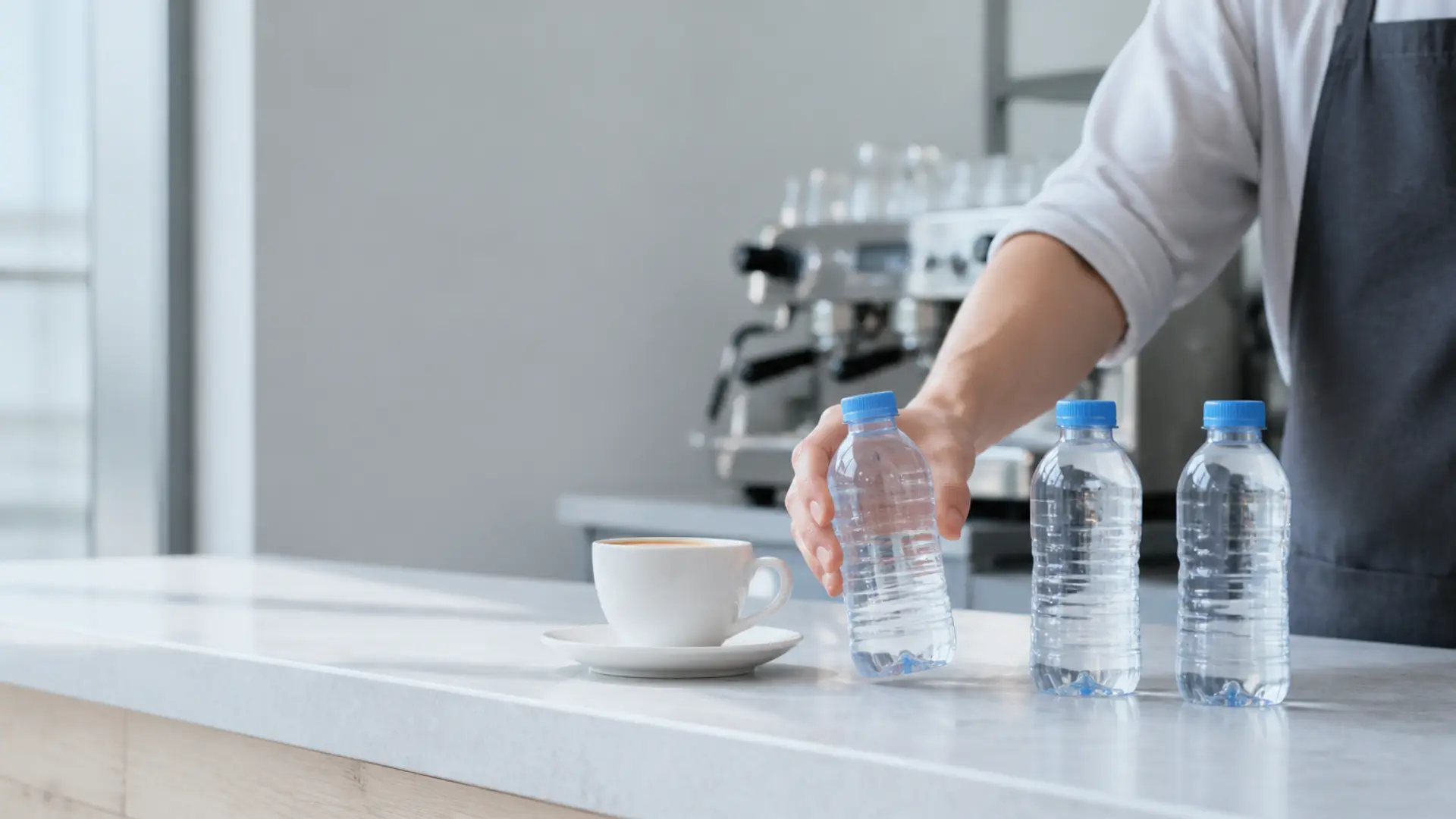
A third of a litre is a single-serve size. It was not designed to be carried around but to be set in front of someone: on a meeting table, a tray, in a hotel room, at a conference registration desk. A guest opens their own bottle, finishes it during the meeting and does not leave a half-drunk one behind.
That is exactly what people buy along with the water — a sealed cap. A carafe on the table saves money but needs glasses, washing up and someone to refill it; a single-serve bottle needs nothing but a spot on the tray. That is why 0.33 lives in venues, not in home fridges.
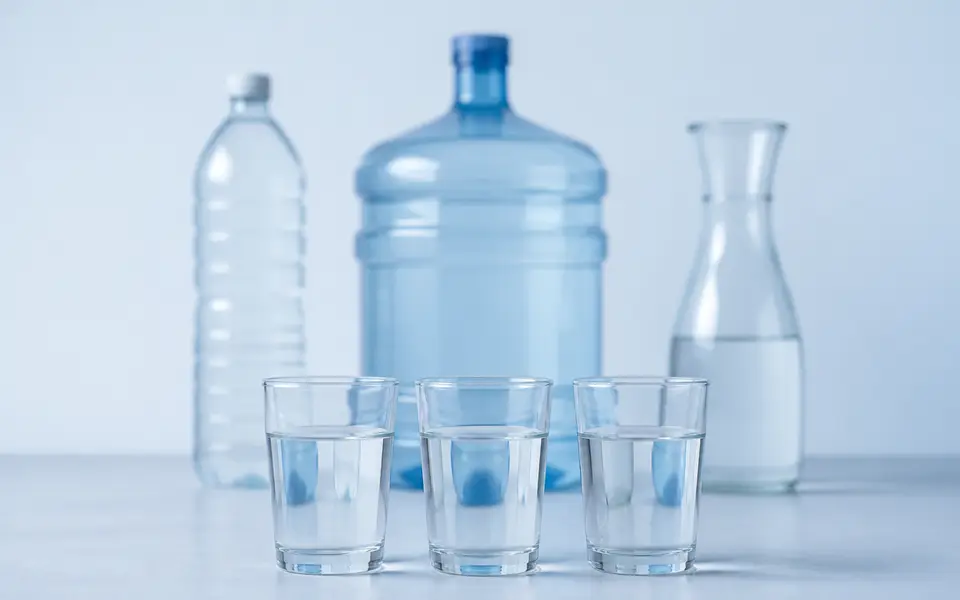
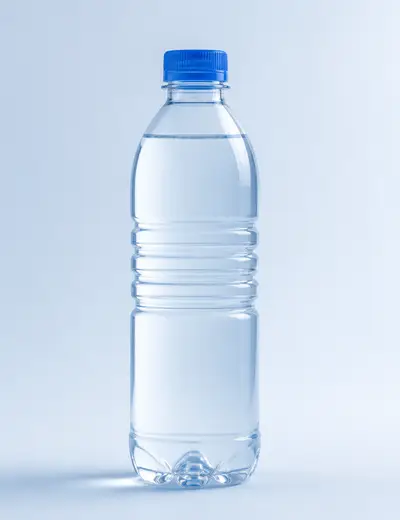
Our 0.33 water is the same artesian water as in our 19 L bottles. The difference is not the water but that guests see the bottle: it is set with the label facing the person, and in this format the label is held to a higher standard than on any other bottle.
The single-serve range: 0.25, 0.33 and 0.5 on the table
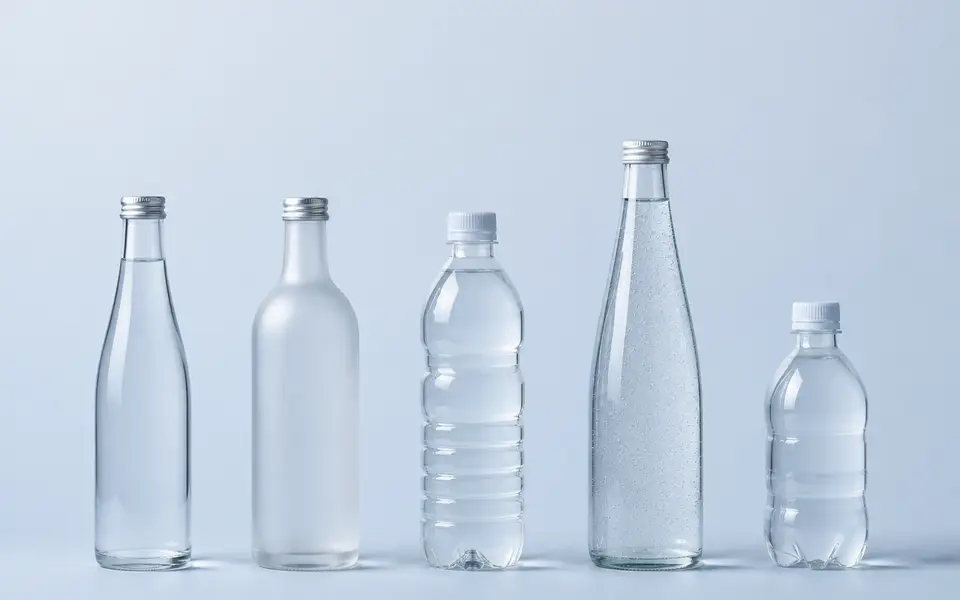
There are really three single-serve sizes, and the choice between them depends not on price but on how long the event lasts and what else is on the table. The longer people sit and the less else there is to drink, the bigger the bottle should be. Erring on that side costs more than overpaying: a meeting where the water ran out after an hour is remembered longer than its price.
| Size | Where it usually stands | How long it lasts a guest |
|---|---|---|
| 0.25 litres | next to an espresso in a coffee shop, next to wine at a banquet | one cup or one toast |
| 0.33 litres | meeting room, conference, hotel room, tray | a meeting of an hour and a half to two hours |
| 0.5 litres | handouts at the entrance, field crews, sports events | half a day, if the guest takes the bottle away |
A hotel room works on the same logic. Two third-of-a-litre bottles on the bedside table means one per guest for the evening, and housekeeping never has to decide whether a guest finished a big bottle: an opened one goes, a sealed one stays. Any other size breaks that simplicity, which is why hotel rooms all over the world have roughly the same thing.
A third of a litre became the meeting-room standard precisely because it covers an average meeting in full. With a quarter of a litre you have to open a second bottle, and it reaches the guest already warm; half a litre is left unfinished, and after the meeting half-drunk bottles have to be cleared off the table with nowhere to put them.
Consumption depends heavily on what else is on the table. Where guests are served tea, coffee or juice, noticeably less water goes — it works as an extra. Where there is nothing but water — at training sessions, technical meetings, waiting rooms — it becomes the only drink, and you should plan for the upper limit. That is why the same room for twenty people gets through ten bottles one day and forty another.
A quarter of a litre, meanwhile, belongs in coffee shops and at banquets, where water is not the main drink but an accompaniment. Half a litre, on the other hand, suits places where the guest gets up and leaves bottle in hand: at the entrance to a hall, at a race registration, when a crew heads out. A third of a litre is the only one of the three that people both finish on the spot and do not leave behind.
Why a small bottle costs more than a large one
A third of a litre almost always costs more than half a litre of the same water, and that is not a mistake in the price list. The bottle, cap, label and pallet space cost the same whatever the amount of water inside, and a small bottle holds less. On top of that, mineral water and glass are bottled in this size more often — the format is a restaurant one from the start.
So comparing 0.33 with a half-litre bottle on price makes no sense: they are different purchases. In one case you are buying water, in the other — table service. As soon as a third of a litre is bought for personal drinking, it loses at once to both the half-litre and the one-litre bottle.
How single-serve water is served to guests
A single-serve bottle is part of the table setting and is handled like cutlery. The difference between “put water out” and “served water” is obvious to a guest at once, and it costs nothing but staff attention: the bottle is set with the label facing the person, the glass to its right, and the guest opens the bottle, not the waiter in advance.
- The label faces the guest: that is why it is designed as the front, not a technical side
- The cap is not cracked in advance — a sealed bottle is exactly what you pay for in the single-serve format
- A glass goes next to it even if people drink from the bottle: the choice stays with the guest
- Serving temperature is about 10–12 degrees; ice-cold water drowns out the taste of food and coffee
- Opened bottles are cleared once the guest leaves, not moved to the next table
Self-service is a separate case: a reception desk, a waiting area, a doctor's office, a lounge. Nobody serves the bottle there, and it only works if it is visible and within reach without asking. The usual solution is a basket or an ice bucket in plain view with a stock next to it, so visitors help themselves and the administrator is not distracted from their work.
Temperature is the only difficulty of the single-serve format at an off-site event. A third of a litre warms up faster than any other bottle: the mass is small and the surface relatively large. Out of the fridge, such a bottle reaches room temperature in about half an hour, and in the sun in a matter of minutes. So at a venue the water is kept in the shade and in crates and brought to the tables in batches, not all at once.
A venue checks a delivery on three points, and it takes a minute. The shrink film is intact, the caps have not been twisted, and the bottling date and shelf life can be read on the label. A bottle with torn film or a leak under the cap does not go to a guest's table: in the single-serve format the sealed cap is the whole point of the purchase, and one suspicious bottle costs more than a whole carton.
At long events a simple rule helps: water goes out for each break, not for the whole event. A dozen and a half bottles on a coffee-break table are gone in ten minutes, and it is easier to bring them twice from a cool place than to put out a hundred at once and be handing out warm water by lunchtime.
0.33 water wholesale: how venues plan their purchases
Purchases are counted in guests, not packs. Venues' experience gives a simple guide: at a meeting or training session a person drinks one bottle in an hour and a half to two hours, at a banquet one and a half over the evening, and in hot weather or with spicy food twice as much.
| Event | How many people | 0.33 bottles |
|---|---|---|
| A two-hour meeting | four | six to eight |
| A half-day training session | twenty | about forty |
| An evening banquet | fifty | about a hundred |
| A summer day in a coffee shop with ten tables | depends on turnover | about fifty |
Then a margin is added to the calculation: water is the one item whose shortage everyone notices at once. A sensible margin for an event is a tenth on top of the estimate; for a permanent outlet, a week's turnover in stock.
Buying 0.33 water one pack at a time makes little sense: delivering one pack costs more than the pack itself. We deliver this size either as part of a regular order or wholesale for a venue — on a schedule and on our own route.
There is a third cost that venues do not account for right away — the empties. Single-serve bottles pile up faster than any other kind: fifty guests in an evening leave fifty empty bottles, and room for them in the storeroom has to be planned in advance. Permanent outlets set up a separate bin and a collection schedule for this.
Stock at the outlet: where it sits and how it rotates
Single-serve water takes up a lot of space per litre: the same hundred litres in third-of-a-litre bottles means three times as many cartons as in one-and-a-half-litre ones. So stock at an outlet is planned before the first purchase, not after it, and the limit is usually not money but square metres of storeroom.
- The space for cartons should be cool and dark: heat and direct sun spoil water faster than any shelf life
- Cartons go on a pallet or a shelf, not on the floor — that makes them easier to count and to clean under
- A fresh batch goes to the back, the older one moves to the front: stock is always used from the earliest bottling date
- The bottling date and batch number are visible on the side of the carton — keep count by them, not by the number of boxes
- Flatten empty cartons right away: in a small outlet the cardboard takes up as much room as the water itself
A sensible stock level for a permanent outlet is a week's turnover plus a small reserve for the weekend. Holding more is doubly unprofitable: the money is tied up in cartons, and meanwhile the water is ageing in the storeroom rather than being served. Holding less is bad too — the venue runs out of water on the day a delivery is late.
About shelf life, remember that it is counted from the bottling date and applies to a sealed bottle kept in normal conditions. A batch that has spent the summer on the sunny side of a warehouse is formally still in date, but its taste has actually changed: the plastic heats up, and you notice it with the first sip. That is why outlets with slow turnover buy less and more often, not the other way round.
In summer the calculation shifts noticeably. In hot weather consumption indoors rises one and a half to two times, and on a terrace even more, so an outlet that managed with ten packs a week in winter needs fifteen to twenty in July. It is easier to recalculate the schedule at the start of the season than to top up one pack at a time with urgent runs every week.
Unloading at the venue: what we ask before the run
An event differs from an office in that the address is not the same as the unloading point. The van pulls up not at the office door but at a gate, a service entrance or a car park by a park entrance, and that affects not only the run time but how many people are needed to unload. So before setting off we ask a few things, and it is best to answer them straight away.
- The exact venue address and how a vehicle gets there: courtyard, barrier, pass, no-entry zones
- The time by which the water must be on site, not the time that suits the courier
- Where exactly to unload: the hall, the storeroom, the stage, under the registration desk
- Whether there is a lift and which floor takes the delivery, if the venue is not on the ground floor
- Who meets the courier and signs: the name and phone number of the person who will be there at that time
The most common hold-up is not the address or traffic but the pass. Business centres, exhibition halls and parks let vehicles in on an application made in advance, and a courier with water waits at the barrier for as long as it takes to phone the organiser. It is easier to submit the entry request together with the water order than on the day of the event.
If the venue is outdoors, mention that too. Water outdoors has its own rules: cartons must not be left in the sun or on the asphalt, they need an awning or at least the shade of a marquee, and in the rain cardboard gets soaked within an hour and the pack stops being a pack. The courier will bring the water either way, but you prepare the spot for it, and it is best to think it through before the van pulls up at the entrance.
The second thing worth mentioning in advance is the set-up time. If the hall is set up in the morning and guests arrive at six, it is more convenient to bring the water during set-up: the tables are still empty, the aisles are clear and nobody wheels a trolley past guests. Usual delivery windows are 9–13, 13–17, 17–21, and set-up almost always falls into one of them.
Where a single-serve bottle really is better
Beyond venues, this size has two everyday uses where it beats everything else. The first is a child's backpack: a child finishes a third of a litre but brings a half-litre bottle home opened and warm. The second is a short trip: an hour in the car, a flight, a doctor's visit with a wait.
- For a child at school and sports club — finished in full, no open bottle carried around all day
- For meeting tables and meeting rooms — a sealed cap instead of a carafe and glasses
- Catering and off-site registration — count one bottle per person per two hours
- For hotel rooms and reception desks — single-serve bottles that are no loss if unused
Regular deliveries to a venue: schedule and paperwork
A one-off purchase for an event and supplying a working outlet are two different tasks, and the second is solved with a schedule. A coffee shop, barbershop or clinic needs not a fast run but a predictable one: the water arrives on a known day, a known person accepts it, and nobody thinks about it until the next time.
The schedule is based on how fast the venue goes through water, not on the size of the storeroom. We look at how much goes in a week, add a weekend reserve and set the delivery day so the van arrives before the peak, not after it. For an outlet busy on Saturdays that is Thursday or Friday; for an office coffee shop, Monday. The day can be changed with one message, and the contract does not need to be redone for it.
The schedule survives breaks too. A terrace closes for the winter, an outlet shuts for renovation, an office goes on holiday — in such cases deliveries are paused rather than the contract cancelled: coming back later is easier than setting everything up again. Just say in the chat from which week to stop coming and when to expect you back.
A company needs paperwork with its water, and it is best arranged before the first delivery, not after the third. The contract, invoice and closing documents are prepared once, the price is fixed in the contract, and every delivery after that comes with a delivery note. This removes the main source of delays: the courier arrives on time, but the water is stuck in accounts as an unsigned piece of paper.
A venue makes one more decision once and then lives with it for years: is water a complimentary gift or a menu item. That determines both the purchase volume and which bottle is on the table. A complimentary bottle is counted in the cost of a cover, and the venue buys exactly the amount a guest drinks per visit; a menu item is stocked in two kinds, still and sparkling, and needs a larger stock. Both approaches work, but they are calculated differently, and mixing them in one purchase is a bad idea.
It is also worth arranging who accepts deliveries in advance. If a barista takes the water in the middle of a busy shift, the cartons end up wherever was closest, not where they belong, and nobody counts the batch. Name the person and the time they are free — the courier will fit that window just like any other.
The last thing to agree at the outset is what to do about unplanned demand. A venue rarely gets the average week wrong, but almost always gets wrong the day an unplanned group walks in. For that case it is easier to agree not on a bigger stock but on whom to message and how: an order placed before 10:00 goes out the same day, and a couple of packs can usually be added by Friday without a separate run.
What to check before ordering
Three things we ask first in the chat: how many bottles and by what date, whether you need still water or a pair of still plus sparkling, and where exactly to unload — the hall, the storeroom or the event venue. The last one affects the run time more than the address does.
Then as usual: orders placed before 10:00 go out the same day, delivery windows are 9–13, 13–17, 17–21, day off — Sunday. Delivery in the city is free from 2 large bottles per order; if you do not need large bottles, we will price the run separately and tell you the cost before you confirm.